Small Business Auto Insurance: Affordable Solutions for Your Fleet

Running a business fleet comes with real costs and real risks. Vehicle accidents, liability claims, and uninsured losses can drain your budget fast.

Small business auto insurance protects your company from these financial hits while keeping you compliant with state laws. At Aurora National Insurance, we help business owners find coverage that fits their fleet size and budget without overpaying for protection they don’t need.

Why Your Business Needs Commercial Auto Insurance

State Law Requires It-And the Penalties Are Severe

State law requires commercial auto insurance if you operate any vehicle for business purposes. This requirement exists for a reason: accidents happen, and someone must pay for the damage. If you cause an accident while driving an uninsured business vehicle, you face personal liability that can exceed hundreds of thousands of dollars. Your personal assets, home, and business income become targets if you’re underinsured or uninsured.

Personal Auto Policies Leave You Completely Exposed

A personal auto policy won’t cover business use-insurers specifically exclude commercial activities. This means you have zero protection the moment you use your vehicle to visit clients, make deliveries, or transport equipment for work. The moment you cross that line from personal to business use, your personal policy becomes worthless. You drive uninsured, whether you realize it or not.

The Real Cost of an Accident Without Coverage

The financial impact of an accident without proper coverage hits immediately and lasts for years. A minor fender-bender with injuries costs $50,000 to $100,000 in medical claims and vehicle damage. A serious collision involving multiple vehicles or permanent injury easily exceeds $1 million. Small business owners typically pay between $200 and $400 monthly for commercial auto coverage-a fraction of what a single accident costs.

What Commercial Auto Insurance Actually Covers

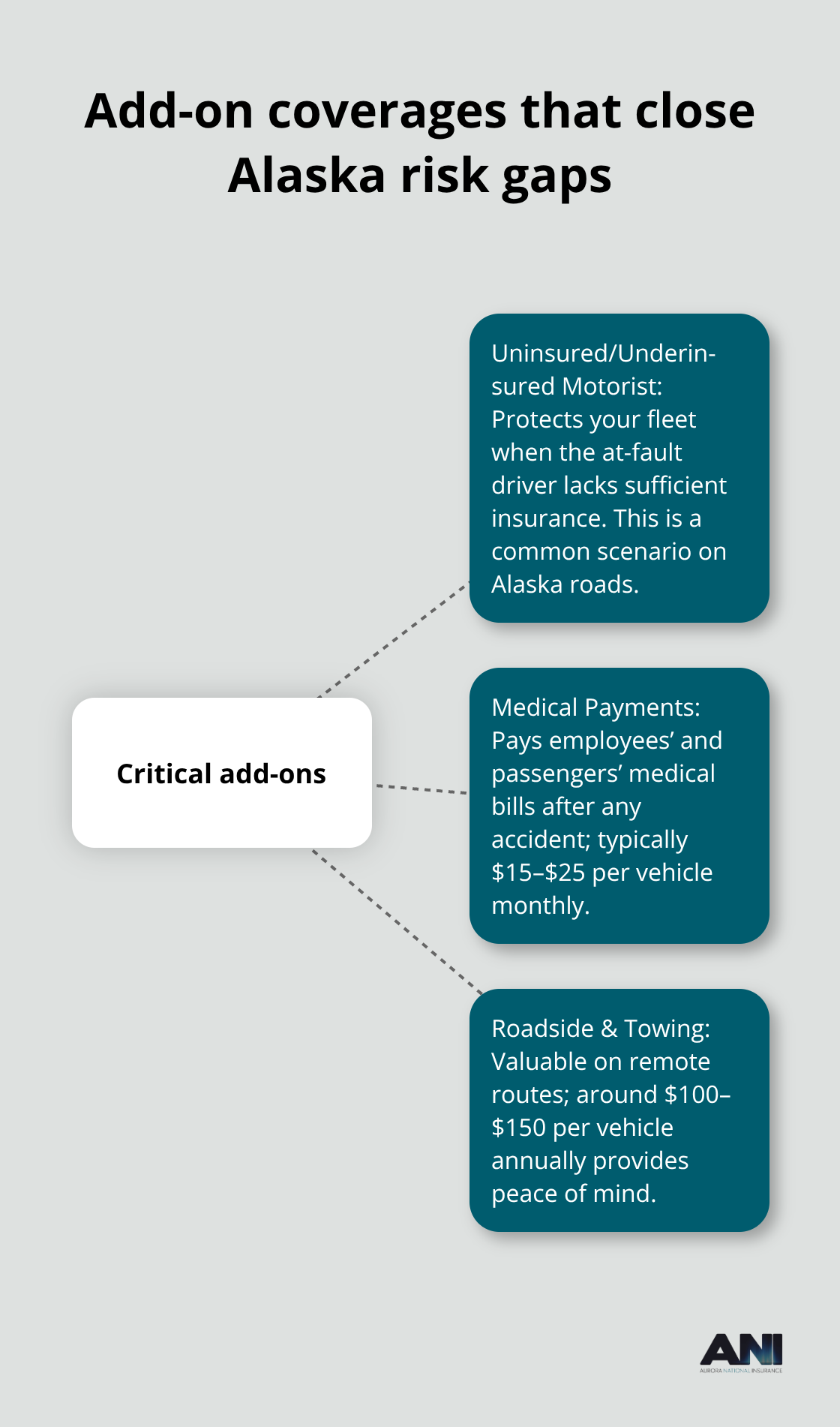
Commercial policies cover liability when you’re liable for damages, physical damage to your own vehicles, medical payments for injured parties, and uninsured motorist protection. Personal policies explicitly exclude all business use, leaving you exposed. The difference between commercial auto insurance and personal auto insurance is critical: one protects your business, the other leaves it vulnerable.

Core coverages included in commercial auto insurance for U.S. small businesses - Small business auto insurance

Understanding Your Fleet’s Specific Risks

Different fleets face different risks. A delivery service with multiple drivers on the road daily faces higher exposure than a contractor who occasionally uses a truck for site visits. Your vehicle types matter too-cargo vans and pickup trucks carry different risk profiles than sedans. The coverage you need depends entirely on how you operate. Choosing the right commercial auto coverage requires understanding exactly what risks your fleet faces and what protection actually covers those risks.

How to Pick the Right Coverage for Your Fleet

Match Coverage to Your Operations

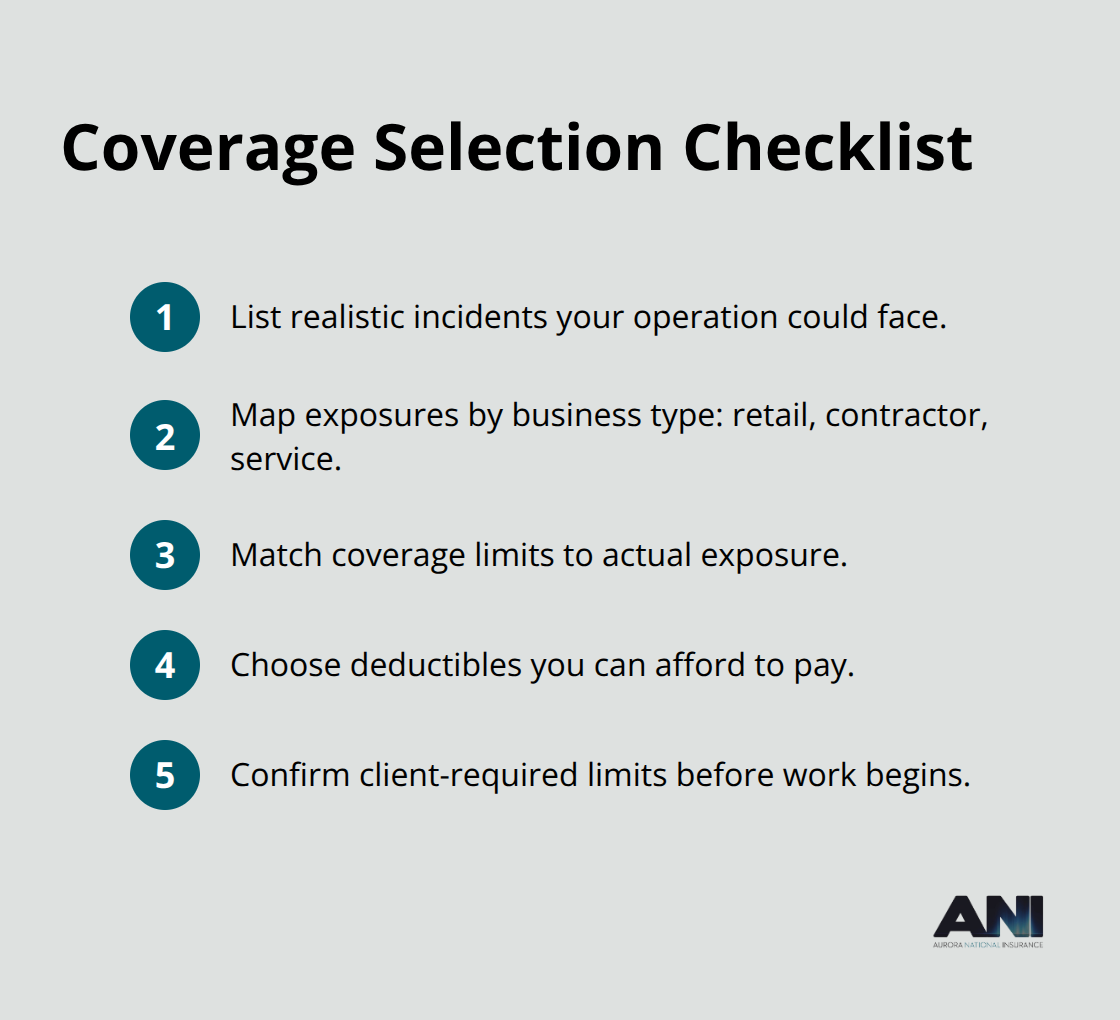
Choosing commercial auto insurance requires matching coverage to how your business actually operates, not picking the cheapest quote. Start by listing every vehicle you own or lease for business purposes, then note the vehicle type-sedans cost far less to insure than cargo vans or pickup trucks. According to industry data, sedans run $130–$185 monthly while cargo vans range $160–$265 and pickup trucks $210–$340. Your location matters significantly too; Florida averages $412 monthly while California averages $154 for the same coverage, reflecting state-specific accident rates and repair costs.

Assess Your Drivers and Risk Profile

Next, count your drivers and pull their motor vehicle records. A driver with multiple violations or recent accidents can double your premium, while a clean record keeps costs down. Small businesses with 1–4 vehicles typically pay $200–$400 monthly total, though construction contractors and high-risk trades average $264–$299 monthly because their work exposes vehicles to greater damage. Once you know your fleet composition, compare coverage limits across quotes-this step stops you from accidentally comparing apples to oranges.

Determine Your Coverage Limits

Most contractors need $1 million per occurrence liability with $2 million aggregate, but verify what your client contracts actually require before binding coverage. Hired and non-owned auto coverage costs under $50 monthly in most states and protects you when employees use personal vehicles or when you lease equipment temporarily, making it a practical addition for growing fleets.

Shop Multiple Carriers and Bundle Policies

Finding competitive rates demands shopping multiple carriers rather than accepting the first quote. Progressive can issue a certificate of insurance in 15 minutes, ERGO NEXT provides instant online COIs, and BiBERK completes quotes in under 10 minutes-all critical when you need coverage fast for a new client contract. Bundling auto insurance with general liability and inland marine coverage typically saves 10–15% compared to buying policies separately, so always ask carriers about multi-policy discounts. Request quotes from at least three carriers because rate differences for identical coverage regularly exceed $100 monthly.

Bundling auto with general liability and inland marine saves 10–15% compared to buying separately - Small business auto insurance

Optimize Rates Through Safety and Monitoring

When comparing quotes, ensure deductibles are identical; a $1,000 deductible costs less than a $500 deductible but shifts more risk to your business when accidents occur. Vehicle type affects pricing dramatically, so don’t mix quotes for different vehicle lists. Implementing a fleet safety program directly affects your commercial auto insurance premiums and claims, often qualifying you for discounts that offset the program investment within months. Telematics systems that monitor driver behavior and vehicle performance further reduce premiums while protecting your business from distracted driving claims, which cause 57% of all commercial vehicle accidents according to industry data. Review your motor vehicle records annually and remove high-risk drivers from your policy or require additional training, since your loss history directly determines your future rates and insurability. These steps position your fleet for better coverage options and lower costs as your business grows.

How to Actually Cut Your Fleet Insurance Costs

Bundle Policies to Slash Your Total Premium

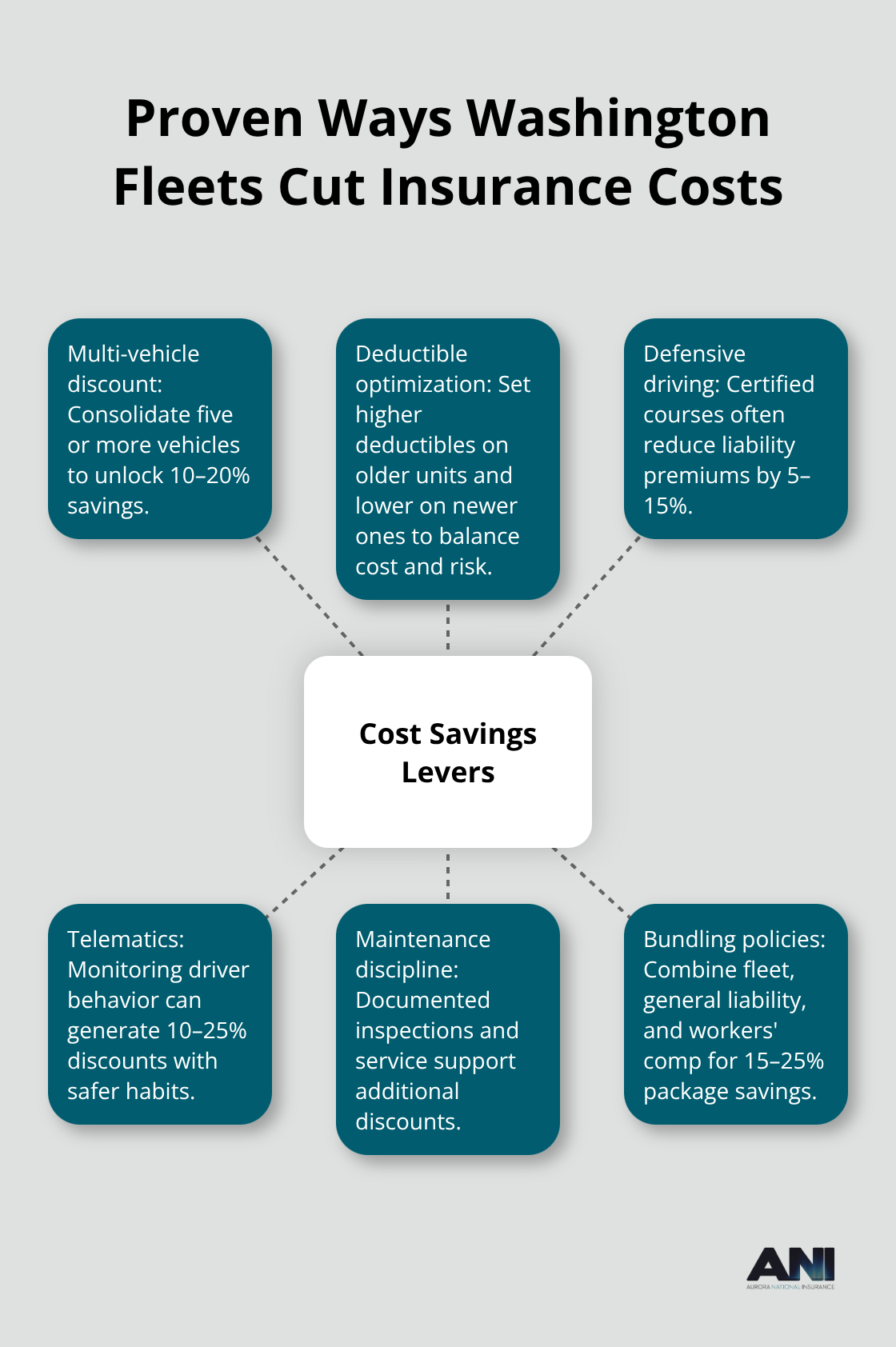
Combining your auto policy with general liability and inland marine coverage cuts 10–15% from your total premium compared to buying policies separately. This isn’t theoretical savings-carriers reward customers who consolidate their business insurance. When you shop for quotes, ask each carrier about multi-policy discounts before comparing final prices. Some carriers build the discount into their quote automatically while others require you to request it, so don’t assume the cheapest single-policy quote beats a bundled rate from another carrier. A $150 monthly auto policy bundled with general liability might cost $280 total, while buying them separately runs $320. That $40 monthly difference adds up to $480 annually with no change to your coverage.

Implement Safety Programs That Carriers Reward

Safety programs directly reduce your premiums because they reduce your claims. A fleet safety program can help reduce your premiums by 15-30% with tools like GPS tracking and AI dash cams. Distracted driving causes 57% of all commercial vehicle accidents, so establish a clear policy against mobile device use while driving and address your biggest risk. Telematics systems track driver behavior and vehicle performance, qualify you for additional discounts, and provide real data on which drivers create risk.

Impact of safety programs and distracted driving on commercial auto risk and premiums in the U.S.

Pull motor vehicle records for every driver annually and remove anyone with recent violations or multiple at-fault accidents, since your loss history determines your future insurability and rates.

Maintain Clean Records and Document Your Efforts

Carriers review your claims history carefully; three years of clean driving records with no accidents positions you for better quotes than a fleet with claims on file. Regular vehicle maintenance prevents breakdowns that lead to rushed decisions and accidents, so establish a maintenance schedule and document completion. Track your fleet’s safety metrics-miles driven, accidents, near-misses, and training completion-because this documentation proves to underwriters that you take risk seriously and qualify for preferred rates. When you renew your policy, provide this safety data to your carrier; it often justifies lower rates or retention with a carrier that might otherwise drop you due to industry-wide claims challenges.

Final Thoughts

Small business auto insurance protects your fleet from financial devastation while keeping you legally compliant. A single accident without proper coverage costs $50,000 to over $1 million, wiping out years of profit. Affordable coverage exists for every fleet size and budget, and you can move fast when you need it-Progressive issues certificates of insurance in 15 minutes, ERGO NEXT provides instant online quotes, and BiBERK completes quotes in under 10 minutes.

List your vehicles, note their types and locations, pull your drivers’ motor vehicle records, and determine what coverage limits your client contracts require. Request quotes from at least three carriers because rate differences for identical coverage regularly exceed $100 monthly. When comparing quotes, match deductibles and coverage limits exactly across all options, then bundle your auto policy with general liability and inland marine coverage to save 10–15% compared to buying policies separately.

Implement a fleet safety program and telematics monitoring to qualify for additional discounts while reducing your actual accident risk. Pull motor vehicle records annually and remove high-risk drivers, since your loss history directly determines your future rates and insurability. We at Aurora National Insurance help business owners find small business auto insurance that fits their fleet and budget-visit us today for instant online quotes and expert guidance tailored to your operation.

The information provided in this blog is for general informational purposes only and does not constitute legal, financial, or insurance advice. Coverage options, terms, and availability may vary. Please consult with a licensed professional for advice specific to your situation.
Artificial intelligence may have been used to generate text and images in some blog articles.

Alaska Condo Insurance Quotes: Is a Condo Policy Right for You?

Condo ownership in Alaska comes with unique insurance needs that standard homeowners policies simply don’t address. Your HOA insurance covers the building structure, but it leaves significant gaps in personal protection.

At Aurora National Insurance, we help condo owners understand why getting accurate Alaska condo insurance quotes matters. The right policy protects your belongings, covers your liability, and shields you from unexpected HOA assessments.

Why Your HOA Insurance Leaves You Exposed

Your HOA master policy covers the building structure and common areas, but it explicitly excludes what’s inside your unit. This creates a dangerous gap that many condo owners don’t realize until after a loss occurs. The master policy pays for damage to exterior walls, the roof, hallways, and shared spaces-not your kitchen cabinets, flooring, furniture, or personal belongings. In Alaska, where winter damage from frozen pipes and ice dams is common, this distinction matters enormously. If a pipe bursts in your unit and damages your hardwood floors and belongings, the HOA policy won’t cover any of it. You’re responsible for everything within your four walls, which is why a separate condo insurance policy is not optional-it’s essential.

The Real Cost of the HOA Deductible

When a covered loss affects common areas, the HOA master policy deductible gets split among all unit owners. Loss assessment coverage, an optional add-on to your condo policy, protects you from these surprise assessments. Without it, you could face unexpected bills that strain your finances. Many Alaska condo owners overlook this coverage entirely, then face assessments they can’t afford. The cost to add loss assessment coverage is minimal compared to the financial protection it provides when the HOA needs to cover a deductible or fund repairs to common areas.

Liability in Shared Living Spaces

Personal liability exposure in a condo is higher than in a single-family home because guests and neighbors live in closer proximity. If a visitor slips on your icy balcony or gets injured inside your unit, they can sue you for medical bills and damages. The HOA master policy doesn’t cover your personal liability-only liability for common areas. Your condo policy provides personal liability coverage that protects you if you or a household member cause injury to others or damage to their property. Standard limits are typically $100,000 to $300,000, but given Alaska’s legal environment and rising medical costs, higher limits are worth considering. Medical payments coverage, included in most condo policies, covers guest injuries regardless of fault, preventing small incidents from becoming costly disputes.

What Your Condo Policy Actually Protects

Your condo insurance covers interior walls, fixtures, and personal belongings that the HOA policy ignores. This includes your furniture, clothing, electronics, and permanently attached improvements like cabinets and appliances. If fire, theft, or water damage strikes your unit, your condo policy reimburses you for replacement costs (assuming you select replacement cost coverage rather than actual cash value). Loss of use coverage also reimburses your additional living expenses if you cannot occupy your unit while repairs happen. These protections fill the gaps that the HOA master policy leaves open, giving you complete coverage for everything you own and control within your unit.

Understanding Your Ownership Boundaries

The line between what the HOA covers and what you cover depends on your condo association’s bylaws and master policy. Most associations state that owners are responsible for everything inside the unit, including permanently attached fixtures and improvements. You need to review your HOA agreement to understand exactly where the association’s responsibility ends and yours begins. This clarity prevents coverage gaps and helps you select appropriate policy limits when you shop for quotes. The master policy deductible and the association’s potential assessments also influence how much loss assessment coverage you should carry, making this review step essential before you request quotes from carriers.

What Your Condo Policy Actually Covers

Interior Improvements and Personal Belongings

Your condo policy protects three critical areas that the HOA master policy ignores: your interior improvements, your personal belongings, and your liability exposure. A traditional condo insurance policy will cover damages to interior improvements, walls, floors and ceiling coverings, as well as your personal belongings. If you’ve upgraded your kitchen with custom cabinets or installed hardwood floors, these improvements receive coverage under your policy’s dwelling coverage, up to your chosen limit.

Personal property coverage reimburses furniture, clothing, electronics, and other belongings you own. You should select replacement cost coverage rather than actual cash value to avoid depreciation penalties. Many Alaska condo owners underestimate the value of their belongings and set limits too low, then face claim denials for items that exceed their coverage. Take time to inventory your possessions and add up replacement costs realistically-a used couch costs more to replace than insurance companies typically estimate.

Water Damage and Theft Protection

Water damage and theft represent two perils that hit Alaska condos frequently, and your condo policy covers both. Frozen pipes, ice dam leaks, and toilet overflows damage flooring, cabinets, and personal property constantly during Alaska winters, and your policy pays for repairs and replacement. Theft coverage protects your belongings if someone breaks into your unit or steals items from common areas, though you may need to document serial numbers or purchase receipts for high-value electronics to streamline claims.

Loss Assessment Coverage

Loss assessment coverage separates smart condo owners from those facing financial surprises. When the HOA needs to pay a large deductible or fund repairs to common areas, the association spreads costs among all unit owners through special assessments, and loss assessment coverage reimburses these unexpected bills up to your chosen limit. Without this optional coverage, you could face assessments of several thousand dollars if a major loss affects the building’s roof, foundation, or electrical systems.

Alaska condo associations frequently levy assessments for winter weather damage, and the cost to add loss assessment coverage-typically $50 to $100 annually for reasonable limits-is minimal compared to the protection it provides. Choose a loss assessment limit that matches your HOA’s master policy deductible and the potential size of assessments based on your building’s age and condition. If your association has an older roof or aging plumbing, higher assessment coverage makes sense. Review your HOA meeting minutes and reserve study documents to understand what major repairs may be coming, then set your loss assessment limit accordingly.

Medical Payments and Liability Protection

Medical payments coverage rounds out your policy by paying medical expenses for guests injured in your unit, regardless of fault, preventing small slip-and-fall incidents from becoming lawsuits. Most policies include $1,000 to $5,000 in medical payments coverage, which covers an injured guest’s doctor visits and minor emergency care without requiring you to prove negligence. These three coverage components-interior improvements, personal property, and liability protection-work together to fill the gaps left by your HOA master policy.

Hub-and-spoke showing interior improvements, personal property, liability, medical payments, loss assessment, and loss of use coverage - Alaska condo insurance quotes

Understanding what each component covers helps you select appropriate limits when you shop for quotes and compare carriers in Alaska’s competitive insurance market.

How to Get Accurate Condo Insurance Quotes in Alaska

Gather the Information Carriers Need

Requesting condo insurance quotes in Alaska requires preparation that most owners skip. You need specific information about your unit and HOA coverage before contacting carriers, or you’ll receive quotes that don’t reflect your actual situation. Start by collecting your HOA master policy documents, your condo association’s bylaws, and details about your unit’s improvements. Note the master policy’s coverage limits, deductible amount, and what it explicitly excludes. Contact your HOA directly and ask for the master policy deductible, the association’s reserve study, and any planned assessments.

Compact list of information to collect for accurate condo insurance quotes - Alaska condo insurance quotes

This information determines how much loss assessment coverage you need and what dwelling limits make sense for your improvements.

If your kitchen has custom cabinets or you’ve installed hardwood floors, document these upgrades with photos and receipts. When you contact insurers, provide your unit’s square footage, year built, number of units in the building, and whether your condo is owner-occupied or tenant-occupied. Alaska Service Agency, a local resource for Alaska condo quotes, requires your name, email, and phone number to provide personalized quotes and operates at (907) 337-2311.

Compare Rebuild Cost Estimates Across Carriers

Comparing quotes across multiple carriers reveals massive price variations driven by how each insurer calculates rebuild costs and assesses risk. A Reddit discussion on r/anchorage showed a USAA customer facing a premium jump from $2,100 to $3,500 annually due to a higher rebuild cost estimate, a 66.7% increase that illustrates why comparing carriers matters. Request quotes from at least three carriers and ask each one to justify their rebuild cost figure, because this single number drives your premium more than any other factor.

When reviewing quotes, verify that loss assessment coverage limits align with your HOA’s deductible and building age. Older buildings with aging roofs or plumbing systems warrant higher assessment limits, typically $5,000 to $10,000, while newer condos may need only $2,500 to $5,000.

Key checks for rebuild costs and coverage alignment

Verify Coverage Details Match Your Needs

Pay close attention to whether quotes include replacement cost or actual cash value for personal property, as replacement cost coverage costs more but prevents depreciation penalties on claims. Request identical coverage limits across all quotes so you’re comparing apples to apples, not different protection levels at different prices. Don’t select a quote based on price alone; verify that the carrier is financially strong and has responsive claims handling, because a cheap premium means nothing if the insurer struggles to pay claims when you need them.

Final Thoughts

Choosing the right condo insurance in Alaska requires you to balance three critical factors: understanding what your HOA master policy covers, selecting appropriate limits for your personal improvements and belongings, and protecting yourself from unexpected assessments. The gap between what the association covers and what you own is substantial, and underestimating this gap leaves you financially exposed when loss strikes. Your condo policy must reflect your unit’s actual condition, including any upgrades you’ve made, and your liability exposure in a shared living environment.

Alaska condo insurance quotes vary significantly across carriers because each insurer calculates rebuild costs differently-sometimes by thousands of dollars annually. You should gather your HOA documents, document your improvements with photos, and request quotes from multiple carriers using identical coverage details. Verify that each carrier offers replacement cost coverage for personal property, adequate loss assessment limits, and strong financial ratings before you make your decision.

Local Alaska agents understand your state’s unique risks and how HOA policies interact with personal coverage in ways that national carriers often miss. Aurora National Insurance represents multiple top-rated carriers and provides tailored comparisons that help you find the right protection at competitive prices. Contact us today for instant online quotes and expert guidance on Alaska condo insurance that fits your needs and budget.

The information provided in this blog is for general informational purposes only and does not constitute legal, financial, or insurance advice. Coverage options, terms, and availability may vary. Please consult with a licensed professional for advice specific to your situation.
Artificial intelligence may have been used to generate text and images in some blog articles.
Rural Alaska Home Insurance: Protecting Remote Homes From Seasonal Risks

Rural Alaska home insurance isn’t a luxury-it’s a necessity. Homes in remote areas face weather patterns, isolation, and wildlife threats that standard policies simply don’t cover.

At Aurora National Insurance, we’ve seen firsthand how seasonal risks can devastate unprotected properties. The right coverage makes the difference between financial security and catastrophic loss.

What Makes Rural Alaska Homes So Hard to Insure

Frozen Pipes and Water Damage in Extreme Cold

Extreme cold in rural Alaska destroys homes systematically. When temperatures drop below minus 20 degrees Fahrenheit for weeks at a time, frozen pipes become inevitable without constant vigilance. Water damage from burst pipes ranks as one of the costliest claims in remote Alaska properties, and standard homeowners policies cover the damage itself, but only if you take reasonable precautions. You must keep cabinet doors open around plumbing, let faucets drip during cold snaps, and insulate pipes in crawlspaces and basements. If a pipe freezes, you shut off water immediately and warm the area slowly with a space heater-never use an open flame, which risks fire in structures already vulnerable due to isolation.

Ice dams compound the problem significantly. Heavy snow combined with temperature swings causes melted water to back up under shingles and leak inside. The EPA notes that average winter temperatures in Alaska have risen about 6 degrees Fahrenheit over six decades, yet this warming paradoxically increases freeze-thaw cycles that create ice dams. You prevent them by keeping your attic well-insulated, regularly clearing snow from the roof with a roof rake, and installing heat cables along roof edges if dams recur.

Checklist of preventive steps to reduce winter water damage risk in rural Alaska homes - Rural Alaska home insurance

Fire Risk and Limited Emergency Response

Limited fire protection infrastructure in rural areas means that when a fire starts, your home faces near-total loss. Remote properties typically have ISO protection classes of 9 or 10 due to sparse fire departments and slow response times, which directly increases your insurance premiums and may make some carriers unwilling to write coverage at all. Wildfire risk around areas like Fairbanks and the Mat-Su Valley can trigger surcharges or coverage denials if your property lacks defensible space-a 30-foot cleared perimeter around structures is standard, though insurers increasingly use satellite vegetation data to assess risk precisely.

Heating System Failures and Underwriting Challenges

Heating system failures during extreme cold create life-threatening situations that insurance cannot prevent but must account for in underwriting. Many remote homes rely on wood stoves or portable heaters as primary heat sources, which complicates coverage because insurers view these as higher-risk than permanent propane or electric systems. You significantly improve your insurability and reduce premiums by installing a permanent heat source rather than depending on wood.

Isolation as an Underwriting Factor

Isolation itself becomes an underwriting factor that shapes your coverage options. The lack of year-round road access can limit coverage options entirely, forcing you toward excess and surplus lines carriers that charge substantially more. You must disclose proximity to water sources and other location details to your agent because these factors influence both premium and coverage terms directly. Understanding these underwriting realities helps you prepare the documentation and property improvements that make your remote home more insurable-a topic we address in detail as we explore the specific coverage options available to rural Alaska homeowners.

What Coverage Actually Works for Remote Alaska Homes

Why Standard Policies Fall Short in Rural Settings

Standard homeowners policies sold in urban Alaska collapse under the weight of rural conditions. The standard HO-3 policy covers fire, windstorm, hail, theft, and vandalism, but it excludes flood damage entirely and typically excludes earthquake damage unless you add a separate endorsement with deductibles running 10 to 20 percent of your home’s value. More critically, standard policies assume fire departments arrive within minutes and that repair crews can reach your property year-round. In remote Alaska, neither assumption holds true.

Three reasons standard homeowners insurance falls short in remote areas

Insurers classify rural properties at ISO protection classes 9 or 10 due to limited fire protection infrastructure, which directly drives higher premiums and causes many carriers to decline coverage altogether.

Layering Coverage for Remote Alaska Risks

You cannot simply buy a standard policy and expect it to protect a remote home. You need specialized coverage that acknowledges the realities of your location. Flood insurance through the National Flood Insurance Program forms the foundation of rural protection. NFIP policies cost roughly 20 to 40 percent less than private flood carriers in Alaska and provide up to standard limits, though a proposed Alaska Flood Authority under SB 11 could eventually offer up to one million dollars in coverage. Water backup endorsements address sump pump failures and drain backups that plague freeze-thaw cycles, typically costing 10 to 15 dollars annually per thousand dollars of coverage. Earthquake endorsements become essential if your property sits in high-risk zones like Anchorage or southern coastal areas, though these require separate policies with substantial deductibles and sometimes geological assessments that add 200 to 400 dollars to your annual cost.

Excess and Surplus Lines Carriers for High-Risk Properties

Specialized policies for excess and surplus lines carriers become necessary when standard insurers reject your property outright. These carriers accept risks that traditional companies won’t touch, including homes with wood stove heating, limited road access, or high wildfire exposure. Expect premiums 30 to 50 percent higher than standard market rates, but the alternative is no coverage. Home Protector endorsements add roughly 25 percent to your rebuilding cost coverage and address specific gaps in standard protection.

Structuring Personal Property and Liability Protection

Personal property coverage on remote properties should run at least 50 percent of your dwelling limit, and if you own high-value equipment like snowmobiles or fishing gear, scheduled personal property coverage protects these items at replacement cost rather than depreciated value. Personal liability coverage should exceed 100,000 dollars on rural properties where you host workers or guests regularly. The average Alaska homeowner pays around 1,035 dollars annually for 300,000 dollars of dwelling coverage according to Quadrant Information Services data, but rural properties typically cost 1,500 to 2,200 dollars for equivalent coverage due to underwriting challenges.

Reducing Premiums Through Property Improvements and Documentation

Permanent heat sources like propane or electric systems can reduce premiums by 15 to 25 percent compared to wood stove reliance. Maintaining detailed documentation of heating system installation, annual maintenance records, and roof condition gives you leverage during underwriting and renewal. Agents experienced in remote properties account for Alaska-specific risks far better than automated online quotes, which cannot adapt to the complexities of your location. This expertise becomes invaluable as you move forward with selecting the right agent and preparing your property for the seasonal challenges ahead.

Protecting Your Rural Home Through the Seasons

Winter Pipe Protection and Maintenance

Winter demands relentless attention to prevent catastrophic damage. The most effective defense against frozen pipes starts before temperatures plummet-you must insulate all exposed pipes in crawlspaces, basements, and exterior walls with foam sleeves or heat tape rated for Alaska’s extreme cold. During subzero stretches, you should open cabinet doors under sinks to circulate warm air around plumbing and let faucets drip slightly to maintain water movement through the lines. If a pipe freezes despite these measures, you must shut off the water supply immediately and warm the area slowly using a space heater or electric heat tape. Never use an open flame, which creates fire risk in structures already vulnerable due to isolation and delayed emergency response.

Managing Ice Dams and Roof Damage

Ice dams require year-round preparation to prevent costly water intrusion. You should keep your attic insulated to at least R-38 to prevent heat loss that melts snow on the roof, and you must regularly clear accumulated snow using a roof rake before it builds up. If dams recur seasonally, you can install heat cables along roof edges to manage the problem. These preventive steps directly reduce your risk profile and can lower your insurance premiums.

Heating System Reliability and Backup Plans

Heating system failures become life-threatening in extreme cold, so you must schedule annual maintenance before winter arrives and replace filters regularly. You should keep fuel tanks filled to ensure continuous heat availability throughout the season. You need backup heat sources ready-electric heaters or a properly installed wood stove-and you should know how to close unused rooms to conserve warmth if your primary system fails. Your documentation of heating system installation and annual maintenance records directly influences your insurability and premium rates, making these records essential to maintain and provide to your agent during underwriting.

Wildfire Prevention and Defensible Space

Wildfire prevention and year-round inspections protect both your property and your insurance coverage. You must clear vegetation within 30 feet of all structures to create defensible space, removing dead branches, fallen limbs, and dense brush that fuel rapid fire spread. Insurers increasingly use satellite vegetation data to assess wildfire risk precisely, so this work directly affects your ability to secure coverage and your premium cost. You should inspect your roof annually for damage, missing shingles, or debris accumulation that compromises fire resistance-a newer roof or one maintained in good condition can reduce premiums by 10 to 15 percent.

Property Inspections and Documentation

You must check all exterior walls, foundation, and outbuildings for gaps, cracks, or deterioration that allows water infiltration during freeze-thaw cycles. You should test your water system before winter to ensure pipes flow freely and identify weak points before temperatures drop. You must document these inspections with photos and maintenance records, which strengthen your position during claims and demonstrate that you maintain the property to insurable standards. This consistent attention to your property’s condition separates insurable remote homes from those carriers reject outright.

Five quick actions to cut costs and strengthen underwriting for rural Alaska homes - Rural Alaska home insurance

Final Thoughts

Rural Alaska home insurance requires a fundamentally different approach than coverage in urban or suburban areas. Standard homeowners policies cannot address frozen pipes, wildfire exposure, heating system failures, and delayed emergency response that define remote Alaska living. You need flood coverage through the National Flood Insurance Program, water backup endorsements for freeze-thaw damage, and earthquake protection if your property sits in a high-risk zone, plus excess and surplus lines carriers when standard insurers decline your property.

An agent who understands Alaska’s specific challenges separates adequate coverage from catastrophic gaps. Local expertise matters because remote properties require documentation, property improvements, and coverage structures that automated online quotes cannot address. An experienced agent knows which carriers accept remote properties, how to layer coverage for maximum protection, and which underwriting factors directly influence your premium and eligibility.

We at Aurora National Insurance work with you to structure the protection your rural Alaska home actually needs. Contact Aurora National Insurance to get quotes from multiple carriers and discuss the specialized coverage your remote property requires.

The information provided in this blog is for general informational purposes only and does not constitute legal, financial, or insurance advice. Coverage options, terms, and availability may vary. Please consult with a licensed professional for advice specific to your situation.
Artificial intelligence may have been used to generate text and images in some blog articles.
Oregon Commercial Auto Quotes: Compare Top Auto Coverage

Running a business in Oregon means protecting more than just your vehicles-you’re protecting your employees, your reputation, and your bottom line. Commercial auto insurance works differently than personal coverage, with higher limits and specialized protections that standard policies simply don’t offer.

At Aurora National Insurance, we help business owners find Oregon commercial auto quotes that actually match their risk. The right policy can mean the difference between a manageable claim and a financial crisis for your company.

Why Commercial Auto Coverage Costs More Than Personal Policies

Oregon law requires minimum liability coverage of 25/50/20 for personal vehicles, but commercial auto policies operate under completely different rules. Business owners often face a harsh reality: their personal auto policy excludes any claim related to business use-even a single delivery or client visit can void coverage. Commercial policies aren’t just personal coverage with higher numbers; they’re built to handle the realities of business operations.

Oregon requires commercial vehicles to carry the same 25/50/20 minimum, but that’s genuinely inadequate for most businesses. A single lawsuit from a serious accident can easily exceed $100,000, and if you operate without proper coverage, your personal assets become vulnerable. Most businesses should evaluate whether higher limits like 100/300/100 make financial sense for their operation. Progressive often offers these elevated limits for only modestly more than minimum coverage.

Vehicle-Specific Coverage Protects Your Business Assets

Commercial policies protect the tools, equipment, and materials permanently attached to your vehicles. If you operate a construction truck with mounted equipment or a delivery vehicle with expensive tools, standard collision and comprehensive coverage won’t protect those assets. You should explicitly list any expensive attachments with your insurer, as unattached items like generators or toolboxes fall outside standard coverage.

Hired and Non-Owned Vehicle Coverage Fills a Critical Gap

Hired and non-owned vehicle coverage becomes critical if your employees drive personal vehicles for work tasks. Without this coverage, you face significant liability if an employee’s personal vehicle is involved in a work-related accident.

This coverage protects you against medical costs and legal fees but doesn’t cover damage to the employee’s personal vehicle itself. The distinction matters because your business bears the financial risk even though you don’t own the vehicle.

Employee Safety and Driver Verification

Commercial policies let you list multiple drivers, and you should verify that anyone operating company vehicles has a clean driving record and proper training. Your business bears liability for their actions on the road, which means a single employee with a poor driving history can substantially increase your premiums and expose your company to significant claims. Proper driver vetting and training programs reduce both your insurance costs and your actual accident risk on Oregon roads.

Getting Oregon Commercial Auto Quotes Without Wasting Time

Collecting accurate information upfront saves hours later and prevents quote rejections that force you to start over. You need your business structure, annual revenue, number of employees, and the specific vehicles you want to insure, including the Vehicle Identification Number, year, make, model, and current mileage for each. Most carriers also ask about your industry and primary use-whether you’re doing deliveries, construction, client transport, or something else entirely.

Checklist of information to collect before requesting Oregon commercial auto insurance quotes

Have your current driving records ready for any employees who operate company vehicles, since a driver with a DUI or multiple violations can spike your rates substantially or even disqualify your company from certain carriers. Oregon’s average commercial auto insurance costs about $184 per month, but your actual premium depends heavily on these specific details, so vague information leads to inaccurate quotes that don’t reflect your real costs.

Compare Coverage Across Multiple Carriers

Comparing quotes requires identical coverage across carriers to matter at all. Request the same liability limits, deductibles, and additional coverages from each insurer so you’re genuinely comparing apples to apples. Progressive, Travelers, and Country Financial rank among Oregon’s top-rated commercial auto carriers, and getting quotes from all three takes less than an hour online.

Steps to accurately compare Oregon commercial auto insurance quotes - Oregon commercial auto quotes

Higher liability limits like 100/300/100 often cost only slightly more than the state minimum of 25/50/20, so calculate what makes financial sense for your business assets and potential lawsuit exposure rather than defaulting to minimum coverage.

Review Policy Language and Ask Direct Questions

Once you receive quotes, the real work begins-reviewing the actual policy language matters far more than fixating on the monthly premium. Ask each carrier directly whether hired and non-owned vehicle coverage is included or costs extra, how they handle permanently attached equipment, and whether your specific industry faces any exclusions or restrictions. Some carriers exclude certain high-risk uses or require additional training certifications, so clarifying these details prevents coverage denials when you actually need the protection.

Verify Coverage Details Before Commitment

Request a certificate of insurance in writing before you commit, and verify that the policy effective date aligns with when you need coverage active on your vehicles. This step protects your business from operating without proper protection and confirms that the carrier has accepted your application with the exact terms you negotiated. With quotes compared and policies reviewed, you’re ready to identify the coverage gaps that most Oregon business owners overlook.

Common Coverage Gaps Business Owners Miss

Most Oregon business owners discover coverage gaps only after an accident exposes them. Your commercial auto policy may seem comprehensive, but three specific gaps create massive financial exposure that catches owners off guard. Employees driving personal vehicles for work, accidents involving uninsured drivers, and liability limits that fail to match your actual business risk represent the three biggest blind spots in Oregon commercial auto coverage.

Hub-and-spoke diagram showing common commercial auto insurance coverage gaps for Oregon businesses - Oregon commercial auto quotes

These gaps exist because standard policies are built around single-vehicle operations, not the complexity of how modern businesses actually use vehicles.

When Your Employees Drive Their Own Cars for Work

Hired and non-owned vehicle coverage protects your business when employees use personal vehicles for work tasks. Without it, you face full liability if an employee’s personal car is involved in a work-related accident, even though you don’t own the vehicle. This coverage pays medical expenses and legal fees for third parties injured in the accident, but it doesn’t cover damage to the employee’s personal vehicle itself. The critical detail most owners miss is that their personal auto policy doesn’t extend coverage to business use, and their commercial auto policy doesn’t cover vehicles they don’t own.

If your employee hits another car while making a delivery in their own vehicle, your business becomes the liable party without this coverage. Adding hired and non-owned vehicle protection costs minimal amounts compared to the exposure you face. Get explicit confirmation from your insurer that this coverage is included in your quote, because some carriers charge extra or exclude it entirely depending on your industry and how frequently employees drive personal vehicles for work.

Uninsured Drivers Create Unplanned Expenses

Oregon requires uninsured motorist coverage with minimum limits of 25/50, but most business owners carry only the state minimum despite operating vehicles constantly on Oregon roads. Uninsured motorist protection covers medical expenses and lost wages when another driver without insurance hits you, and underinsured motorist coverage extends protection when the at-fault driver’s insurance limits are too low to cover your damages. The reality is stark: uninsured drivers cause significant accidents in Oregon, and if you’re hit by one, your business absorbs the costs unless you have robust protection.

Increasing your uninsured motorist limits from the state minimum to 100/300 costs very little but protects your business from catastrophic financial loss. This coverage becomes especially important if your vehicles are involved in accidents regularly or if your business depends on vehicle availability to generate revenue. You should compare quotes at these elevated limits to see the actual cost difference, which often surprises business owners with its modest increase.

Liability Limits That Actually Match Your Business Exposure

Oregon’s minimum liability requirement of 25/50/20 provides almost no protection for a business vehicle. A single serious accident involving your vehicle can generate medical bills exceeding $100,000, property damage claims above $50,000, and legal fees that push total exposure well beyond state minimums. Your personal assets face seizure if a judgment exceeds your policy limits, which happens routinely in serious injury cases.

Higher limits like 100/300/100 or 250/500/250 cost only marginally more than minimum coverage but provide genuine protection for your business. Progressive and Travelers often price these elevated limits competitively in Oregon, so comparing quotes at higher limits reveals that the cost difference is far smaller than most owners assume. Calculate your actual exposure based on your vehicle type, number of employees who drive, industry, and annual mileage, then select limits that protect both your business assets and personal wealth from a major lawsuit.

Final Thoughts

Choosing the right commercial auto coverage for your Oregon business requires matching protection to your actual risk, not defaulting to state minimums that leave you exposed. Vehicle type, industry, number of drivers, and annual mileage all shape which coverage limits make financial sense for your operation. A construction business with multiple trucks and expensive mounted equipment faces entirely different risks than a consulting firm with one vehicle used occasionally for client meetings.

Start by gathering your business details and vehicle information, then request Oregon commercial auto quotes from multiple carriers at identical coverage levels. Progressive, Travelers, and Country Financial consistently rank among Oregon’s top-rated options, and comparing their quotes takes minimal time online. Request higher liability limits like 100/300/100 alongside minimum coverage quotes so you see the actual cost difference, which often surprises business owners with its modest increase.

Verify that hired and non-owned vehicle coverage is included, confirm how permanently attached equipment is handled, and ask whether your specific industry faces any exclusions. A licensed insurance agent who understands Oregon’s commercial auto landscape makes this process faster and more reliable by catching coverage gaps you might miss and explaining policy language in plain terms. Once you’ve selected a policy, request a certificate of insurance in writing and verify the effective date aligns with when you need coverage active on your vehicles.

The information provided in this blog is for general informational purposes only and does not constitute legal, financial, or insurance advice. Coverage options, terms, and availability may vary. Please consult with a licensed professional for advice specific to your situation.
Artificial intelligence may have been used to generate text and images in some blog articles.

Alaska Home Insurance Quotes: Fast Local Coverage Options

Getting Alaska home insurance quotes shouldn’t mean waiting weeks or dealing with generic national carriers that don’t understand your state’s specific risks. At Aurora National Insurance, we know that Alaska homeowners face distinct challenges-from extreme weather to remote locations and higher rebuild costs.

That’s why we’ve put together this guide to help you find fast, local coverage options tailored to your property.

Alaska’s Unique Home Insurance Challenges

Extreme Weather Patterns Drive Up Your Costs

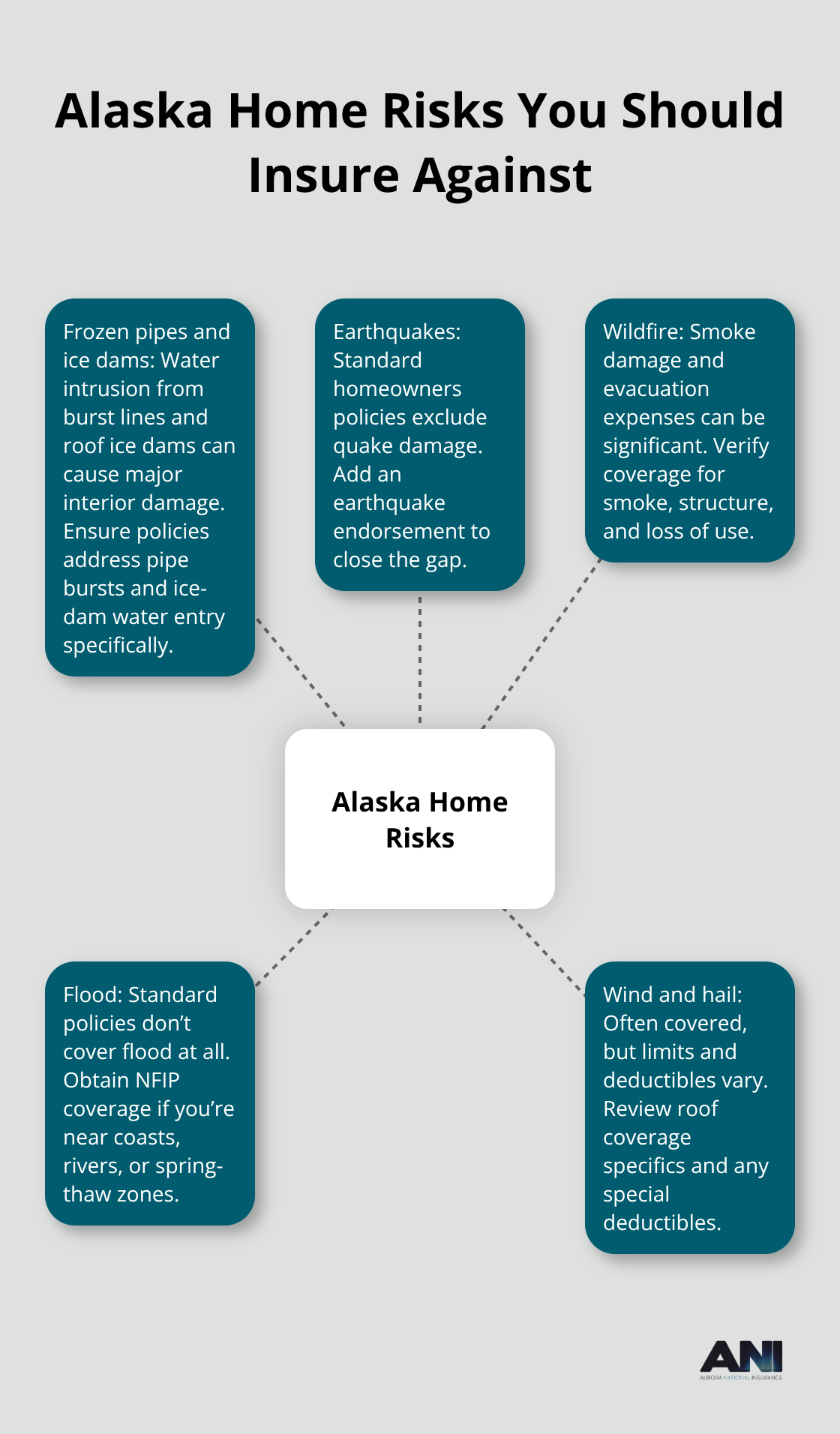
Alaska’s extreme weather creates measurable risks that directly affect your home insurance quotes. According to Britannica, Alaska’s climate swings from summertime highs in the 90s to winter lows around minus 60 degrees. This temperature volatility causes specific damage patterns that standard homeowners policies in other states simply don’t account for.

Ice damming represents one of the most costly problems Alaska homeowners face. Ice buildup on roofs can force water under shingles and into the home, leading to damage that costs tens of thousands to repair. Winter freeze-thaw cycles also crack foundations and burst pipes-damage that occurs far more frequently in Alaska than in lower 48 states.

Wind damage from Alaska’s coastal storms and interior temperature swings damages roofs and siding at rates that push insurers to charge higher premiums to cover these predictable losses.

Remote Location Increases Replacement Costs Significantly

Alaska’s geographic isolation directly increases your replacement costs. Building materials, labor, and specialty contractors command premium prices because suppliers must ship everything north, adding weeks to delivery timelines and significant markups to invoices. When your roof needs replacement after a storm, contractors in Fairbanks or Juneau face supply-chain delays that contractors in Seattle don’t experience.

This reality means your home’s replacement cost value-the number that determines your dwelling coverage limit-must be higher in Alaska than it would be for an identical home in Oregon or Washington. Insurers factor in these higher rebuild expenses when calculating your quote. Alaska’s limited contractor availability in smaller communities means repair costs climb when demand spikes after widespread storms.

The Alaska Earthquake Center reports that earthquakes occur roughly every 15 minutes in Alaska, with historical magnitude 9.2 events like the 1964 Good Friday quake reshaping entire regions. While standard homeowners policies cover wind and storm damage, earthquake coverage isn’t included and must be added separately-another cost consideration for properties in seismically active areas.

Wildfire and Flood Risks Require Separate Coverage

Wildfires have grown more frequent across Alaska as climate patterns shift. NASA Earth Observatory data shows that rising temperatures extend fire seasons and increase wildfire risk across the state, yet standard homeowners policies treat wildfire damage inconsistently. Some carriers exclude it entirely; others cover it under the dwelling section. Your quote will reflect whether your property sits in a wildfire-prone zone, and homes in high-risk areas face steeper premiums or coverage restrictions.

Flood risk compounds this challenge because Alaska’s geography includes coastal properties, riverside homes, and areas vulnerable to glacial melt and ice-jam flooding. The National Flood Insurance Program and private flood insurance are not included in standard homeowners policies, meaning you must purchase flood coverage separately if you live in or near a flood zone. This adds another line item to your total insurance cost that homeowners in Arizona or Texas typically don’t face.

Understanding these unique insurance challenges helps you know exactly what coverage gaps exist in a standard policy-and that’s where the right quote comparison becomes essential.

How to Get Fast Home Insurance Quotes in Alaska

Online Quote Tools Deliver Instant Estimates

The fastest way to compare Alaska home insurance quotes starts online, where most carriers now offer instant estimates within minutes. Major insurers like State Farm, Allstate, and USAA provide quote tools that let you enter your home’s details and receive price comparisons without waiting for a callback. You control the pace and can compare multiple carriers in a single session.

Online quotes in Alaska often miss important local variables that affect your actual premium. A quote for an Anchorage home might differ significantly from a quote for a Fairbanks property, even if the homes are identical, because insurers weight climate risk, contractor availability, and supply-chain costs differently by region. When you use online tools, have your home’s year built, square footage, roof material, and dwelling coverage amount ready. The more accurate your information, the closer your quote will be to your actual premium.

One limitation stands out: online tools rarely account for Alaska-specific coverage gaps like flood or earthquake protection. You’ll need to manually add these endorsements and recalculate to see your true cost.

Local Agents Identify Coverage Gaps Online Tools Miss

Working with a local Alaska agent offers something online quotes cannot: someone who understands why your ice dam risk in Fairbanks differs from coastal storm risk in Juneau, and how to position your coverage accordingly. An agent identifies coverage gaps that generic online quotes miss entirely, such as whether your home qualifies for lower rates based on roof upgrades or whether you’re underinsured for wildfire risk.

An agent also handles the back-and-forth with carriers when you need clarification on what’s covered, saving you hours of frustration. The trade-off is speed: a phone consultation takes longer than an online quote, but the result is far more precise. Local agents know exactly which carriers price competitively in different Alaska regions and which ones restrict coverage in high-risk zones.

Prepare Your Home Information in Advance

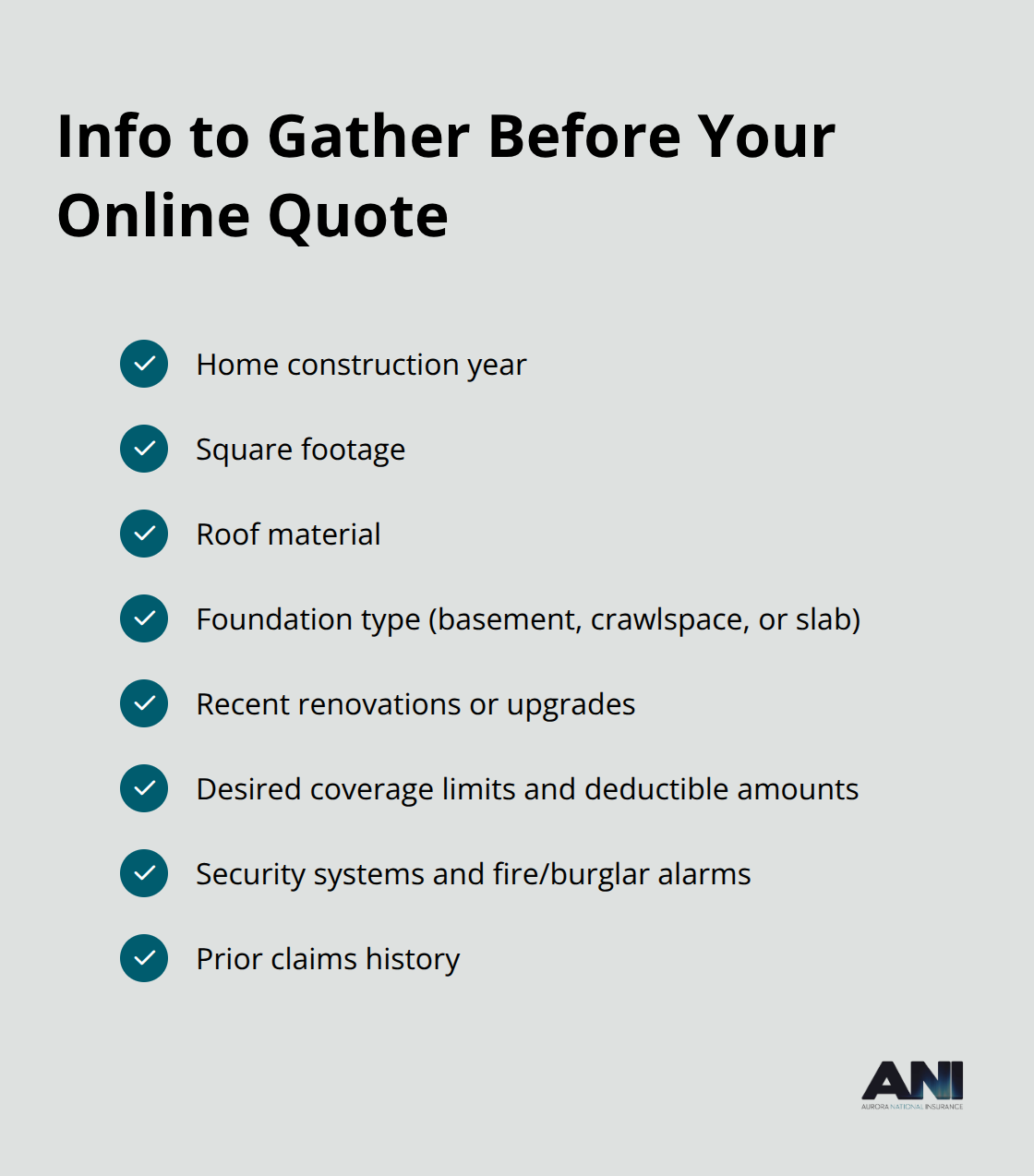
Before contacting an agent or submitting an online quote, gather your home’s year of construction, square footage, roof type, number of stories, any recent renovations, prior insurance claims, and your desired deductible. Having this information ready cuts quote time significantly and prevents the frustration of starting a quote, realizing you’re missing information, and having to restart.

If your home has high-value items like jewelry or art, mention those upfront so the agent can explain how scheduling or endorsements affect your quote and premium. This preparation step transforms the quoting process from a time-consuming back-and-forth into a streamlined conversation that produces accurate, actionable quotes.

With your quotes in hand and your home information organized, the next step involves understanding which coverage options actually protect your Alaska property against the specific risks you face.

Finding the Right Coverage for Your Alaska Home

Standard Homeowners Policy Components

A standard homeowners policy in Alaska covers six essential areas: dwelling, other structures, personal property, loss of use, personal liability, and medical payments to others. Your dwelling coverage pays to rebuild your home after a covered loss, and this number matters more in Alaska than anywhere else because replacement costs run significantly higher due to supply-chain expenses and contractor scarcity. If your home would cost $400,000 to rebuild and you only insure it for $300,000, you’ll absorb tens of thousands in losses when a major fire or storm hits.

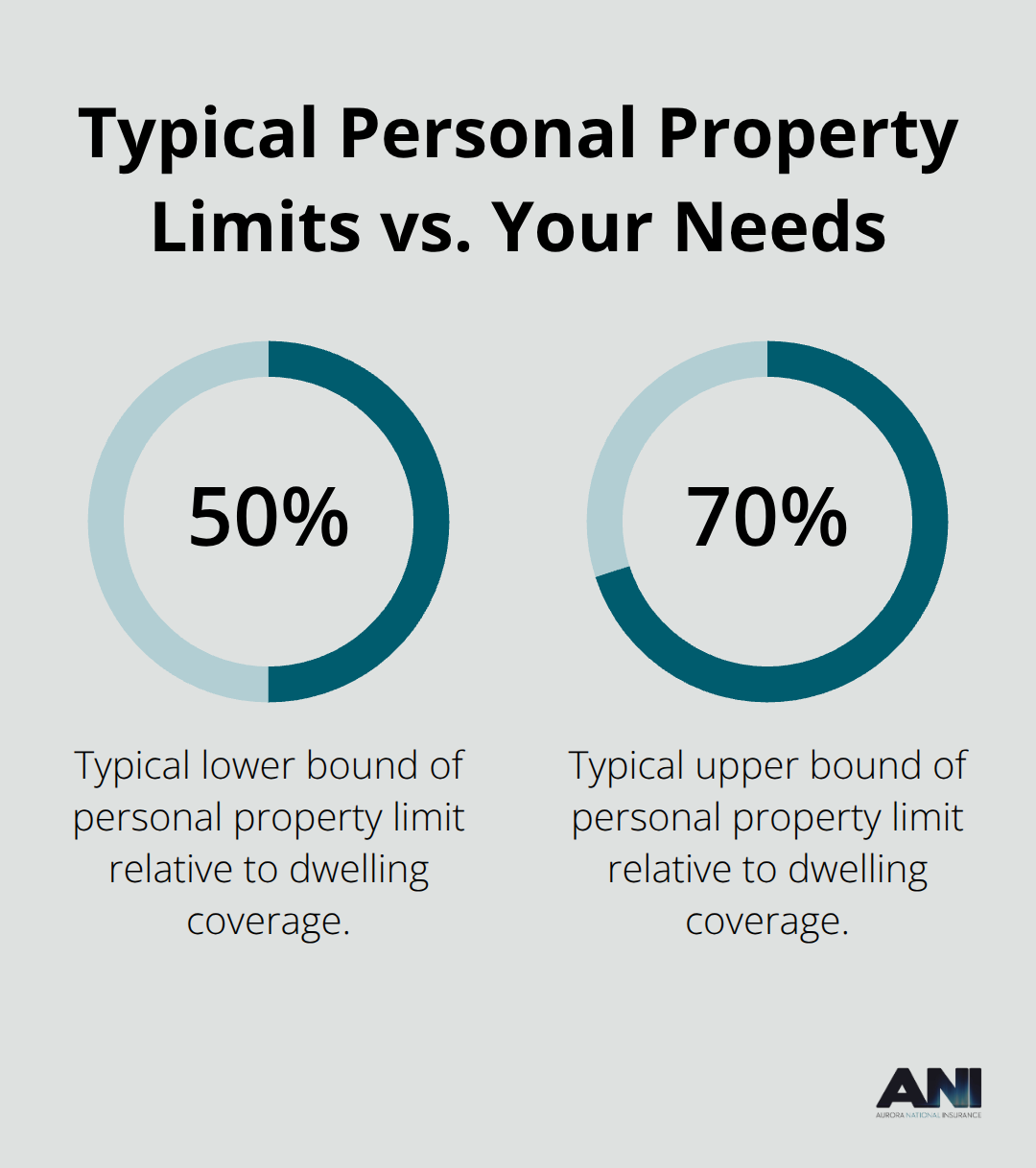
Other structures coverage typically equals 10 percent of your dwelling limit, which works fine if you have a small shed but falls short if you own a detached garage or multiple outbuildings. Personal property coverage usually sits at 50 percent of dwelling coverage, meaning a $300,000 dwelling policy provides only $150,000 for your furniture, electronics, and clothing. That gap matters when you lose everything in a house fire.

Loss of use coverage pays for temporary housing if your home becomes uninhabitable after a covered loss, typically covering 20 percent of your dwelling limit. Personal liability protection starts at $100,000 on most policies, which protects you if someone is injured on your property and sues, though Alaska homeowners with significant assets should seriously consider raising this to $300,000 or $500,000.

Additional Coverage Options for Alaska Properties

Alaska’s specific risks demand additional coverage that standard policies exclude entirely. Earthquake insurance costs roughly $15 to $25 per month but becomes essential given that the Alaska Earthquake Center documents earthquakes annually, including the magnitude 9.2 Good Friday quake of 1964. Flood insurance through the National Flood Insurance Program or private carriers costs between $400 and $1,200 annually depending on your flood zone, yet standard policies provide zero flood coverage.

Compact list of common Alaska home insurance add-ons and what they typically cost. - Alaska home insurance quotes

Water backup coverage protects you when sump pumps fail or sewage backs up during heavy storms, typically adding $75 to $150 annually. If you own valuables like jewelry, cameras, or art, scheduling these items with appraisals provides replacement cost protection rather than the depreciated actual cash value most standard policies pay.

Comparing Quotes from Multiple Carriers

Comparing quotes from at least three carriers reveals dramatic price differences across Alaska. COUNTRY Financial averages $942 annually for $300,000 of dwelling coverage, while State Farm runs roughly $1,021 and Allstate approaches $1,525 for identical coverage in the same location. Rates shift dramatically by city: Anchorage averages $758 annually, Juneau $655, and Wasilla $708, yet Eagle reaches $1,538 for the same coverage amount.

When you receive quotes, verify that each one includes the same deductible, dwelling limit, and coverage options, because comparing a $500 deductible quote against a $1,000 deductible quote produces meaningless results. Bundling home and auto insurance typically saves 10 to 15 percent on your total premium, making it worth shopping both policies together rather than separately.

Final Thoughts

Alaska home insurance quotes reveal one consistent truth: your coverage needs differ fundamentally from homeowners in the lower 48 states. The extreme weather, remote location, higher replacement costs, and unique natural disaster risks demand a thoughtful approach to selecting both your coverage limits and your insurance partner. A $942 annual premium from one carrier versus $1,525 from another for identical coverage represents real money, yet the cheapest quote isn’t always the best choice if it leaves gaps in earthquake or flood protection.

Online quotes give you speed and broad price comparisons, while local agents provide the expertise to identify coverage gaps that generic quotes miss entirely. The most effective approach combines both: use online tools to establish baseline pricing, then consult with a local agent who understands Alaska’s specific risks and can explain why your Fairbanks home needs different protection than an identical home in Anchorage. We at Aurora National Insurance represent multiple top-rated carriers and combine instant online quotes with licensed agents who understand the real risks Alaska homeowners face.

Start by gathering your home information and requesting Alaska home insurance quotes from at least three carriers. Then contact a local agent to review those quotes and identify any coverage gaps. This two-step process takes a few hours but protects your home and your finances for years to come, and our team can help you navigate the options at competitive prices.

The information provided in this blog is for general informational purposes only and does not constitute legal, financial, or insurance advice. Coverage options, terms, and availability may vary. Please consult with a licensed professional for advice specific to your situation.
Artificial intelligence may have been used to generate text and images in some blog articles.
Alaska Commercial Auto Insurance: Smart Coverage for Remote Operations

Running a business across Alaska’s vast landscape means facing challenges that most commercial operators never encounter. Extreme weather, isolated routes, and limited repair options create real risks that standard commercial auto insurance simply doesn’t address.

At Aurora National Insurance, we’ve built Alaska commercial auto insurance specifically for businesses like yours. The coverage options in this guide are designed to protect your fleet against the conditions you actually face.

What Makes Remote Alaska Operations Different

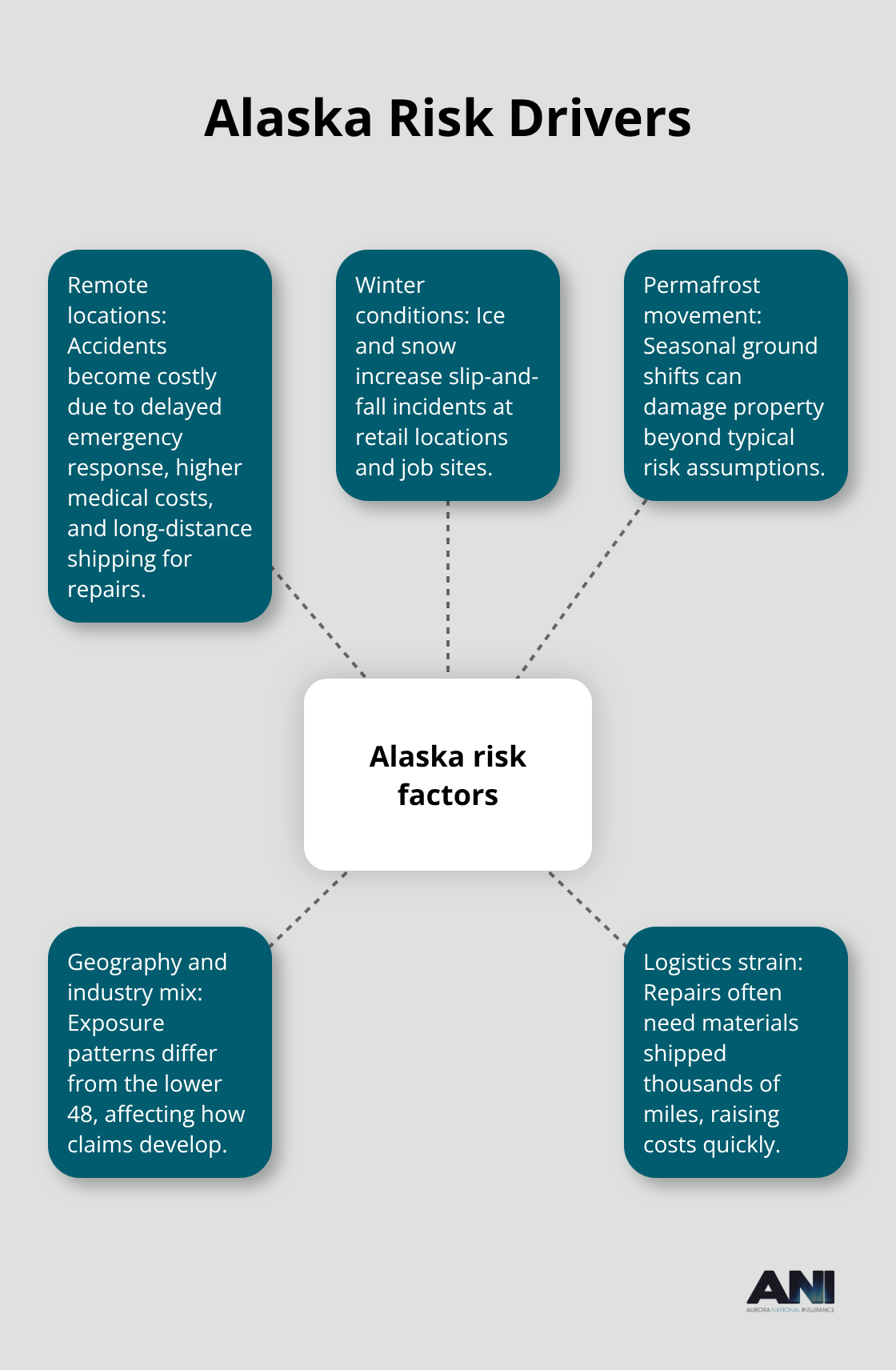
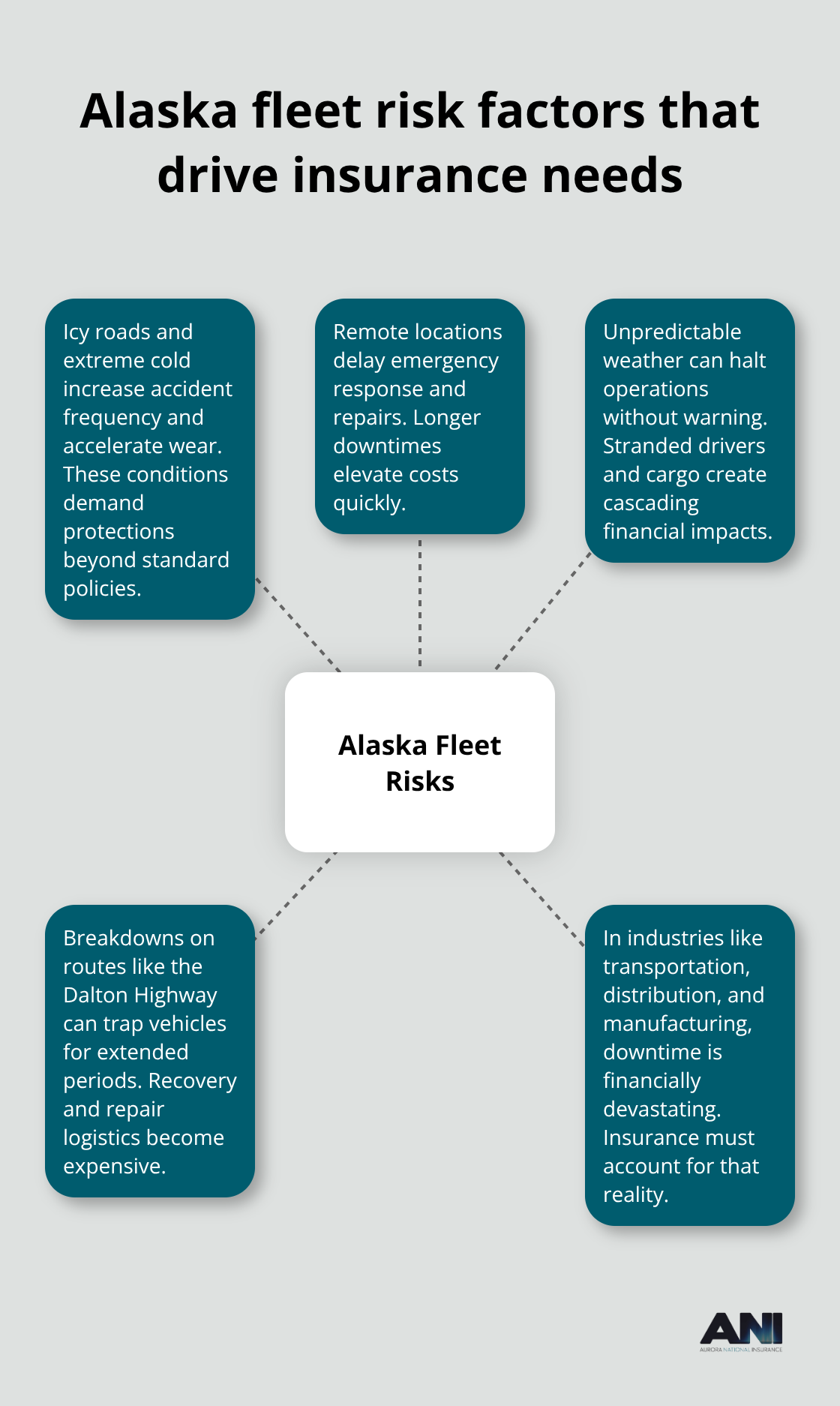
Operating across Alaska forces your business to confront risks that operators in the lower 48 states rarely face. Approximately 75 percent of Alaska communities lack year-round road access, meaning your vehicles either travel extreme distances on limited roads or don’t reach certain markets at all. When your fleet operates 200 miles from the nearest repair facility, a transmission failure doesn’t just cost you the repair-it costs you days or weeks of downtime while a technician travels to your location or your vehicle sits waiting for transport. Winter ice roads provide temporary access to some communities, but these routes exist only during specific cold months and depend entirely on weather, creating narrow delivery windows that force rushed decisions.

Share of Alaska communities without year-round road access affecting fleet operations - Alaska commercial auto insurance

The Alaska Marine Highway System and air freight fill some gaps, but both add significant cost and complexity to your operations. This isn’t theoretical risk-it’s your operational reality, and standard commercial auto policies treat Alaska like any other state.

Extreme weather demands better physical protection

Alaska’s weather creates damage patterns that most insurance carriers don’t understand. Temperatures regularly drop below negative 40 degrees, which degrades battery capacity, thickens oil, and causes engine block cracking if vehicles lack proper block heaters. Road salt and corrosive minerals accelerate rust on undercarriages and brake lines. Heavy snow and ice cause rollovers and collisions at lower speeds than you’d expect in milder climates, yet impact severity remains high because rescue operations take longer. Windshield damage from gravel on icy roads happens constantly. Standard collision and comprehensive coverage handles these claims, but carriers unfamiliar with Alaska conditions often underestimate replacement costs or dispute whether damage resulted from maintenance neglect rather than weather exposure. Coverage tailored for Alaska accounts for winterization requirements, higher replacement costs for specialized parts, and the reality that preventive maintenance in extreme cold costs more upfront but prevents catastrophic failures later.

Distance transforms a minor breakdown into a major crisis

A flat tire 50 miles outside Fairbanks becomes an entirely different problem than a flat tire near a city. Roadside assistance that takes 30 minutes in urban areas might take 6 hours in remote Alaska, and if weather deteriorates, your driver might need airlift evacuation. Food trucks and mobile service vehicles carrying expensive attached equipment face additional exposure-if your vehicle breaks down, that equipment sits unprotected in harsh conditions, potentially suffering freeze damage or theft.

Hub-and-spoke diagram of operational risks in remote Alaska impacting insurance design - Alaska commercial auto insurance

Tow trucks in Alaska require specialized coverage like on-hook liability and garagekeepers liability to protect customers’ vehicles in your care while you manage the tow. Your policy should explicitly cover multi-hour response times and the cost of fuel for long-distance towing, not just the tow itself.

Coverage gaps leave your fleet exposed

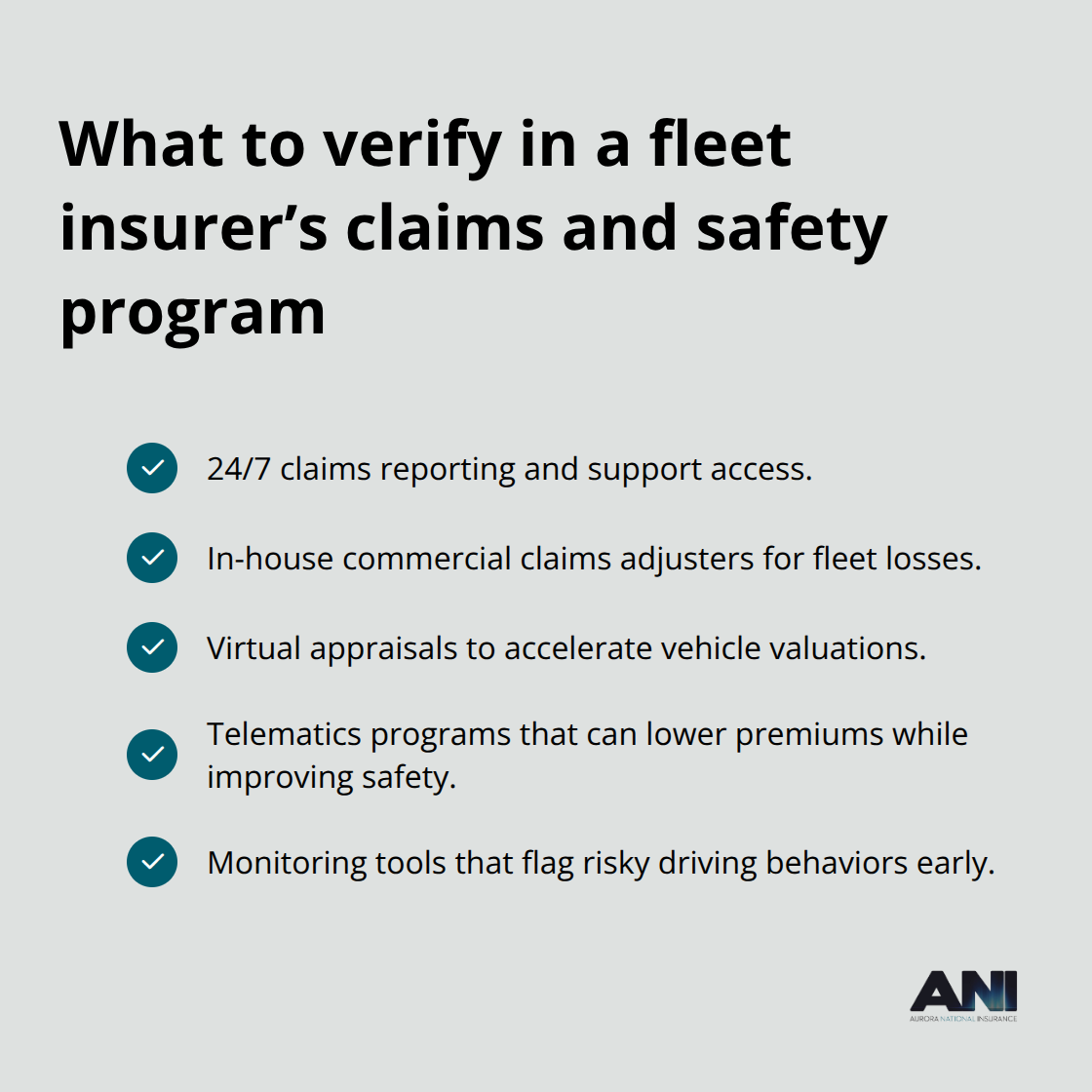
Standard national insurance networks treat Alaska as a low-priority market, which means claims adjusters lack local knowledge and response times stretch far beyond acceptable limits. Your vehicles operate in conditions that demand 24/7 support from people who understand Alaska’s specific challenges. A claims adjuster in the lower 48 states cannot accurately assess damage from freeze-thaw cycles or determine whether a breakdown resulted from inadequate winterization or a mechanical defect. When your fleet sits idle waiting for parts or repairs, you lose revenue and disappoint customers. The right commercial auto policy includes claims support designed specifically for rural operations, not generic national programs that fail to account for Alaska’s geography and weather patterns. This specialized approach directly affects how quickly you return vehicles to service and how fairly insurers evaluate your claims.

Protecting Your Fleet Against Alaska’s Harsh Realities

Physical Damage Coverage for Extreme Weather Exposure

Alaska’s extreme conditions demand coverage that goes far beyond what standard policies provide, and physical damage protection sits at the foundation of any fleet strategy in this environment. Collision coverage protects against the specific crash patterns Alaska creates-rollovers on icy roads, impacts with wildlife, and collisions at lower speeds than you’d encounter in milder climates. Comprehensive coverage handles the weather-related damage that happens constantly: windshield damage from temperature changes, freeze-thaw cracking of engine blocks, rust damage from road salt and corrosive minerals, and battery degradation in temperatures below negative 40 degrees.

The critical mistake most operators make involves choosing deductibles that make sense for the lower 48 states rather than Alaska. A $1,000 deductible might feel reasonable until you pay it repeatedly for windshield replacements that occur monthly in winter, or until a freeze-crack in your engine block costs $8,000 and you cover a quarter of that expense out of pocket.

Selecting Deductibles Based on Alaska Claims Patterns

Evaluate deductibles based on your actual claims frequency in Alaska conditions, not national averages. If your vehicles operate primarily in Anchorage or Fairbanks, where repair facilities exist and response times measure in hours rather than days, a $500 deductible paired with comprehensive coverage makes financial sense. If your operations extend into truly remote areas where vehicles sit for weeks waiting for parts, a $250 deductible on comprehensive coverage pays for itself within two or three weather-related claims.

Vehicle size and equipment matter significantly here-a heavy food truck carrying $50,000 in attached equipment faces different damage exposure than a service van, and your policy must reflect that distinction. Cargo coverage and equipment breakdown protection should appear explicitly in your policy rather than assumed, especially if your vehicle’s value exceeds the vehicle itself.

Liability Limits That Account for Remote Emergency Response Costs

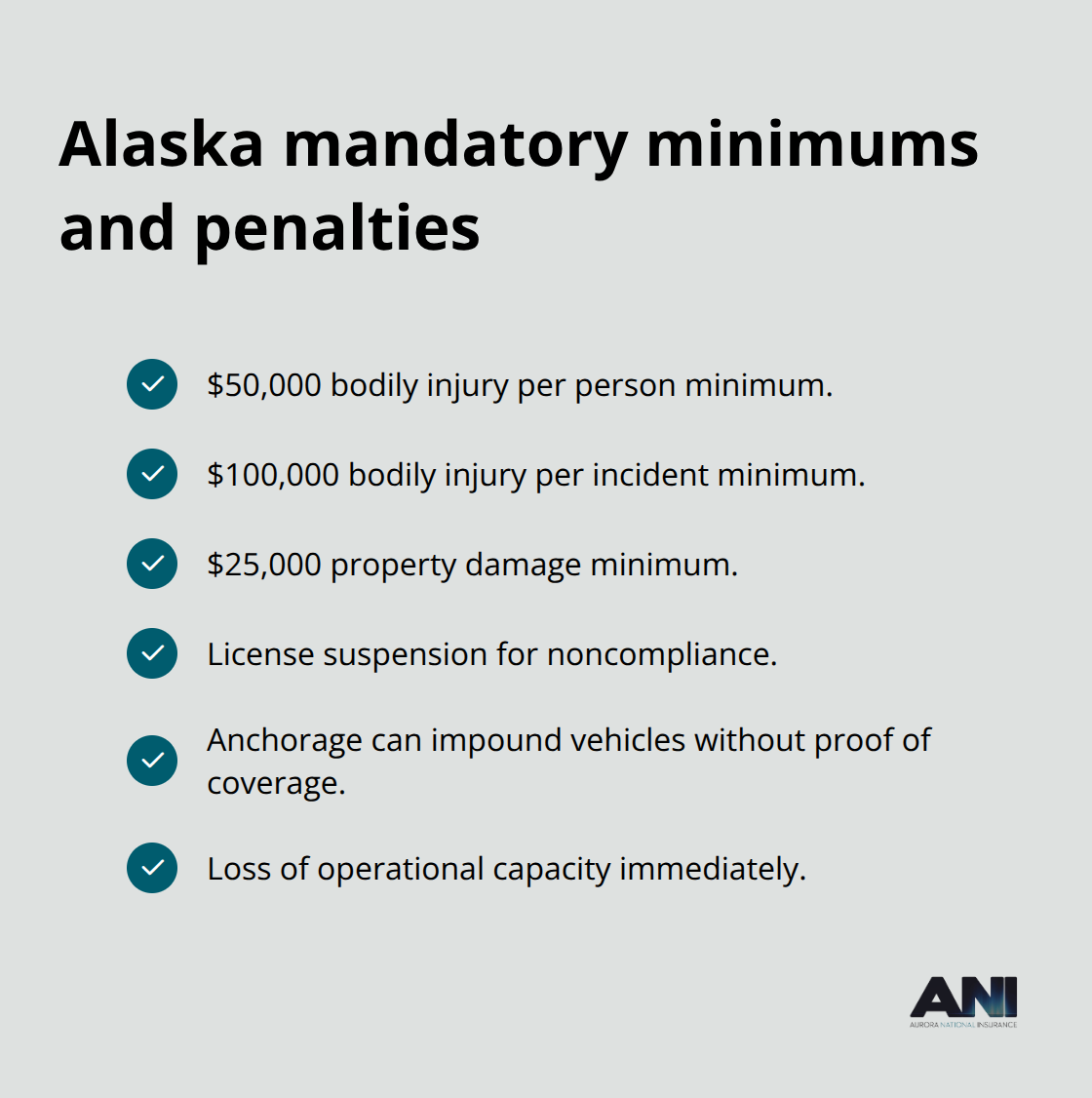
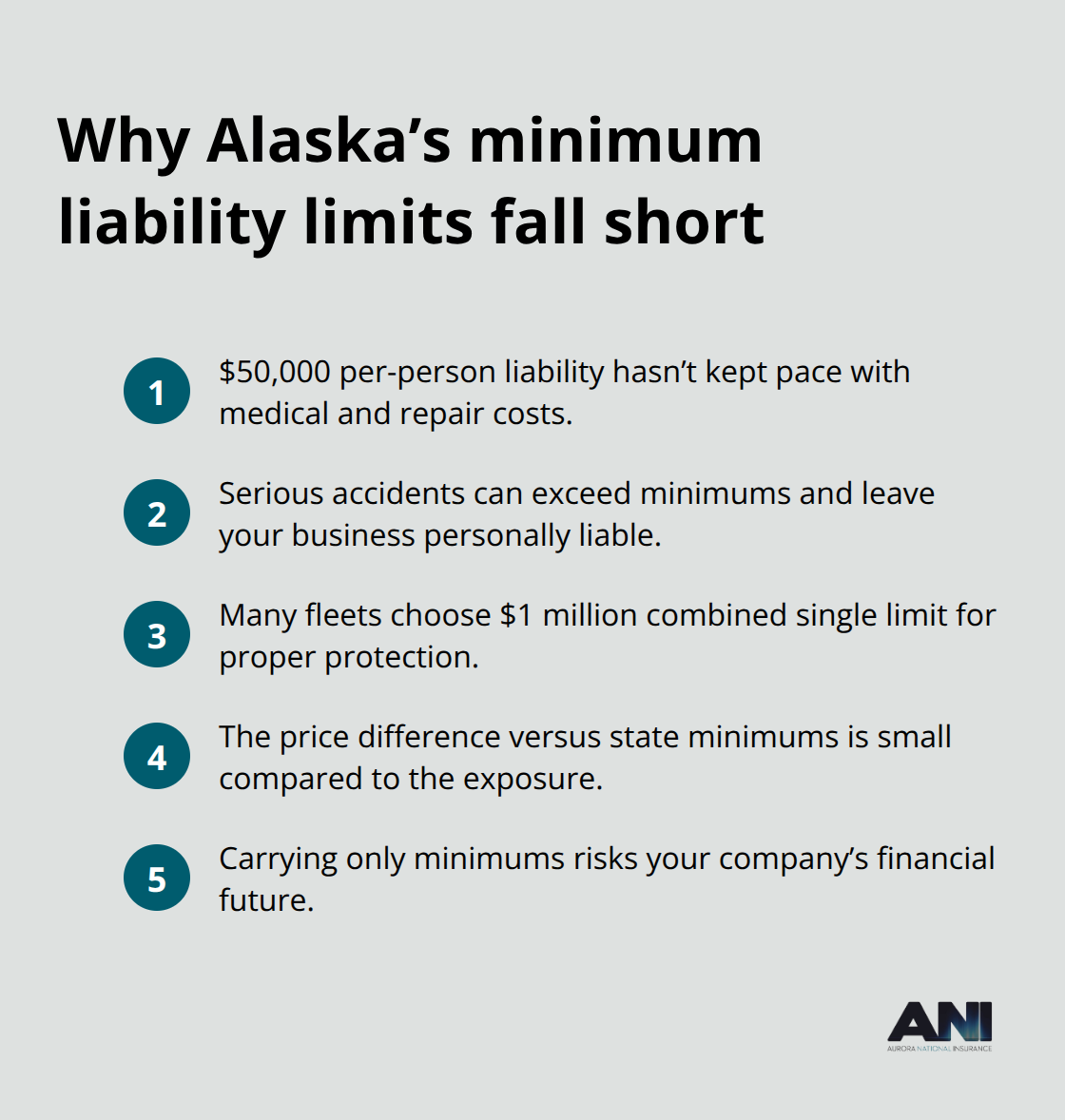
Liability coverage in remote Alaska requires limits that account for the reality that emergency response costs far more than in populated areas. Alaska law sets a baseline of $50,000 per person and $100,000 per accident for bodily injury, but that minimum provides almost no protection in a serious crash. If your vehicle causes an accident that injures multiple people, medical helicopter evacuation from a remote location costs $15,000 to $25,000 per person before any hospital treatment begins.

A single serious injury can generate $100,000 in emergency response and medical costs within hours, meaning the state minimum disappears instantly. Try minimum liability limits of at least $300,000 per accident for any business operating outside major population centers, and $500,000 or higher if your routes regularly take vehicles more than 100 miles from Anchorage or Fairbanks. For contractors and service businesses where clients visit remote worksites, general liability coverage layered with your commercial auto policy becomes essential-if a client sustains an injury at a jobsite and also happens to be near your vehicle, the liability exposure compounds.

Uninsured and Underinsured Motorist Protection for Remote Routes

Uninsured and underinsured motorist protection addresses the reality that not every driver on Alaska roads carries adequate coverage, and some carry none. Alaska’s No Pay, No Play law bars uninsured drivers from recovering non-economic damages, but that protection does nothing for you if an uninsured driver hits your vehicle and injures your employees. Uninsured motorist coverage pays your medical bills and lost wages when an uninsured driver causes a crash.

Underinsured motorist coverage fills the gap when another driver’s insurance proves inadequate-if you’re hit by a driver carrying only the $50,000 minimum and your damages exceed that, underinsured coverage pays the difference up to your policy limit. For remote operations where emergency response costs escalate dramatically, underinsured motorist limits should match or exceed your liability limits, not fall short by half. These protections transform your policy from basic compliance into genuine financial security when accidents happen far from help.

Matching Coverage to Your Fleet’s Real Operations

Choosing the right commercial auto policy for remote Alaska operations requires abandoning the approach of selecting coverage based on national averages or what competitors quote. Your fleet operates under conditions that demand a customized assessment of vehicle types, operational territory, and realistic damage frequency.

Catalog Every Vehicle and Classify It Correctly

Start by listing every vehicle your business uses for work, including occasional-use vehicles that employees drive for business purposes. A contractor might operate a pickup truck daily, a service van three days weekly, and occasionally use a personal vehicle for client visits. Each vehicle needs explicit coverage classification on your policy, because mixing vehicle types under generic coverage language creates claim denial risk when an accident occurs.

A vehicle classified as a light service vehicle will have claims denied if it actually carries heavy equipment or tows regularly. Document the actual weight of equipment your vehicles carry, not estimated weight, because vehicles exceeding 10,001 pounds GVWR trigger higher liability requirements under Alaska law. A food truck with attached cooking equipment, a contractor’s truck loaded with tools, or a delivery van carrying inventory can easily exceed this threshold, which means your policy must reflect the correct GVWR classification or you’ll face coverage gaps during claims.

Match Liability Limits to Your Territory

Your operational territory directly determines which coverage limits actually protect your business rather than leaving you exposed. If your operations stay within Anchorage, Fairbanks, or other major cities where repair facilities respond within hours, you can manage with more modest coverage limits and higher deductibles. If your vehicles regularly travel routes more than 100 miles from population centers, your liability limits must increase significantly because emergency response costs in remote areas consume your minimum coverage instantly.

A contractor operating jobsites across interior Alaska should try minimum liability of $300,000 per accident, not the $100,000 state minimum. If your routes take vehicles to communities accessible only by barge or air freight, uninsured and underinsured motorist coverage becomes essential because you cannot predict what other drivers carry.

Adjust Deductibles Based on Alaska Claims Patterns

Compare deductibles based on your actual claims history in Alaska conditions, not national benchmarks. If your vehicles experience windshield damage monthly during winter, a $1,000 comprehensive deductible costs you $12,000 annually out of pocket before insurance pays anything. Reducing that deductible to $250 or $500 typically increases your premium by 8 to 15 percent but eliminates the pattern of repeated out-of-pocket payments that erode your operating budget.

The math shifts dramatically when you account for Alaska’s specific damage patterns rather than applying lower-48 assumptions to your policy selection. A vehicle that operates primarily in remote areas where parts take weeks to arrive justifies a lower deductible because downtime costs exceed the premium increase. A vehicle that stays near major repair centers can absorb a higher deductible without financial strain.

Final Thoughts

Alaska commercial auto insurance built specifically for remote operations protects your fleet against conditions that standard national policies ignore. The coverage decisions you make today directly determine whether your business survives a serious accident in a remote location or faces financial devastation that could end operations entirely. Your fleet’s protection depends on three concrete actions: classify every vehicle accurately by documenting actual weight and equipment, set liability limits based on Alaska’s emergency response costs rather than the state minimum, and evaluate deductibles through the lens of Alaska claims patterns rather than national averages.

Compact list of essential coverage decisions for Alaska operations

The right Alaska commercial auto insurance policy accounts for the reality that your vehicles operate 200 miles from repair shops, that winter ice roads create narrow delivery windows, and that emergency response in remote areas costs multiples of what it costs in populated states. This isn’t theoretical protection-it’s the difference between returning to work quickly after an accident and watching your business stall while waiting for parts or repairs. A vehicle misclassified as light-duty when it regularly carries heavy equipment will have claims denied when damage occurs, leaving you exposed at the worst possible moment.

Aurora National Insurance takes the guesswork out of coverage selection with licensed agents who understand Alaska’s specific operational challenges. Instant online quotes let you see options immediately, and their Anchorage-based team delivers the local expertise that matters when you need claims support in remote areas. Start your quote process today to secure your fleet against Alaska’s unique challenges.

The information provided in this blog is for general informational purposes only and does not constitute legal, financial, or insurance advice. Coverage options, terms, and availability may vary. Please consult with a licensed professional for advice specific to your situation.
Artificial intelligence may have been used to generate text and images in some blog articles.
Retail Fleet Auto Insurance: Managing Risk Across Your Vehicles

Retail fleet auto insurance isn’t optional for businesses with multiple vehicles on the road. One accident involving a company vehicle can expose your business to significant liability claims and repair costs that threaten your bottom line.

At Aurora National Insurance, we understand the real financial pressure fleet owners face. The right coverage protects your vehicles, drivers, and business from unexpected losses while keeping your premiums manageable.

Why Your Retail Fleet Faces Real Liability Exposure

Retail businesses operate on thin margins, and one serious accident involving a company vehicle can wipe out months of profit. Commercial auto claims in the United States have logged 13 consecutive years of underwriting losses, and liability claim severity has risen due to social inflation and nuclear verdicts. When a delivery driver or service technician injures someone or damages property, your business becomes the defendant-and settlements routinely exceed what many retail owners expect. A single bodily injury verdict can reach six or seven figures, especially if the injured party pursues litigation. Without proper fleet coverage, you face personal liability for these costs, and your business assets are at risk.

Why Multiple Vehicles Demand Coordinated Coverage

Individual auto policies for each company vehicle create inefficiency and leave gaps in protection. A fleet policy consolidates all your vehicles under one agreement, simplifies administrative overhead, and ensures consistent coverage across your entire operation. More importantly, it gives insurers visibility into your complete driving exposure-vehicle types, driver profiles, mileage patterns, and accident history. This transparency allows underwriters to price your risk accurately rather than treating each vehicle in isolation.

Retail fleets with delivery vans, service trucks, or company cars need coverage that accounts for how drivers actually use these vehicles. Distracted driving alone causes over 3,000 deaths and 424,000 injuries annually in the United States, according to the Centers for Disease Control and Prevention, and retail delivery drivers face constant temptation to check phones while navigating traffic. Fleet policies let you implement telematics monitoring, driver coaching programs, and safety requirements across all vehicles simultaneously-something individual policies cannot do.

Hub-and-spoke showing how coordinated fleet policies enhance safety and oversight across vehicles and drivers. - Retail fleet auto insurance

Repair Costs Rise Faster Than Your Revenue

Vehicle repair costs have climbed steadily due to advanced safety technology, supply chain disruptions, and inflation. Physical damage costs are rising because of these factors, leading to higher repair bills and longer claim resolution times. Retail businesses cannot absorb these costs from operating cash flow.

A single collision involving a modern vehicle with lane-detection systems, autonomous-braking components, and electronic stability control can cost $15,000 to $30,000 or more to repair-far beyond what most small business owners budget for. Comprehensive and collision coverage protects you from these shocks, but only if your policy limits match current repair costs. You should review your coverage limits annually and adjust them upward if vehicle values or repair costs in your market have increased.

These rising costs make the next step-understanding what coverage options actually protect your fleet-more important than ever.

What Coverage Actually Protects Your Fleet

Liability Coverage: Your First Line of Defense

Liability coverage forms the legal foundation of every fleet policy, and it’s non-negotiable. When your driver injures someone or damages their property, liability coverage pays their medical bills, lost wages, and legal judgments-up to your policy limit. Most retail fleet owners set limits too low, which creates serious personal exposure. A serious injury claim routinely exceeds $100,000, and if your limit is $50,000, you personally owe the difference. Minimum limits of $250,000 per person and $500,000 per accident work better for retail fleets, though higher limits make sense if your vehicles operate in dense urban areas or carry high-value cargo. Third-party property damage claims-hitting a parked car, damaging a storefront, or destroying someone’s fence-are separate from bodily injury claims, so your liability limit must cover both exposures simultaneously.

Collision and Comprehensive Coverage: Protecting Your Assets

Collision and comprehensive coverage protects your own vehicles, and this is where repair cost inflation hits hardest. Collision covers damage from crashes, while comprehensive covers theft, weather, vandalism, and catalytic converter theft, which has become a serious problem for stationary fleets. Modern vehicles with advanced safety technology cost significantly more to repair than older models, and supply chain delays mean repair shops often wait weeks for parts, extending downtime and lost productivity.

Your deductible directly affects your premium, but choosing a $2,500 deductible just to save money on the premium creates real risk. If your van needs a $10,000 repair, you’ll pay that deductible out of pocket. Most retail fleets perform better with $1,000 or $1,500 deductibles that balance affordability with manageable out-of-pocket costs.

Uninsured and Underinsured Motorist Coverage: Filling the Gaps

Uninsured and underinsured motorist coverage protects you when another driver causes an accident but lacks adequate insurance-a real threat given that roughly one in eight drivers nationwide carries no insurance. If an uninsured driver injures your driver or damages your vehicle, this coverage steps in and covers medical expenses, lost wages, and repair costs up to your policy limit.

Underinsured motorist coverage fills the gap when the at-fault driver’s liability limit is too low to cover your damages, which happens frequently in low-income areas where drivers carry minimal coverage. This coverage is often overlooked but deserves serious attention because it protects your drivers and your bottom line when someone else’s negligence creates a protection gap.

Compact ordered list of the three core insurance coverages for retail fleets.

Understanding these three coverage pillars positions you to make informed decisions about your fleet’s specific needs. The next step involves identifying which strategies actually reduce your premiums without sacrificing the protection your business requires.

How to Cut Fleet Insurance Costs Without Cutting Safety

Reducing your fleet insurance premium requires hard evidence that your drivers and vehicles pose less risk than the average retail operation. Insurers do not lower rates based on promises or good intentions-they respond to measurable data showing fewer accidents, better maintenance, and safer driving habits. The most effective cost reduction strategy combines driver accountability, vehicle reliability, and real-time monitoring systems that give insurers confidence in your risk profile. A 2023 study showed that fleets using structured coaching programs saw 57% fewer accidents within four months, a reduction substantial enough to justify rate negotiations with your carrier. Before you renew your policy, you need concrete evidence of these improvements to present to your insurer and justify lower premiums.

Percentage chart highlighting accident reduction and compliance improvements from fleet programs. - Retail fleet auto insurance

Driver Training and Accountability Transform Your Risk Profile

Driver behavior directly drives your accident frequency and claim costs, which means training programs deliver measurable ROI. The most effective approach combines initial safety training with ongoing in-vehicle coaching that identifies specific risky behaviors-hard braking, speeding, distracted driving, and unsafe following distance-then corrects them in real time. Nine people in the United States are killed every day in crashes involving distracted drivers, and retail delivery drivers constantly battle phone temptation while navigating traffic. Telematics systems with in-cab coaching capabilities alert drivers when they exceed speed limits or brake too hard, creating immediate feedback that changes behavior faster than annual training sessions.

When you implement this level of accountability, document the accident reduction and share it with your insurer during renewal. Expressway Logistics achieved a 40% reduction in their compliance score and lowered insurance costs through driver coaching and compliance improvements, demonstrating that measurable risk reduction translates to premium reductions. Your insurer wants evidence that your drivers meet minimum safety standards, so enforce escalation policies for drivers who fail to meet performance benchmarks-online safety training for minor violations and removal from service for serious infractions.

Preventive Maintenance Reduces Breakdowns and Claims

Vehicle maintenance directly impacts both your downtime and your claims frequency because mechanical failures often trigger accidents. A well-maintained fleet experiences fewer breakdowns that could strand drivers on roadways or cause collision-related incidents. Track maintenance using your telematics system to identify vehicles approaching service intervals based on mileage and engine hours, then schedule maintenance before problems develop. Supply chain delays mean repair shops often wait weeks for parts, extending downtime and lost productivity, so preventive maintenance that avoids emergency repairs also avoids these delays.

Require drivers to report defects immediately using digital vehicle inspection reports that let them photograph damage and timestamp the report, streamlining your maintenance workflow and preventing small issues from becoming expensive repairs. This data also helps your insurer understand that you maintain your vehicles to manufacturer specifications, supporting your case for lower premiums at renewal. Modern vehicles with advanced safety technology cost significantly more to repair when damaged, making prevention more valuable than ever.

Telematics Data Creates Negotiating Power at Renewal

Telematics and GPS tracking systems generate the specific data insurers use to assess your actual risk, not industry averages. When you deploy these systems across your entire fleet, you capture speed, braking patterns, location, mileage, and maintenance intervals-information that proves your fleet operates more safely than carriers assume. Before renewal, compile this data into a simple report showing your accident rate compared to similar retail operations, your average speed patterns, your maintenance compliance, and any safety improvements over the past year.

Insurers benchmark fleet performance against comparable operations, so demonstrating that your accident rate falls below industry norms gives you leverage to negotiate better rates. The data also helps you identify high-risk drivers early and intervene with training before they cause expensive accidents. Real-time alerts let you reroute vehicles away from hazardous weather or high-crime areas, reducing physical damage and theft claims that inflate your premiums. Without this data, insurers rely on claims history and general assumptions about retail fleets, which often results in higher rates. With documented evidence of lower risk, you have concrete justification for premium reductions at renewal.

Final Thoughts

Retail fleet auto insurance protects your business from the financial devastation that follows a serious accident. Your vehicles represent significant capital investment, and the liability exposure they create can exceed your annual profit in a single claim. The right policy structure-combining liability, collision, comprehensive, and uninsured motorist coverage-creates a complete safety net that keeps your business solvent when accidents happen.

Your actual premium depends entirely on the risk you present to insurers, and driver training programs that reduce accidents by 57% within months, preventive maintenance that prevents breakdowns, and telematics systems that document your safety performance all translate to measurable premium reductions at renewal. Insurers respond to hard data, not promises, so compile evidence of lower accident rates, safer driving patterns, and consistent vehicle maintenance to gain real negotiating power. When you present this information at renewal, you lower your costs without sacrificing protection.

Start by documenting your current fleet composition, annual mileage, driver profiles, and accident history, then request quotes from multiple providers and ask each one how your safety improvements affect your rate. Aurora National Insurance provides instant online quotes and expert consultation to help you find the right retail fleet auto insurance protection at competitive prices. The difference between adequate coverage at a fair price and inadequate coverage at a bargain price determines whether your business survives the next accident.

The information provided in this blog is for general informational purposes only and does not constitute legal, financial, or insurance advice. Coverage options, terms, and availability may vary. Please consult with a licensed professional for advice specific to your situation.
Artificial intelligence may have been used to generate text and images in some blog articles.
Washington Homeowners Insurance Costs: How to Save on Premiums

Washington homeowners insurance costs have climbed steadily over the past few years, leaving many property owners searching for relief on their premiums.

At Aurora National Insurance, we’ve helped thousands of Washington homeowners find real savings by understanding what drives their rates and where to look for discounts. This guide walks you through the specific factors affecting your costs and the practical steps you can take to lower them.

Factors That Drive Up Washington Homeowners Insurance Premiums

Location and Weather Risk Create the Biggest Price Differences

Location matters far more than most homeowners realize. Washington sits on the Cascadia Subduction Zone, creating significant earthquake risk that standard policies exclude entirely. Western Washington faces heavy Pacific storms with wind and rainfall that damage roofs and foundations, while eastern Washington battles wildfire exposure that has driven some of the state’s billion-dollar weather disasters since 1980.

Your ZIP code alone shifts your premium by hundreds of dollars because insurers price based on local fire department proximity, wildfire risk zones, and historical claim patterns in your specific area. Within Washington, costs vary dramatically by city: Tacoma averages around $1,658 annually, Seattle around $1,505, and Spokane around $1,458 for similar coverage.

Home Age and Construction Type Affect Your Rate

Home age and construction type directly influence what insurers charge. Older homes with original electrical wiring, plumbing, and roofing systems cost more to insure because they fail more often and create fire hazards. Wood-frame homes typically cost more than brick or stone construction due to fire risk.

Claims History and Credit Score Impact Your Premium

Your claims history works against you immediately: filing even one claim typically raises premiums by about 20 percent and can affect rates for years. If you’ve lived in your home for three to five years without filing claims, you qualify for loyalty discounts around 5 percent, which climb to roughly 10 percent after six years.

Your credit score influences rates as well, with better scores yielding lower premiums. Try for a FICO score above 670 and fix any errors on your credit report through Experian before shopping for quotes. Paying bills on time and keeping credit card balances below 30 percent of your limit can improve your score within three to six months, directly lowering the rates you receive from insurers.

Three core factors that influence Washington homeowners insurance premiums

Understanding these three factors positions you to take action-and that’s where practical strategies come into play.

How to Cut Your Washington Homeowners Insurance Costs Right Now

Compare Quotes Across Multiple Insurers

Comparing quotes across multiple insurers reveals the true scope of savings available to Washington homeowners. Rates for identical coverage vary dramatically between carriers-sometimes by hundreds of dollars annually-because each insurer weighs risk factors differently. Get quotes from at least three insurers before committing to a policy; the Insurance Information Institute reports that shopping around consistently delivers the best overall value. Most homeowners complete this process in about five minutes using online quote tools, making it one of the fastest ways to identify savings.

Bundle Strategically, But Verify the Math

Bundling your homeowners and auto policies with the same carrier typically saves about 10 percent on homeowners premiums, though bundling does not always produce the lowest total price when you factor in auto costs. Verify exactly how the bundling discount applies in your policy documents and confirm the savings actually appear on your bill before signing. If one insurer offers the best homeowners rate and another offers better auto pricing, calculate your total cost for both scenarios rather than assuming bundling wins automatically.

Raise Your Deductible to Lower Monthly Costs

Raising your deductible from $500 to $1,000 reduces annual premiums by roughly 10 to 25 percent depending on your location and rebuild cost, according to the Insurance Information Institute. Moving from $1,000 to $2,500 shaves approximately 17 percent off your premium. The key is choosing a deductible you can actually afford to pay out of pocket if you file a claim; a lower premium means nothing if you cannot cover the deductible when disaster strikes.

Percentage impacts from common homeowners insurance actions - Washington homeowners insurance costs

Install Security Systems and Storm Hardening

Home safety improvements deliver measurable premium reductions that compound over time. Installing a monitored security system with burglar alarms, smoke detectors, and deadbolts typically saves at least 5 percent and potentially 15 to 20 percent with advanced systems like monitored fire sprinklers. Storm hardening measures such as impact-resistant roofing, shatterproof glass, and storm shutters qualify for discounts in Washington, though verification requirements vary by insurer. Ask your carrier which specific mitigation upgrades qualify for credits and what proof or inspections they require before investing in improvements.

Modernize Your Home’s Systems and Request Renovation Discounts

Modernizing your home’s electrical wiring, plumbing, and HVAC systems also reduces premiums because newer infrastructure poses lower fire and failure risks. Home renovations completed within the past five years often qualify for dedicated discounts that you must explicitly request-insurers rarely volunteer these credits. Contact your agent to confirm which upgrades qualify and ensure the discounts appear in your policy documents before your renewal date. Once you’ve locked in these savings, the next step involves identifying and avoiding the costly mistakes that undo your progress.

Mistakes That Waste Money on Washington Homeowners Insurance

Price Alone Masks Coverage Gaps

The biggest mistake Washington homeowners make is selecting a policy based purely on the lowest price without verifying what coverage actually comes with that quote. A $1,200 annual premium means nothing if your dwelling coverage falls $150,000 short of your home’s rebuild cost or if critical perils like wind or hail carry separate deductibles you never anticipated. Homeowners discover coverage gaps only after filing a claim, when it’s far too late to adjust.

Price comparison tools make it easy to spot the cheapest option, but they obscure critical details. Your rebuild cost estimate may not match current construction expenses in your ZIP code. Your deductible may not apply uniformly across all perils. Your policy may include replacement cost coverage or actual cash value-two very different protections. The Washington Department of Insurance emphasizes that dwelling coverage must reflect the actual cost to rebuild your home, not its market value including land, because rebuild costs have climbed significantly in recent years.

Request a detailed coverage summary from each insurer showing dwelling limit, deductible structure, and whether specific perils carry separate deductibles before comparing premiums.

Annual Reviews Prevent Underinsurance and Waste

Most homeowners fail to review their coverage annually, allowing their policies to drift out of alignment with their actual possessions and home improvements. When you install a new roof, upgrade electrical systems, or add a finished basement, your rebuild cost rises but your policy limit often stays frozen at its original amount, leaving you underinsured. Conversely, if you’ve paid down your mortgage or your home’s market value has declined relative to rebuild costs, you may be overinsuring and throwing money away on excess coverage.

The Insurance Information Institute reports that reviewing your policy annually takes roughly 30 minutes and frequently uncovers opportunities to adjust coverage downward or unlock discounts you qualify for but never claimed. This simple step prevents costly surprises and identifies savings you’ve already earned.

Unclaimed Discounts Cost Thousands Over Time

Washington homeowners systematically leave money on the table by never asking about available discounts. Many insurers offer credits for home renovations completed within the past five years, loyalty discounts that climb from 5 percent after three to five years to 10 percent after six years, new-home discounts, non-smoker status, and bundling savings.

Common homeowners insurance discounts Washington owners often miss - Washington homeowners insurance costs

Homeowners never request these credits because they assume the quote already reflects their lowest possible rate.

Contact your agent or insurer directly and ask specifically which discounts apply to your profile, then verify each one appears in your policy documents before renewal takes effect. This conversation takes minutes but can reduce your annual premium by hundreds of dollars.

Final Thoughts

Reducing Washington homeowners insurance costs requires three concrete actions: understanding what drives your rates, comparing quotes across multiple carriers, and claiming every discount you qualify for. Location, home age, claims history, and credit score create the foundation of your premium, but they don’t determine your final bill. The gap between the highest and lowest quotes for identical coverage often exceeds several hundred dollars annually, which means shopping around delivers immediate savings without sacrificing protection.

Bundling policies, raising your deductible to $1,000, and installing a monitored security system each lower your premium by measurable amounts. These steps compound when combined-a homeowner who bundles policies, increases their deductible, installs a monitored security system, and claims loyalty discounts can reduce their annual premium by 30 to 40 percent compared to their initial quote. Annual policy reviews prevent you from overpaying for coverage you no longer need or remaining underinsured after home improvements.

Get quotes from at least three insurers, verify the coverage details match your rebuild cost and risk profile, and ask about every discount your profile qualifies for. Aurora National Insurance represents multiple top-rated carriers and can deliver tailored comparisons to help you find the right protection at competitive prices for Washington homeowners insurance costs.

The information provided in this blog is for general informational purposes only and does not constitute legal, financial, or insurance advice. Coverage options, terms, and availability may vary. Please consult with a licensed professional for advice specific to your situation.
Artificial intelligence may have been used to generate text and images in some blog articles.
Portland Homeowners Insurance Quotes: Fast Local Quotes for Your Home

Portland homeowners face real risks from heavy rainfall, windstorms, and occasional earthquakes. Getting Portland homeowners insurance quotes from multiple providers is the fastest way to find coverage that fits your needs and budget.

At Aurora National Insurance, we help homeowners understand what protection actually costs in your area. This guide walks you through getting quotes quickly and spotting coverage gaps that could leave you exposed.

Why Portland Homeowners Need Insurance Quotes

Real Risks Shape Local Insurance Costs

Portland’s weather patterns create genuine insurance needs that most homeowners underestimate. Heavy rainfall causes water damage, windstorms topple trees and damage roofs, and occasional earthquakes threaten structural integrity. The risk isn’t theoretical-it’s baked into local premiums. Portland homeowners pay an average of $801 per year for coverage, which is 54% below the national average but still represents a significant expense that deserves careful attention.

Percentage savings insights for Portland homeowners insurance

Why Quotes Vary So Dramatically

Different insurers price these regional risks differently, meaning two quotes for identical homes can vary by hundreds of dollars annually. Multiple quotes reveal which carriers actually understand Portland’s specific hazards versus those applying generic pricing. The cheapest option in Portland comes from Mutual of Enumclaw Insurance at around $397 per year, while Allstate averages $1,034 per year for similar coverage-a $637 annual difference for the same protection level.

Coverage Gaps That Cost You Money

Your coverage choices matter equally. Standard homeowners policies protect against fire, wind damage, and theft, but they don’t cover flooding-a critical gap given Portland’s rainfall patterns. Water backup coverage, which handles damage from sewage or storm drain backups, is especially valuable for Portland-area properties and often costs just $50 to $100 annually to add. Earthquake coverage is optional but worth considering given Oregon’s seismic activity, though it requires a separate endorsement since standard policies exclude it.

How Your Home’s Details Drive Price

Dwelling coverage directly drives premiums upward. Deductible selection dramatically impacts your annual cost. Choosing a $1,000 deductible instead of $500 saves roughly $100 annually, and jumping to $2,000 saves another $80. The trade-off is clear: higher deductibles lower your monthly burden but increase what you pay out-of-pocket if you file a claim.

Your home’s age and construction matter too. Older homes cost more to insure because replacement materials and labor are more expensive. Bundling home and auto insurance saves approximately 11% on average across Portland carriers, which translates to hundreds of dollars annually. Comparing quotes forces you to articulate what coverage actually matters for your situation. Many Portland homeowners discover they’re either overinsured for their needs or carrying dangerous gaps.

What Fast Quotes Actually Reveal

This isn’t about finding the cheapest option-it’s about matching protection to your home’s actual value and your financial capacity to handle losses. Once you understand how your specific home influences price, you’re ready to move forward with the actual quote process.

How to Get Fast Online Quotes for Portland Homes

Organize Your Home Information First

Collect your home’s address, year built, square footage, construction type (wood frame versus brick), and roof material before you request quotes. You’ll also need your current coverage limits if you’re switching insurers, or a rough estimate of your home’s replacement cost if you’re new to insurance. Most online quote tools ask for dwelling coverage amount, personal property limits, liability coverage, and your preferred deductible. Know what you’re currently paying if you have existing coverage-this context helps you spot whether a new quote represents genuine savings or just a lower coverage level.

Use Local Data to Benchmark Your Quotes

The Oregon Department of Insurance publishes statewide averages that help you benchmark quotes, but Portland-specific data matters more since ZIP code drives significant rate variation. Properties in 97217 and 97201 have different rate profiles, so checking your specific ZIP code helps set realistic expectations. Having this information upfront means you can request quotes from three to five carriers simultaneously rather than dragging the process across weeks.

Work with Local Portland Agents

Local Portland agents understand nuances that online tools miss. An agent can explain why water backup coverage costs extra but makes sense for your neighborhood’s drainage patterns, or why earthquake endorsements matter given Oregon’s seismic history. They can also identify bundling opportunities that save money when you combine home and auto policies. Most importantly, agents can access quotes from carriers you won’t find on generic comparison sites.

Request Quotes with Matching Coverage Details

Getting quotes typically takes 15 to 30 minutes per carrier when you have your information organized. Request quotes with identical coverage levels across all carriers so you’re actually comparing apples to apples-dwelling coverage, personal property, liability, and deductible amounts must match. This approach reveals which insurers genuinely price Portland’s risks lower versus those simply undercutting on coverage.

Compact checklist of steps to get fast, comparable homeowners insurance quotes in Portland - Portland homeowners insurance quotes

Compare Your Results and Identify Coverage Gaps

Once you have three to five quotes with matching details, you’ll notice patterns in how different carriers price your home. Some quotes will look attractive on price but offer thinner coverage, while others cost more because they include protections you actually need. This is where many Portland homeowners discover they’re either overinsured for their needs or carrying dangerous gaps that could expose them to significant financial loss.

Common Coverage Gaps Portland Homeowners Miss

Flood and Water Damage Protection

Most Portland homeowners discover their coverage gaps only after filing a claim. Standard policies protect against fire, wind, and theft, but they explicitly exclude flooding, which is the most common and costly disaster in the Pacific Northwest. Water damage from heavy rainfall costs Portland homeowners thousands annually, yet standard policies won’t cover it. Adding flood insurance requires a separate policy through the National Flood Insurance Program or private carriers, and it typically costs $500 to $1,500 annually depending on your flood zone.

If you live within a quarter-mile of the Willamette River or in areas prone to storm drain backups, flood insurance becomes a financial necessity rather than an optional add-on. Water backup coverage handles damage from sewage or storm drain overflow during heavy rains and costs only $50 to $100 annually to add. This modest expense prevents losses exceeding $10,000 in a single event, making it one of the smartest investments Portland homeowners can make.

Earthquake Coverage and Structural Risk

Earthquake coverage is similarly underestimated by Portland homeowners. Oregon experiences roughly 0.9 major seismic events per year according to NOAA data, yet most Portland homeowners skip earthquake endorsements because they assume the risk is minimal. A significant earthquake could cost $25,000 to $100,000 in structural repairs, and standard policies won’t cover a penny of it. This gap exposes you to catastrophic financial loss that a modest annual endorsement fee would prevent.

Hub-and-spoke infographic highlighting top coverage gaps for Portland homeowners - Portland homeowners insurance quotes

Personal Property and Replacement Cost Gaps

Personal property coverage limits create another dangerous gap in most Portland policies. Most homeowners insure for $50,000 to $100,000 in personal belongings, but they rarely inventory what they actually own. Electronics, furniture, clothing, and tools add up quickly, and replacement cost coverage (which pays what items actually cost to replace today) costs significantly more than actual cash value coverage (which deducts depreciation). The difference between these two options can mean paying $5,000 out-of-pocket after a theft or fire when replacement cost coverage would have covered the full amount.

How Local Agents Spot Your Specific Gaps

Local Portland agents identify coverage gaps by asking questions that online quote tools never do. They ask whether you work from home, which affects your liability exposure and may require a home-based business endorsement. They ask about expensive hobbies like woodworking or jewelry collecting, which need separate scheduling on your policy. They ask about rental income if you have a guest house or short-term rental, which requires completely different coverage than owner-occupied homes.

Agents examine your home’s specific characteristics-whether you have an older roof that’s more vulnerable to wind damage, whether your plumbing is original copper or updated PEX, whether your electrical panel is outdated. These details directly influence what additional protections make sense. A 1950s home with original plumbing faces higher water damage risk and benefits more from water backup coverage than a 2010 home with modern systems.

Dwelling Coverage and Replacement Cost Reality

Agents also verify whether your coverage limits match your home’s actual replacement cost. Many Portland homeowners base their dwelling coverage on their mortgage balance or purchase price, which often understate what it actually costs to rebuild. Replacement cost estimates in Portland run $150 to $250 per square foot for frame construction depending on finishes and location, meaning a 2,000-square-foot home costs $300,000 to $500,000 to rebuild after a total loss. If your dwelling coverage is only $200,000, you’re carrying massive underinsurance risk.

Local agents pull building cost data specific to Portland neighborhoods and compare it against your current coverage limits, revealing exactly where you’re exposed. This analysis prevents the financial devastation that occurs when homeowners discover their coverage falls far short of actual replacement costs.

Final Thoughts

Multiple Portland homeowners insurance quotes reveal how dramatically rates vary across carriers for identical coverage. Comparing three to five quotes takes less than an hour when you organize your home information upfront, and the savings often reach $200 to $300 annually. More importantly, this comparison forces you to examine your coverage honestly and identify gaps that could leave you financially exposed after a loss.

Local agents understand how your specific neighborhood’s flood risk, seismic activity, and building characteristics influence what coverage actually makes sense for your situation. They spot gaps that online quote tools miss, like the need for water backup coverage given Portland’s rainfall patterns or earthquake endorsements given Oregon’s seismic history. They also identify bundling opportunities that save hundreds annually when you combine home and auto policies.

At Aurora National Insurance, our licensed agents help Portland homeowners navigate this process and access quotes from multiple top-rated carriers. Start by gathering your home information and requesting quotes from local Portland agents today. The time investment pays for itself many times over through better coverage at competitive prices.

The information provided in this blog is for general informational purposes only and does not constitute legal, financial, or insurance advice. Coverage options, terms, and availability may vary. Please consult with a licensed professional for advice specific to your situation.
Artificial intelligence may have been used to generate text and images in some blog articles.
Seattle Landlord Insurance: Protecting Your Rental Property With Local Help

Owning rental property in Seattle comes with real financial exposure. Tenants, natural disasters, and liability claims can drain your savings fast if you’re not properly protected.

At Aurora National Insurance, we’ve helped countless Seattle landlords build coverage that actually matches their properties and local risks. The right Seattle landlord insurance policy stops small problems from becoming expensive disasters.

What Landlord Insurance Actually Covers

Landlord insurance protects the building itself, your rental income, and your liability exposure when someone gets injured on the property. This differs fundamentally from homeowners insurance, which stops working the moment you convert your home to a rental. Standard homeowners policies exclude tenant-caused damage, loss of rental income, and liability related to tenant injuries. Property owners often assume their existing homeowners policy will cover their rental, only to face a denied claim when disaster strikes. Property damage coverage pays for repairs after fire, water damage, storms, or vandalism. Loss of rental income coverage reimburses the rent you would have collected during repairs after a covered event, protecting your cash flow when the property is temporarily unlivable. Liability protection covers legal costs, settlements, and judgments if a tenant or guest is injured on the property-tenant injury claims can exceed $100,000 in medical and legal costs alone.

Key coverage components for Seattle landlords - Seattle landlord insurance

Coverage Limits Matter in Seattle’s High-Cost Environment

Seattle landlords should carry at least $500,000 per occurrence of liability, with $1,000,000 per occurrence recommended for larger portfolios. General liability limits of $300,000 to $500,000 per occurrence fall short in Seattle’s high-cost environment. Dwelling limits must reflect current reconstruction costs, not what you paid for the property years ago. Seattle rebuild costs run approximately $350 to $500 per square foot, so a 2,000 square foot building requires roughly $700,000 to $1,000,000 in coverage to actually rebuild after a total loss. Many landlords underestimate replacement costs and then face massive out-of-pocket expenses when a loss occurs. An umbrella liability policy of around $1,000,000 extends protection after underlying limits are exhausted; this typically costs roughly $200 to $400 per year and fills critical gaps that standard policies leave exposed.

Seattle-Specific Risks Require Specialized Coverage

Earthquake risk in the Cascadia region is significant, with about a 10 to 15 percent probability of a magnitude 9.0 event in the next 50 years according to the Washington Geological Survey. Standard landlord policies exclude earthquakes entirely, so you must add a separate endorsement if you want any protection. Flood coverage is similarly excluded from standard policies, yet a large portion of flood claims occur outside designated high-risk areas, meaning your property could flood even if flood maps suggest low risk. The National Flood Insurance Program offers flood protection, though note there is typically a 30-day waiting period before coverage takes effect. Older properties over 25 years old often require higher liability limits to obtain quotes at all, making maintenance documentation critical. Recent roof, plumbing, or electrical work can reduce premiums by about 5 to 10 percent, so obtain bids before renewal to prove risk reduction to your carrier. Multiple carriers offer different policy forms-DP-2 versus DP-3, for example, can differ by 15 to 25 percent in premium, with DP-3 typically offering broader coverage worth the extra cost for most Seattle landlords.

Next Steps in Building Your Protection Strategy

The coverage types and limits you select today directly impact how well your rental investment survives tomorrow’s unexpected events. Your property’s age, location, and tenant profile all influence which endorsements and limits make sense for your situation. A local insurance agent who understands Washington hazards and Seattle’s rental market can identify gaps that national carriers often miss, helping you avoid costly underinsurance.

Why Local Insurance Agents Understand Seattle’s Rental Market

Insurance costs for Seattle landlords have skyrocketed. From 2019 to 2024, monthly insurance premiums per multifamily unit in the Seattle metro area jumped 84.61%, reaching $62.02 per unit, according to a Federal Reserve study compiled by Trepp that analyzed thousands of multifamily properties with commercial mortgage-backed securities loans. The national average rose 76.5% over the same period, meaning Seattle landlords pay significantly more than their counterparts elsewhere.

Rising premiums and revenue impact in Seattle versus the U.S. - Seattle landlord insurance

For each additional dollar spent on property insurance, a landlord’s net profit declines by about 75 cents. Insurance costs consumed 3.83% of revenue for a typical landlord in 2024, up from 2.3% in 2019. Washington State rental executives from the Washington Multifamily Housing Association attribute this spike to broader economic uncertainty and increased environmental risk. Landlords often cannot raise rents fast enough to offset these premiums due to market competitiveness, which intensifies the problem.

A national agent working from a script cannot explain why your Seattle property costs more to insure than an identical building in Phoenix, nor can they identify which specific local risks drive your quotes higher. Local agents understand that Seattle’s earthquake exposure and flood risk, aging building stock, and tenant demographics create pricing premiums that don’t apply elsewhere. They know which carriers price aggressively in Washington versus those that avoid the market entirely. They can explain why your 1970s building requires different liability limits than a new construction property, and they understand how Washington’s landlord-tenant laws affect your coverage needs.

Washington Tenant Laws Shape Your Coverage Requirements

Washington State imposes strict landlord responsibilities that directly impact your insurance strategy. Landlords must maintain habitable premises under Washington law, which means your policy must cover the repairs needed to restore habitability after a covered loss. Loss of rental income coverage becomes essential because you cannot legally collect rent from uninhabitable units during repairs, even if the tenant remains on site. If a tenant is injured due to your negligence in maintaining the property, Washington’s premises liability standards expose you to significant claims. A local agent knows how courts in King County and surrounding areas interpret these duties and can recommend liability limits that reflect actual exposure rather than generic minimums. They understand which endorsements strengthen your position if a tenant dispute reaches litigation. National carriers sometimes apply generic policy language that conflicts with Washington State requirements, creating coverage gaps that only surface during a claim. Local agents catch these mismatches before they cost you money.

Property-Specific Risk Assessment Requires On-the-Ground Knowledge

Your property’s actual risk profile depends on factors that national databases miss. An agent who understands Seattle’s neighborhoods knows that a rental in Ballard faces different flood exposure than one in Capitol Hill, even though both are Seattle addresses. They can evaluate whether your specific building’s age, construction type, and roof condition warrant the higher liability limits that older properties typically require. They know which maintenance improvements actually lower premiums with specific carriers and which improvements insurance companies ignore. A local agent can assess whether your property sits in a liquefaction zone or landslide area, information that affects both pricing and coverage availability. They understand tenant demographics in your building and how that influences loss history and claims frequency. They can review your current coverage and identify whether you pay for protection you don’t need or leave dangerous gaps in coverage you do need. This assessment takes a site visit or at minimum a detailed conversation about your specific property-something impossible with an online quote engine. The cost difference between a policy that matches your actual risk and one that doesn’t often exceeds $500 to $1,000 annually, making local expertise financially valuable rather than merely convenient.

How Local Agents Navigate Carrier Selection

Different insurance carriers price Seattle properties differently based on their appetite for Washington risk. Some carriers actively compete for Seattle multifamily business while others have pulled back entirely, which means your agent’s carrier relationships directly affect the quotes you receive. A local agent knows which carriers offer the best rates for older buildings, which ones specialize in higher-liability situations, and which ones provide the most responsive claims service when you need it. They can compare DP-2 versus DP-3 policy forms and explain why the 15 to 25 percent premium difference matters for your specific property. They understand how recent roof, plumbing, or electrical work affects pricing with each carrier (improvements can reduce premiums by about 5 to 10 percent). National online platforms cannot replicate this carrier knowledge because they lack the relationships and market intelligence that local agents develop over years of working in Washington. Your agent’s ability to shop multiple carriers and negotiate terms directly impacts both your premium and your coverage quality.

Moving Forward With Confidence

The right local agent transforms insurance from a confusing expense into a strategic asset that protects your rental investment. They identify coverage gaps before claims happen, explain why your Seattle property requires different protection than properties elsewhere, and help you avoid the costly mistakes that come from underinsurance or mismatched coverage. The next step involves evaluating which specific policy features and limits actually fit your property and your financial situation.

Selecting Coverage That Actually Protects Your Seattle Rental

Calculate Your True Replacement Cost

Your dwelling coverage must match what it actually costs to rebuild your property, not what you paid for it years ago. Seattle reconstruction costs can range from $100 to $500 per square foot, with the average around $150 per square foot, which means a 2,000 square foot property needs significant dwelling coverage to rebuild after total loss. Many Seattle landlords set limits based on purchase price from a decade ago, then face six-figure shortfalls when construction costs have climbed substantially since then. Contact local contractors for current rebuild estimates specific to your property’s age and condition. This single step prevents the costly mistake of underinsurance that leaves you paying tens of thousands out-of-pocket after a major loss.

Choose Your Deductible Based on Cash Flow

Your deductible choice trades premium savings against out-of-pocket risk. A $500 deductible costs roughly 15 to 20 percent more annually than a $2,500 deductible, but after a water damage claim costing $8,000 in repairs, that premium difference vanishes in a single incident. For most Seattle landlords with adequate cash reserves, a $1,000 or $2,500 deductible makes financial sense because you save more in premiums over five years than you pay out-of-pocket in a typical claim.

How to choose a landlord insurance deductible

Higher deductibles work well if you have emergency reserves to cover unexpected costs. Lower deductibles protect landlords with tight cash flow who cannot absorb sudden repair expenses.

Set Liability Limits That Match Seattle’s High-Cost Environment

Standard $300,000 to $500,000 per occurrence limits leave dangerous exposure when a tenant or guest injury claim runs $100,000 in medical costs alone plus legal defense fees. Move to $1,000,000 per occurrence, which adds roughly 10 to 15 percent to your annual premium-a modest cost for the protection gap it closes. An umbrella policy extending another $1,000,000 costs roughly $200 to $400 yearly and covers claims that exceed your underlying liability limits. This combination proves essential for landlords with multiple properties or aging buildings where injury risk runs higher.

Compare Quotes Using Identical Specifications

Comparing quotes from multiple carriers reveals dramatic price differences for identical Seattle properties. One carrier might quote $1,200 annually while another quotes $1,800 for the same building because carriers price Washington risk differently based on their claims experience and market appetite. Request quotes using identical specifications: same dwelling limit, same deductible, same liability limit, same property details. This forces apples-to-apples comparison rather than letting carriers hide premium differences in different coverage assumptions. Ask each carrier whether they offer discounts for recent roof replacement, electrical updates, or plumbing work, since these improvements can reduce premiums by 5 to 10 percent but only if the carrier applies the discount. Compare DP-2 versus DP-3 policy forms specifically because the 15 to 25 percent premium difference between them reflects real coverage gaps. DP-3 policies cover additional perils and typically offer broader protection worth the extra cost for most Seattle landlords, while DP-2 policies exclude certain water damage and weather events that regularly occur in Washington.

Work With a Local Agent to Access Better Options

A local agent who understands Seattle’s rental market can access carriers and policy forms that online quote engines never show, expanding your options beyond whatever three national carriers a website compares. They know which carriers actively compete for Seattle multifamily business versus those charging premium rates to discourage applications. They can explain why your specific property qualifies for certain discounts with one carrier but not another-information that determines whether you save $300 or $800 annually. The agent’s carrier relationships allow them to negotiate terms and sometimes secure better rates than you would receive calling the carrier directly, making their consultation financially valuable rather than merely informational.

Final Thoughts

Seattle landlord insurance protects your rental investment from the specific risks that plague this market. Rising premiums, earthquake exposure, flood risk, and Washington’s strict tenant laws create a complex insurance landscape that demands more than a generic online quote. The coverage limits you select today determine whether a major loss becomes a manageable claim or a financial catastrophe that wipes out years of rental income.

Your Seattle rental property requires dwelling limits that reflect current reconstruction costs, liability protection scaled to the high-cost environment, and specialized endorsements for earthquake and flood exposure. A $1,000,000 umbrella policy costs roughly $200 to $400 annually and fills critical gaps that standard policies leave exposed. Comparing quotes from multiple carriers using identical specifications reveals dramatic price differences-sometimes $600 or more annually for the same building.

A local insurance agent who understands Seattle’s neighborhoods, building stock, and tenant demographics identifies coverage gaps that national carriers miss. They know which improvements reduce premiums by 5 to 10 percent with specific carriers and which ones insurance companies ignore. Contact a local agent to review your current coverage and identify whether you pay for protection you don’t need or leave dangerous gaps in coverage you do need, or reach out to Aurora National Insurance to connect with licensed agents who help Seattle landlords find the right protection at competitive prices.

The information provided in this blog is for general informational purposes only and does not constitute legal, financial, or insurance advice. Coverage options, terms, and availability may vary. Please consult with a licensed professional for advice specific to your situation.
Artificial intelligence may have been used to generate text and images in some blog articles.