
Washington Landlord Property Policy: Protecting Rental Assets
Rental properties in Washington generate steady income, but they also expose you to risks that standard homeowners insurance won’t cover. A Washington landlord property policy is specifically designed to protect your investment from property damage, liability claims, and lost rental income.
At Aurora National Insurance, we help landlords across Washington understand exactly what coverage they need. This guide walks you through the essentials of landlord insurance so you can make informed decisions about protecting your assets.
What Your Landlord Policy Actually Covers
A landlord property policy in Washington protects three critical areas that standard homeowners insurance ignores. The building structure itself-the walls, roof, foundation, electrical systems, and plumbing-forms the first layer of protection. When a covered loss like fire, wind, or theft damages these elements, your policy pays for repairs or replacement.
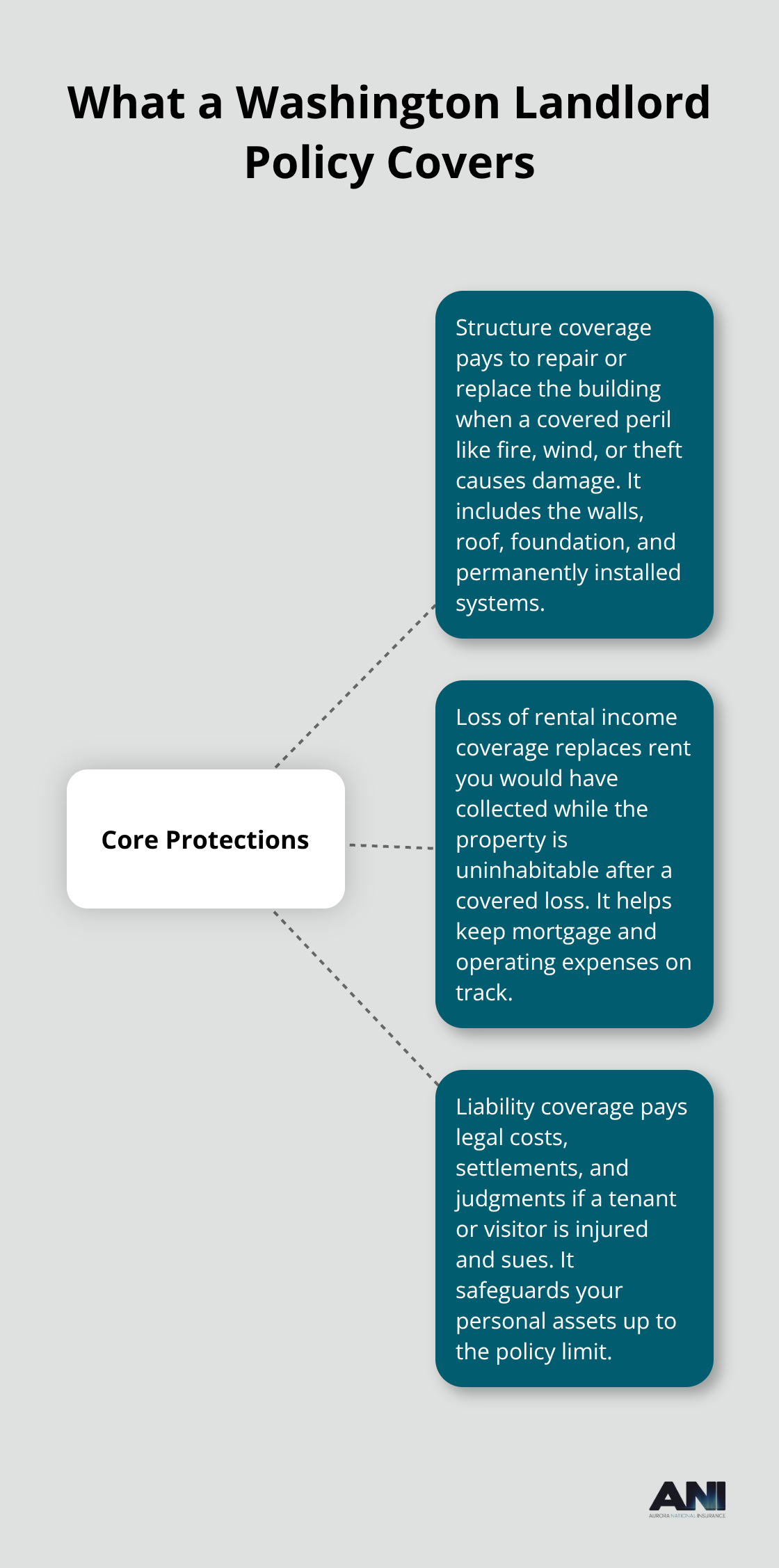
Loss of rental income coverage reimburses you for lost rent when the property becomes uninhabitable due to a covered event. This matters enormously in Washington’s high-rent markets; two-bedroom rentals in Seattle and Bellevue exceed $2,000 per month, so losing even one month of income creates real financial strain. Liability coverage forms the third layer, protecting you if a tenant or visitor is injured on the property and sues. According to the Washington State Office of the Insurance Commissioner, average liability claims by landlords exceeded $22,300 in 2022, making this protection non-negotiable.
Dwelling and Property Damage Protection
Your policy covers the rental structure and permanent fixtures attached to it, including the roof, foundation, walls, built-in appliances, and permanently installed systems like HVAC and plumbing. Most Washington landlords choose either a DP-2 or DP-3 form. A DP-2 policy covers broad perils and typically costs about 15 to 25 percent less than a DP-3, but a DP-3 offers all-risk protection and is especially popular for newer or urban properties where replacement costs matter most. If your property sits in a flood zone (more than 175,000 structures in Washington occupy mapped floodplains), standard policies exclude water damage, so you’ll need a separate flood endorsement or NFIP coverage. Earthquake endorsements are equally important; Cascadia faces a 10 to 15 percent chance of a magnitude 9.0 event within 50 years, yet standard policies exclude earthquake damage entirely. Upgrading features like fire-rated roofing or seismic retrofits can reduce premiums by 5 to 10 percent while lowering your actual loss exposure.
Income Protection When Tenants Cannot Occupy
Loss of rental income coverage reimburses your lost rent during repairs after a covered loss. If a fire makes the unit uninhabitable for three months, your policy covers the rent you would have collected during that period. This protection proves especially valuable if you depend on rental income to cover the mortgage or other expenses. The coverage amount should equal your monthly rent multiplied by the number of months you estimate repairs could take-typically six to twelve months for major losses. Many landlords underestimate this protection and set limits too low, then face a gap between actual lost income and what the policy pays. Set your Loss of Use limit based on realistic repair timelines for your specific property, not optimistic assumptions about quick turnarounds.
Liability and Medical Payments Coverage
Liability coverage protects you when someone is injured on your property and holds you responsible. If a tenant slips on icy steps and breaks an arm, or a visitor is bitten by an animal, liability covers medical costs, legal fees, and court judgments up to your policy limit. Most Washington landlords carry between $100,000 and $300,000 in liability limits; higher limits are available and cost relatively little extra. Medical payments coverage operates separately and covers immediate medical expenses for injuries on the property without requiring fault, capping at $1,000 to $5,000 depending on your policy. This coverage does not apply to you or regular residents, only to guests and visitors. Requiring tenants to carry renter’s insurance with at least $100,000 in liability shifts some responsibility for their belongings to them and reduces disputes after losses.
Choosing Between DP-2 and DP-3 Forms
The form you select determines both your premium and your protection level. DP-2 policies offer broad coverage at a lower cost, making them suitable for landlords with moderate risk tolerance and established properties. DP-3 policies provide all-risk coverage (covering all perils except those specifically excluded) and typically include replacement cost coverage as standard, which means your insurer pays what it actually costs to rebuild or repair, not just the depreciated value. For properties in high-value markets or those with significant replacement costs, the extra 15 to 25 percent premium for DP-3 coverage often makes financial sense. Your agent can help you evaluate which form aligns with your property’s age, location, and replacement cost to ensure you’re not overpaying for coverage you don’t need or underpaying for protection you do.
Why Your Standard Homeowners Policy Won’t Protect Your Rental
Your standard homeowners insurance policy excludes rental properties, which means you have zero coverage the moment you convert your home into a rental or purchase an investment property. Most insurers will outright cancel your homeowners policy if they discover the property generates rental income, leaving you completely exposed. An owner living in the house has financial incentive to maintain it and prevent losses, while tenants have no such stake in the property’s condition. Your homeowners policy reflects that difference in underwriting and pricing, so attempting to use it for a rental property is both impossible and illegal in Washington. The moment you sign a lease, your homeowners coverage becomes void, and any claim you file during that period will be denied.
Homeowners Policies Treat Rentals as Uninsurable Risks
Insurers view owner-occupied homes and rental properties as fundamentally different risks. This is not a gray area or a technicality. Some landlords discover this devastating reality only after a fire, flood, or liability incident occurs, at which point it’s far too late. Your homeowners insurer will deny the claim outright because the property was rented at the time of loss. The policy language explicitly prohibits coverage for any structure that generates rental income, and insurers enforce this restriction without exception.
Washington Law Imposes Strict Maintenance Obligations
Washington state law compounds this problem by imposing strict maintenance obligations on landlords under the Residential Landlord-Tenant Act. You must keep the structure sound, heating and plumbing functional, electrical systems safe, and the property free from pest infestations. Without dedicated landlord insurance, a single liability claim from a tenant injury or a property damage loss from weather or theft will come directly from your personal assets-savings, wages, other real estate, and retirement accounts.
Lenders Require Proof of Landlord Insurance
If you carry a mortgage on the rental property, your lender almost certainly requires proof of landlord insurance before approving the loan or renewing the mortgage. Lenders have seen too many defaults from landlords who faced uninsured losses and could no longer cover the mortgage payment. Washington’s earthquake and flood risks make this requirement even more critical; Cascadia faces a 10 to 15 percent probability of a magnitude 9.0 earthquake within the next 50 years, and more than 175,000 structures in Washington occupy mapped floodplains where standard policies won’t cover it.
A Landlord Policy Protects Your Personal Wealth
A landlord property policy transfers financial risk to an insurer, protecting your personal wealth from claims that arise from your rental business. This protection matters because one uninsured loss can wipe out years of rental income and force you to liquidate personal assets to cover the gap. The policy pays claims up to your selected limits, leaving you free to focus on managing the property rather than worrying about catastrophic financial exposure.
Understanding what your standard homeowners policy cannot do sets the stage for recognizing what a dedicated landlord policy must accomplish-and how to select the right coverage for your specific property and risk profile.
Selecting the Right Coverage for Your Washington Rental
Calculate Your Property’s True Replacement Cost
Start by calculating your property’s replacement cost, not its market value. Market value includes land; replacement cost covers only the structure, systems, and permanent fixtures that would need rebuilding after a total loss. A $600,000 home in Seattle might have a replacement cost of $450,000 because land comprises much of the purchase price. Underestimating replacement cost leaves you exposed to significant out-of-pocket losses when repairs exceed your coverage limit. Most agents use replacement cost estimators or hire appraisers to establish accurate figures. Washington State Office of the Insurance Commissioner data from 2022 showed average property damage claims by landlords exceeded $9,800, which means even moderate losses can strain finances if your coverage limits fall short. Set your dwelling coverage equal to full replacement cost, not some discounted percentage.
Determine Loss of Rental Income and Liability Limits
Evaluate Loss of Rental Income needs realistically. If your two-bedroom unit rents for $2,200 monthly in Seattle or Bellevue, a six-month loss of income equals $13,200. Most landlords should carry Loss of Use limits covering at least six to twelve months of rent, depending on property age and local construction timelines. Older properties with outdated systems face longer repair periods, so increase your limit accordingly. Set your liability limit based on your personal assets and risk tolerance. Most Washington landlords carry $100,000 to $300,000 in liability coverage; higher limits cost surprisingly little extra and provide meaningful protection given that average liability claims exceeded $22,300 in 2022. If you own significant assets beyond the rental property, consider limits at the higher end or add an umbrella policy for additional protection.
Compare Carriers on More Than Price Alone
Comparing carriers requires looking beyond premium alone. Request quotes from at least three insurers and ask specifically about earthquake and flood endorsement costs, since these represent major expense categories in Washington. Earthquake endorsements typically start around $200 annually per $100,000 of dwelling coverage, while flood coverage depends entirely on your zone and property elevation. An agent familiar with Washington’s specific risks will flag properties in Cascadia earthquake zones or mapped floodplains immediately and recommend appropriate endorsements. Deductible selection directly impacts your premium; increasing from $1,000 to $2,500 reduces premiums by 8 to 15 percent, but only if you can absorb the higher out-of-pocket cost without financial strain. Keep a cash reserve equal to your deductible to handle smaller losses without borrowing.
Evaluate Financial Strength and Claims Performance
Check each carrier’s claims satisfaction ratings through JD Power’s Property Claims Study and verify their financial strength rating with AM Best, looking for A- or higher. Short-term rental properties face higher premiums, often 20 to 40 percent above comparable long-term rentals, so confirm upfront whether your property qualifies for standard landlord rates or requires a specialized host guarantee rider. Finally, work with an independent agent licensed in Washington who maintains relationships with multiple carriers and understands local conditions like wildfire smoke damage, heavy rainfall, and landslide risk in specific regions. An agent familiar with your neighborhood can recommend coverage features tailored to actual exposure rather than generic options that may leave gaps or include unnecessary protections.
Final Thoughts
Protecting your rental investment in Washington requires a dedicated landlord property policy that covers your building structure, lost rental income during repairs, and liability when someone is injured on your property. Standard homeowners insurance will not protect you, lenders will demand proof of coverage before approving your mortgage, and Washington’s strict maintenance laws under the Residential Landlord-Tenant Act create real exposure if you operate without proper insurance. Calculate your property’s true replacement cost, set your Loss of Rental Income limit based on realistic repair timelines for your specific property, and choose liability limits between $100,000 and $300,000 depending on your personal assets.
Earthquake and flood endorsements are not optional in Washington given Cascadia’s 10 to 15 percent probability of a magnitude 9.0 event within 50 years and more than 175,000 structures in mapped floodplains. Increasing your deductible from $1,000 to $2,500 reduces premiums by 8 to 15 percent, but only if you maintain a cash reserve to cover the higher out-of-pocket cost. Review your policy annually as your property ages, rents increase, or local conditions change, since a policy that protected you adequately five years ago may leave gaps today if your replacement costs have climbed or your rental income has grown.
Work with an independent agent who represents multiple carriers and understands Washington’s specific risks, from wildfire smoke damage to heavy rainfall and landslide exposure in your neighborhood. Getting a quote takes minutes and costs nothing, and the right Washington landlord property policy protects your investment from the losses that can derail your financial goals.
The information provided in this blog is for general informational purposes only and does not constitute legal, financial, or insurance advice. Coverage options, terms, and availability may vary. Please consult with a licensed professional for advice specific to your situation.
Artificial intelligence may have been used to generate text and images in some blog articles.


