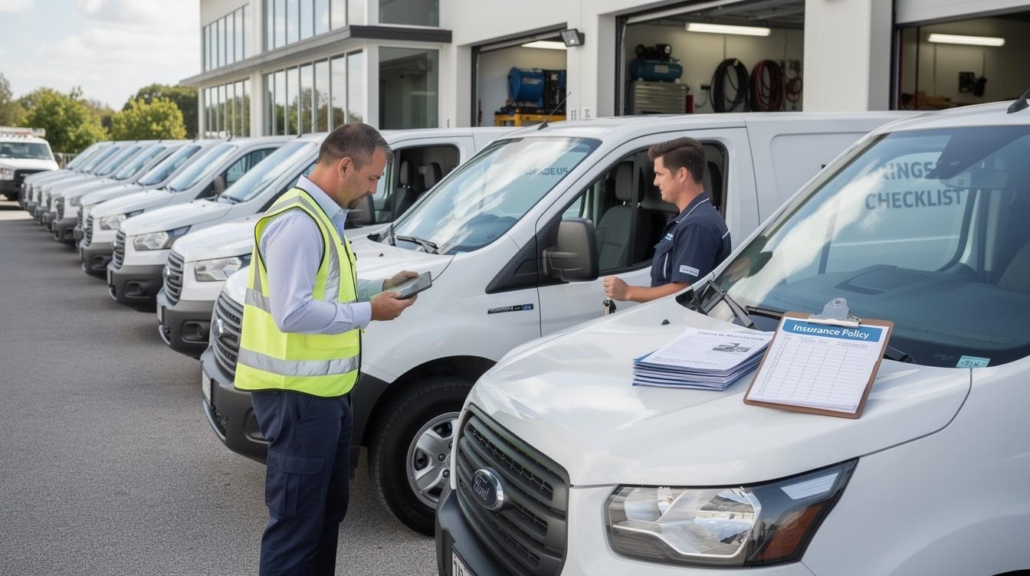
Washington Fleet Auto Insurance: Streamlined Coverage For Your Vehicles
Running multiple vehicles for your business means managing multiple insurance policies-unless you switch to fleet coverage. Washington fleet auto insurance consolidates protection for all your vehicles under one streamlined policy, cutting through the complexity of separate plans.
At Aurora National Insurance, we’ve helped countless Washington business owners simplify their coverage and reduce costs. This guide walks you through the coverage options, savings strategies, and next steps to protect your fleet.
What Fleet Auto Insurance Actually Covers
Fleet auto insurance bundles multiple company-owned, leased, or hired vehicles under a single policy rather than managing each vehicle separately. The core coverage includes liability protection, collision, comprehensive, and optional add-ons like uninsured motorist coverage, medical payments, and specialized protections such as towing and loading/unloading coverage. Washington requires a minimum of $25,000 per person and $50,000 per accident for bodily injury liability, plus $10,000 for property damage, but most fleet operators need higher limits depending on vehicle type and business operations. The real advantage is simplicity: one renewal date, one billing cycle, uniform coverage limits across all vehicles, and straightforward administration when you add or remove vehicles from your fleet.
Which Businesses Actually Need Fleet Coverage
Fleet insurance makes sense when you operate five or more vehicles. Below that threshold, individual policies may work fine, but once you cross five vehicles, the administrative burden shifts dramatically. Service companies like landscaping, cleaning, construction, and delivery operations typically see immediate savings by consolidating coverage.
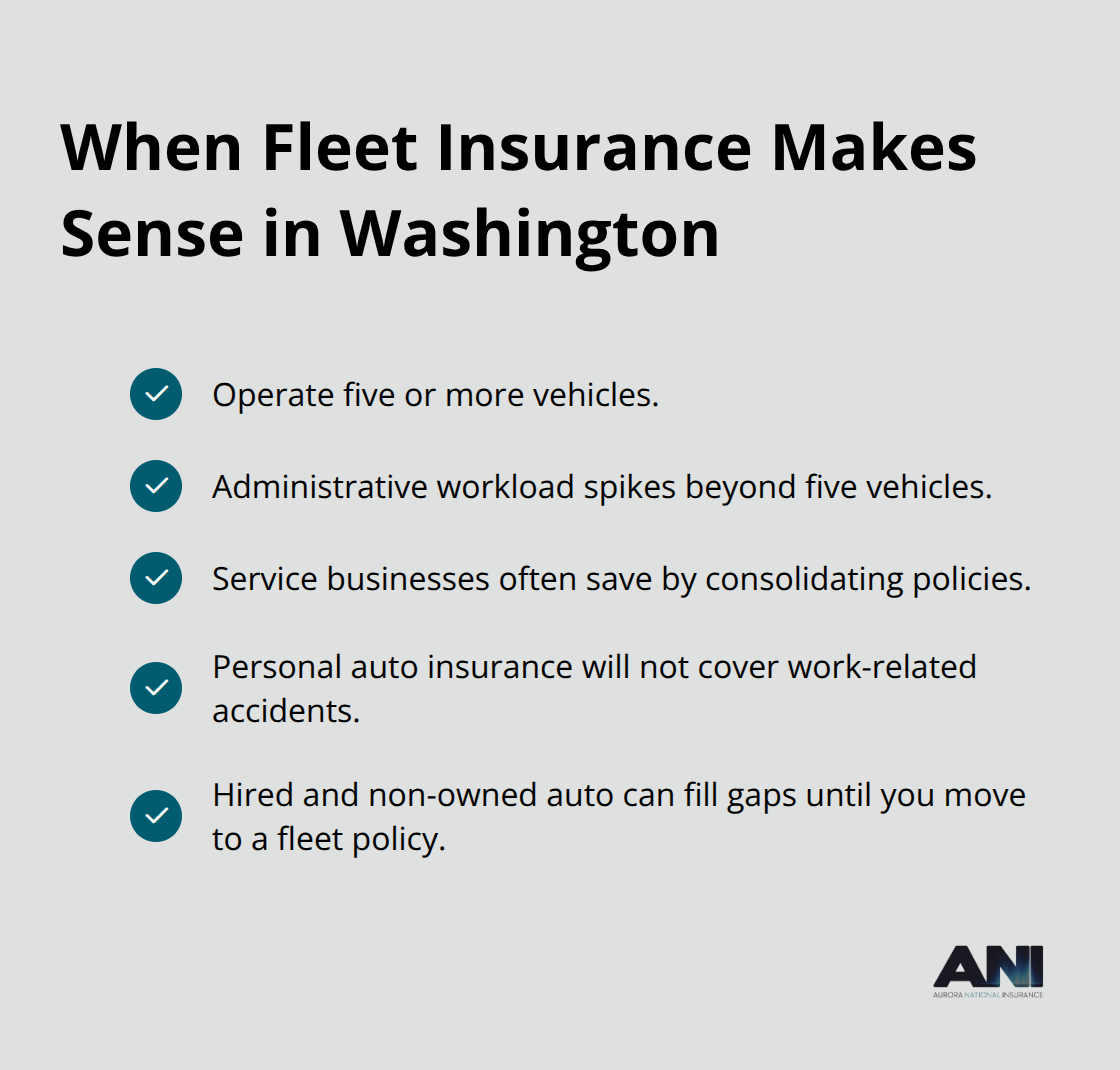
According to Insureon customer data updated in March 2026, the average annual cost for Washington commercial auto insurance runs about $2,469, or roughly $206 monthly. However, this varies significantly based on vehicle type, driver records, and claims history. If you use personal vehicles for work purposes, standard personal auto policies won’t cover work-related accidents, which is why many small businesses need hired and non-owned auto liability coverage as a stopgap until they can move to true fleet protection. The transition to fleet status typically happens when growth forces you to choose between managing separate policies or consolidating under one streamlined plan.
How Fleet Policies Beat Individual Vehicle Coverage
Individual vehicle policies create gaps and inconsistency. Each vehicle renews at a different time, carries potentially different limits, and requires separate claims management. With a fleet policy, all vehicles share the same coverage terms, the same deductible structure, and the same renewal date, eliminating the administrative friction of tracking multiple expiration dates. When you add a vehicle to a fleet policy, the process takes days, not weeks. If you need to adjust coverage limits across your entire operation, one phone call handles it instead of contacting multiple insurers. Premiums under fleet coverage tend to be more stable and predictable than individual policies because risk is pooled across the entire fleet rather than priced per vehicle. This pooling effect often delivers cost savings as your fleet grows, since insurers evaluate overall fleet risk rather than assessing each vehicle in isolation. Washington’s Fleet Account Program through the Department of Licensing further streamlines operations by allowing you to manage vehicle registration and tabs under a single fleet account, reducing paperwork and coordination between your insurance provider and licensing office.
What Comes Next in Your Fleet Coverage Decision
The coverage options available to you depend on your specific vehicles, drivers, and operational risks. Understanding which add-ons protect your business-and which ones you can skip-requires a closer look at liability limits, collision protection, and specialized coverages that match your industry.
Key Coverage Options for Washington Fleet Owners
Liability Protection Forms Your Foundation
Liability protection forms the foundation of any fleet policy, and Washington’s minimum liability requirements represent just a baseline. The law requires $25,000 per person and $50,000 per accident for bodily injury, plus $10,000 for property damage. However, a single serious accident involving your fleet vehicle can generate medical bills, lost wages, and legal costs far exceeding these thresholds. If your fleet operates service vehicles, delivery trucks, or handles client transportation, courts routinely award damages of $100,000 to $500,000 in injury cases.
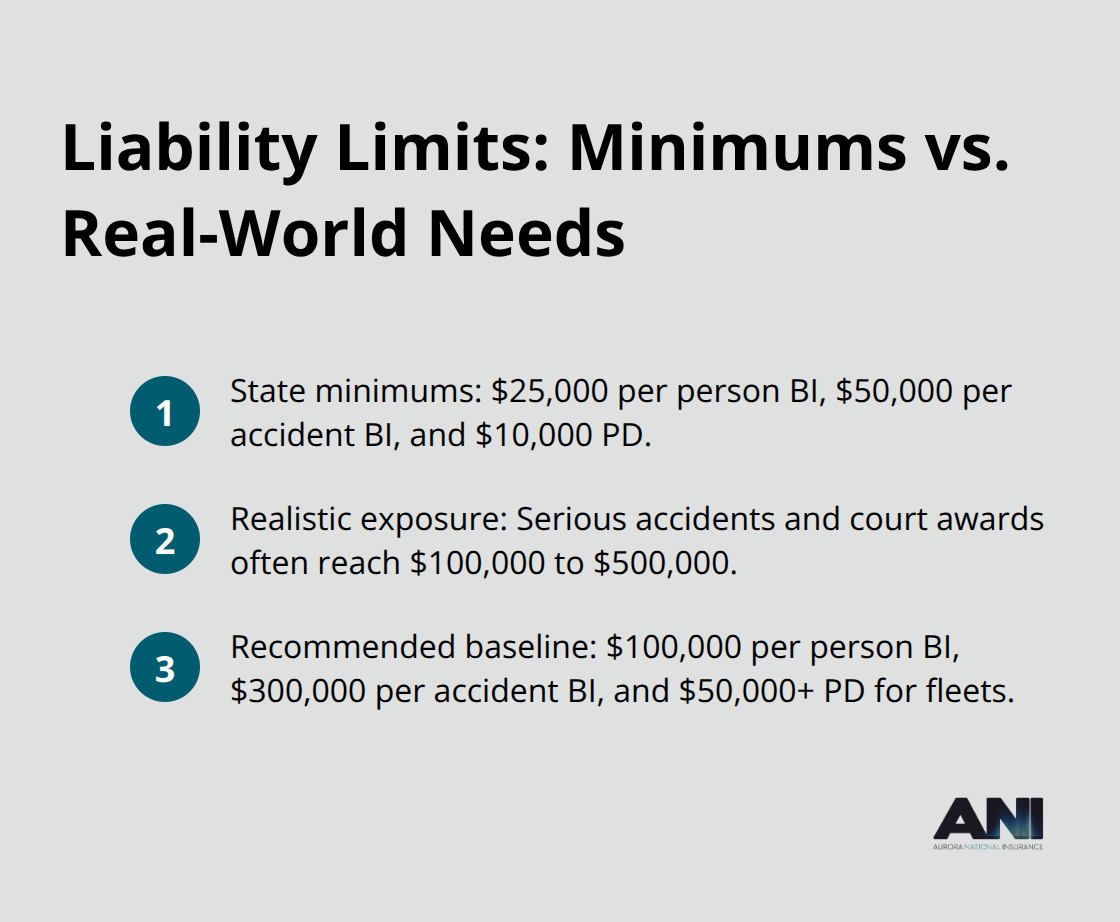
Most Washington fleet operators should carry at least $100,000 per person and $300,000 per accident in bodily injury liability, with $50,000 or higher for property damage. This modest increase in coverage costs only slightly more in premiums but eliminates the catastrophic gap between state minimums and realistic accident expenses.
Collision and Comprehensive Coverage Protect Your Vehicles
Collision covers damage from accidents, rollovers, and impacts with other vehicles or objects, while comprehensive handles theft, vandalism, weather damage, animal strikes, and glass breakage. For newer fleet vehicles or those financed through leasing arrangements, both coverages are typically required by lenders. If your fleet consists of older paid-off vehicles used for basic operations, you might skip collision on the highest-mileage units while keeping it on newer acquisitions. The distinction between these two coverages matters for your decision-making because each addresses different types of damage.
Uninsured Motorist Coverage Fills Critical Gaps
Uninsured and underinsured motorist coverage protects your drivers and vehicles when the at-fault party lacks sufficient insurance to cover damages. Washington requires this protection, and it applies when another driver causes an accident but either has no insurance or insufficient coverage. Medical payments coverage, while optional, handles immediate medical expenses for you and your drivers after an accident regardless of fault. These protections work together to shield your operation from drivers who cannot pay for the harm they cause.
Specialized Coverages Match Your Operations
Towing and labor, loading and unloading protection, and bobtail coverage address specific operational needs. Towing covers roadside assistance and mechanical breakdowns, loading and unloading protects cargo during transit, and bobtail coverage applies to tractors operating without trailers. A landscaping company hauling equipment needs different protection than a cleaning service with passenger vans, and a delivery operation requires different priorities than a construction fleet with specialized equipment aboard. Your actual needs depend entirely on what your vehicles do and how your drivers use them daily.
How to Cut Fleet Costs Without Cutting Coverage
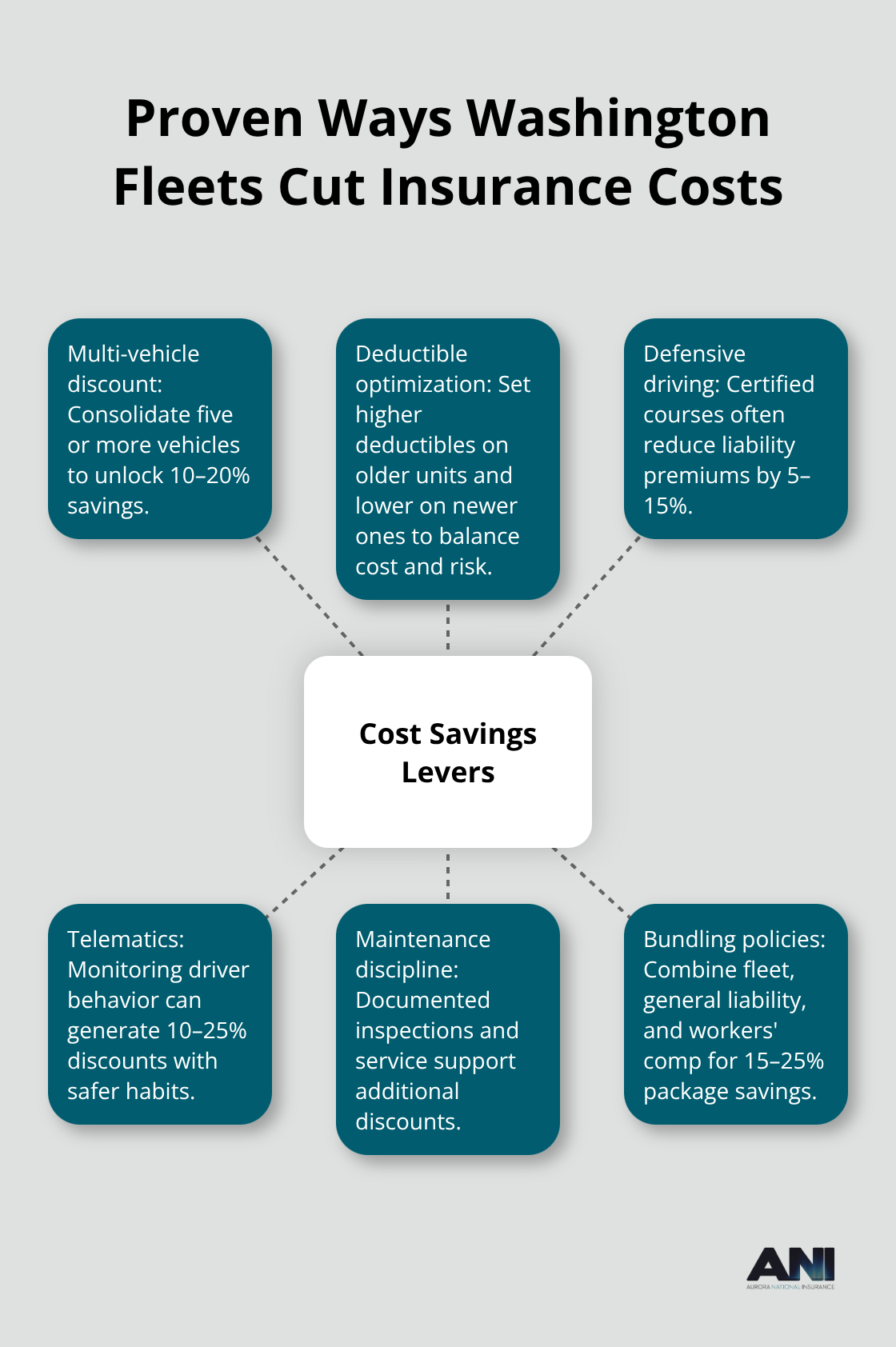
Washington fleet operators leave thousands on the table every year by failing to structure their policies for maximum savings. The multi-vehicle discount is where most fleets start, and it’s substantial. When you consolidate five or more vehicles under a single fleet policy, insurers typically apply a discount ranging from 10 to 20 percent compared to individual vehicle policies. The exact percentage depends on your vehicles, driver records, and claims history, but the math is straightforward: a fleet with an estimated annual premium of $12,500 across five separate policies might pay $10,000 to $11,250 under consolidated fleet coverage. That difference compounds year after year.
Fleet policies also allow you to optimize deductibles across your entire operation. A landscaping company might select a $1,000 deductible on newer equipment trucks while choosing a $2,500 deductible on older vehicles, reducing premiums on high-mileage units while protecting newer assets. This flexibility simply doesn’t exist when you’re locked into individual policies with fixed terms.
Safety Programs Drive Real Premium Reductions
Safety programs represent the most underutilized path to lower premiums in Washington fleets. Insurers offer measurable discounts when your drivers complete certified defensive driving courses, and the reduction typically ranges from 5 to 15 percent on liability coverage. For a fleet paying $2,469 annually according to Insureon data from March 2026, a defensive driving program across your team could save $123 to $370 per year. More importantly, these programs reduce actual accidents, which protects your claims history and prevents future premium increases.
Some carriers require initial training before new drivers operate fleet vehicles, while others offer ongoing refresher courses. Telematics programs that monitor driver behavior through GPS and acceleration sensors generate additional savings of 10 to 25 percent for fleets willing to track their operations. A delivery or service fleet using telematics can identify speeding, harsh braking, and unsafe turns, then coach drivers on safer habits. This data-driven approach appeals to insurers because it demonstrably reduces accident frequency.
Maintenance records also influence your premium. Fleets that document regular vehicle inspections, tire rotations, and brake servicing qualify for discounts because well-maintained vehicles cause fewer accidents and generate smaller claims. Washington’s Department of Licensing fleet program supports this by requiring consistent registration and documentation across your vehicles, making it easier to demonstrate your operational standards to insurers.
Bundling Creates Leverage for Better Overall Pricing
Bundling fleet auto coverage with general liability, property coverage, or workers’ compensation under a single carrier generates competitive advantages that most business owners ignore. When you consolidate insurance needs with one provider, you become a more valuable customer, and carriers respond with package discounts that can exceed 15 to 25 percent across your total insurance spend. A construction company with a five-vehicle fleet, general liability coverage, and workers’ comp might negotiate a combined package discount worth $2,000 to $4,000 annually.
The second advantage is administrative simplification. One agent, one renewal date, one point of contact for claims, and one billing cycle eliminate the coordination headaches of managing multiple carriers. When an accident happens, you contact one insurer who already understands your full business exposure rather than juggling separate carriers with incomplete information.
Independent agencies licensed across multiple states excel at this bundling strategy because they represent multiple top-rated carriers and can position your fleet within a broader coverage portfolio. The third advantage is transparency. When your fleet, general liability, and workers’ comp sit under one policy structure, your agent can identify coverage gaps you’d miss otherwise. A service fleet might discover that their general liability policy excludes certain operations their vehicles perform, or that their property coverage doesn’t extend to tools and equipment inside vehicles (gaps that become obvious when reviewing bundled coverage as a unified strategy rather than isolated policies).
Final Thoughts
Fleet auto insurance consolidates liability protection, collision coverage, comprehensive protection, and specialized add-ons into a single streamlined policy that eliminates the administrative chaos of managing separate vehicle policies. Multi-vehicle discounts ranging from 10 to 20 percent, combined with safety program savings of 5 to 15 percent, deliver measurable cost reductions that compound annually. Bundling fleet coverage with general liability or workers’ compensation amplifies these savings further while simplifying your entire insurance administration into one renewal cycle and one billing statement.
The transition from individual policies to Washington fleet auto insurance typically pays for itself within the first year through administrative time savings alone, before accounting for premium reductions. Your next step is straightforward: request competitive quotes from carriers experienced in Washington fleet operations, compare coverage options specific to your vehicle types and business operations, and identify which add-ons match your actual risk exposure rather than paying for unnecessary protection. This comparison process takes hours, not weeks, and reveals exactly how much you’ll save by consolidating your fleet coverage.
Get an instant online quote to see your options and move forward with protection that fits your Washington business.
The information provided in this blog is for general informational purposes only and does not constitute legal, financial, or insurance advice. Coverage options, terms, and availability may vary. Please consult with a licensed professional for advice specific to your situation.
Artificial intelligence may have been used to generate text and images in some blog articles.