

Washington General Liability Guide: Navigating Local Requirements
Running a business in Washington means protecting yourself from liability risks that are specific to your state. General liability insurance isn’t optional-it’s a business necessity that shields you from costly claims.
At Aurora National Insurance, we’ve helped countless Washington business owners understand their coverage needs. This Washington general liability guide walks you through what you need to know to make informed decisions about your protection.
What Your Washington Business Actually Needs to Know About General Liability
General liability insurance protects your business when someone claims you caused them bodily injury, damaged their property, or injured their reputation through your work or operations. This coverage pays for medical expenses, legal defense, settlements, and judgments up to your policy limits. Washington State Department of Labor & Industries requires minimum general liability coverage of $200,000 for public liability and $50,000 for property damage, or a combined single-limit policy of $250,000. If you work with government agencies or large contractors, they demand proof that L&I is listed as the certificate holder on your policy. Most Washington contractors actually carry $1 million per occurrence and $2 million aggregate limits because clients won’t hire you without it.
How Your Industry and Payroll Shape Your Costs
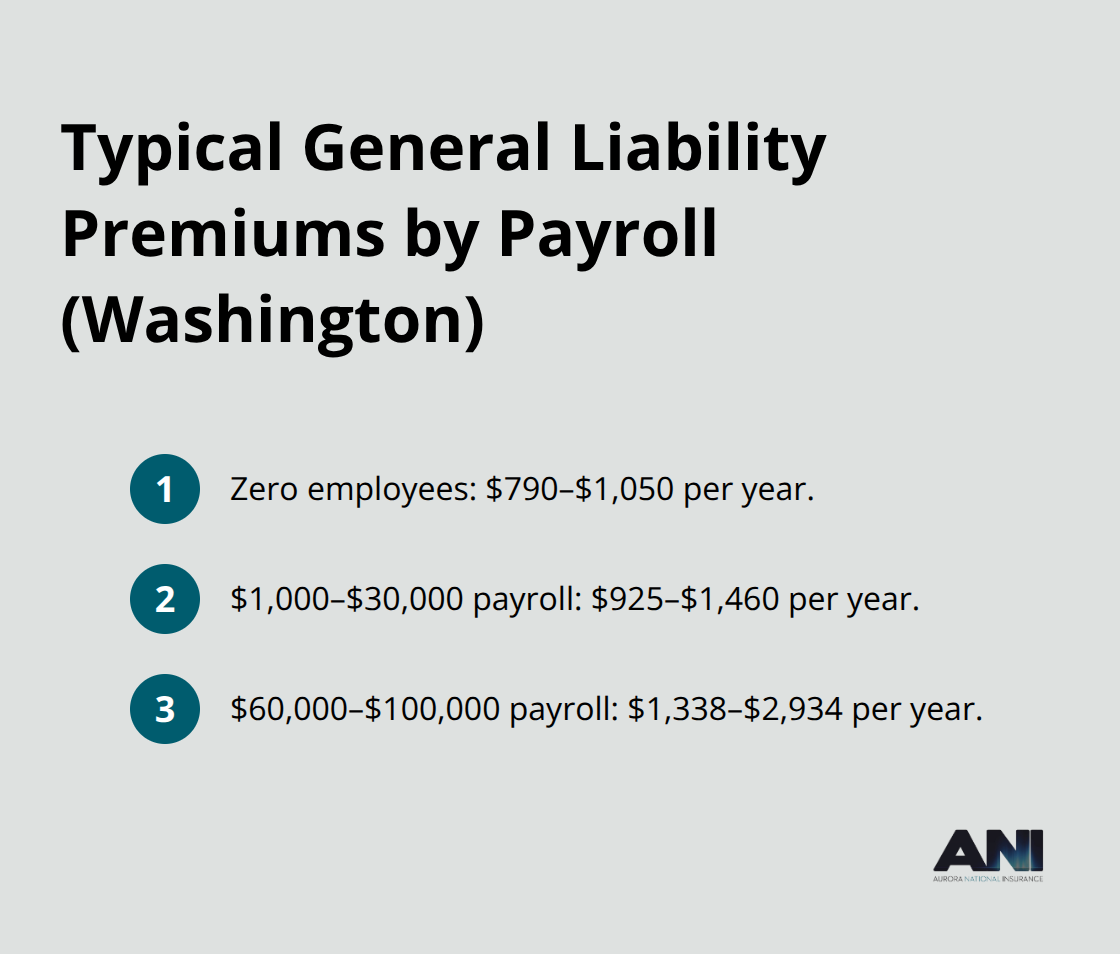
Your industry matters enormously for what you’ll pay and what you actually need. A landscaper faces different risks than an electrician, and your payroll size directly affects your premium. If you have zero employees, you’ll pay roughly $790 to $1,050 annually. With $1,000 to $30,000 in payroll, you’ll face $925 to $1,460 per year. Those numbers jump to $1,338 to $2,934 annually if your payroll reaches $60,000 to $100,000.
General contractors, electricians, plumbers, roofers, HVAC technicians, painters, drywall specialists, concrete workers, landscapers, and carpenters all operate in Washington’s competitive construction market where general liability isn’t negotiable.
Understanding What Coverage Actually Protects
Your policy covers bodily injury claims when someone gets hurt because of your work, property damage when you accidentally damage a client’s building or belongings, medical payments up to about $5,000 for minor injuries, and personal and advertising injury from accusations of slander or copyright infringement. The coverage applies to work you performed during the policy period and continues protecting you after project completion if a claim arises within the policy terms. A roofing job completed in March could generate a leak claim in November, and your policy still covers it. Occurrence-based policies are strongly preferred over claims-made policies because they protect you for work done during the policy period regardless of when the claim is filed. When a claim happens, your insurer handles the legal defense and any settlement up to your limits, and you only pay the deductible.
Getting Coverage Active and Verified
Many carriers offer same-day general liability coverage for Washington businesses. Once your policy activates, you can request a Certificate of Insurance to provide to clients immediately. Your premium gets verified through a premium audit that checks your actual payroll and revenue to confirm you’re paying the correct rate. If your actual numbers differ from your estimate, your premium adjusts accordingly. This transparency prevents surprise bills and ensures you’re not overpaying or underpaying for your risk profile. With the right coverage in place, you’re ready to address the specific risks that Washington’s climate and business environment create for your operation.
Common Risks and Claims in Washington
Weather Creates Persistent Liability Exposures
Washington’s weather patterns and construction environment generate specific liability exposures that show up repeatedly in claims data. Rain and snow don’t just cause property damage-they create liability situations when water intrusion happens during your work, when ice makes walkways hazardous at job sites, or when you fail to properly waterproof structures before handing them over to clients. A contractor who leaves a building envelope unsealed during the rainy season faces water damage claims that can exceed $50,000 easily. Winter weather compounds this because ice accumulation on scaffolding, roofs, or walkways leads to fall injuries that trigger bodily injury claims.
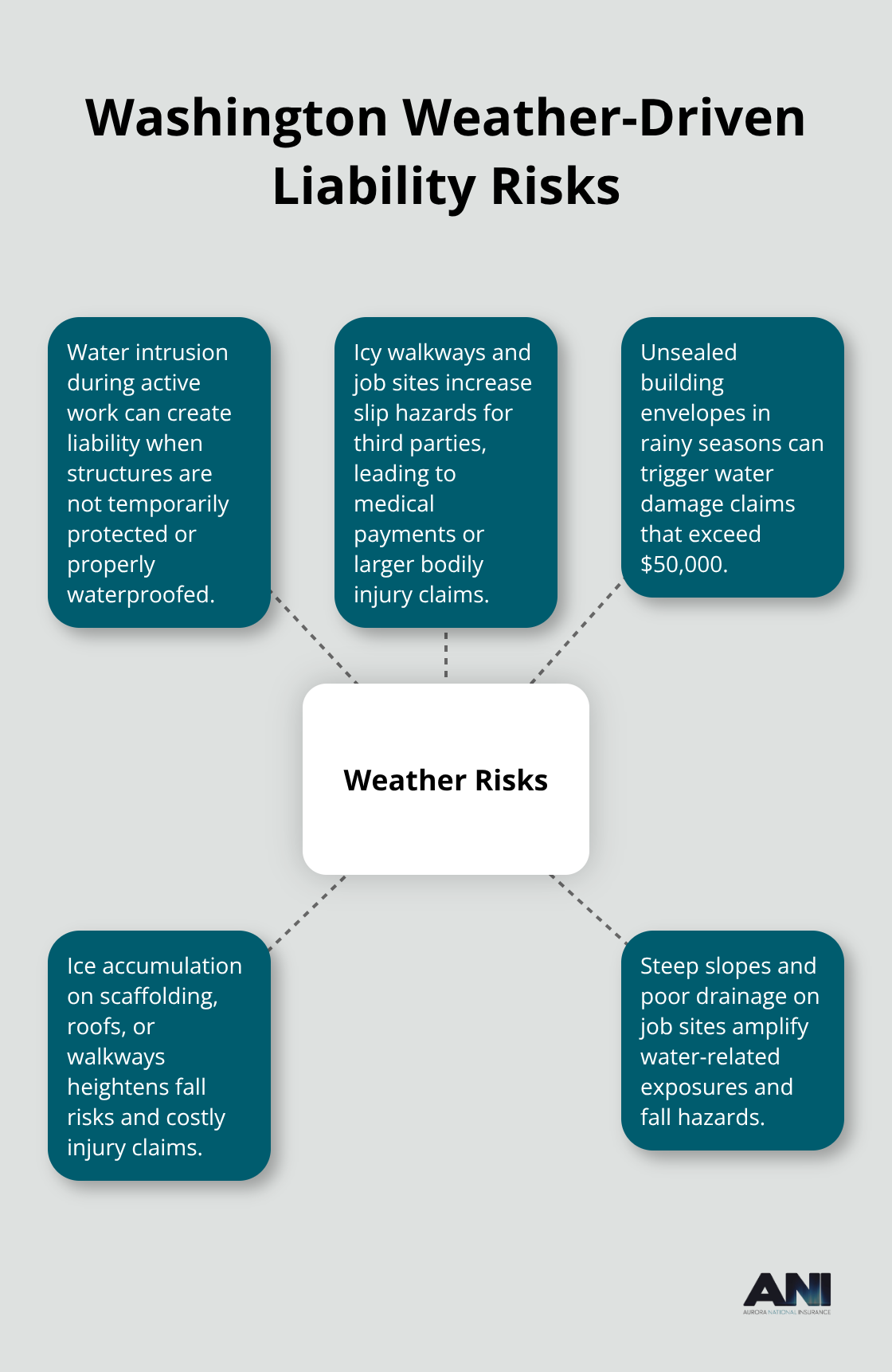
Water damage and freezing claims affect 2.8 percent of insured homes, with such losses representing a significant portion of weather-related claims. The state’s terrain also creates challenges-steep slopes in residential areas increase fall risks during construction, and poor drainage on job sites multiplies water-related exposures.
Third-Party Injuries Generate Significant Claims
Third-party injury claims happen constantly on Washington job sites and at business locations. Someone slips on a wet floor at your retail shop, gets hit by falling materials during construction, or suffers heat-related illness at an outdoor event your company manages. Medical payments coverage up to $5,000 handles minor incidents quickly, but serious injuries generate settlements well beyond that threshold. A single fall from scaffolding can cost $100,000 or more in medical care and lost wages. Your general liability policy covers investigation, legal defense, and settlement costs, protecting your business from financial devastation when these incidents occur.
Property Damage Claims Expose Underinsured Businesses
Property damage claims follow similar patterns to injury claims-you accidentally damage a client’s electrical system while running new wiring, water from your work damages a neighbor’s foundation, or your equipment punctures their driveway. The difference between adequate coverage and underinsurance shows up immediately when a claim arrives. A contractor carrying only the state minimum of $250,000 combined single-limit coverage faces serious financial exposure on any significant claim. This reality explains why Washington clients demand proof that you carry $1 million per occurrence coverage. Without occurrence-based coverage, you face gaps in protection for work completed years earlier that generates claims after your policy expires (a problem that claims-made policies create but occurrence-based policies eliminate).
Coverage Gaps Create Long-Term Exposure
Your insurance handles investigation, legal defense, and settlement costs, but only if your limits match the actual risk. Work you completed in March could generate a water intrusion claim in November, and your policy still covers it if you maintain occurrence-based protection. The seasonal nature of Washington construction means claims often arrive months or years after project completion. Contractors who switch to claims-made policies or let coverage lapse between jobs discover too late that old projects no longer have protection. Understanding these specific Washington risks helps you select coverage that actually protects your operation rather than leaving gaps that expose your business to financial loss. As you evaluate your industry-specific exposures, the next step involves comparing how different carriers price these risks and which coverage options best match your actual business operations.
How to Choose the Right Coverage for Your Washington Business
State Minimums Don’t Match Market Reality
The gap between state minimums and what Washington clients actually demand means you need a strategic approach to coverage selection. State law requires $200,000 public liability and $50,000 property damage, but most Washington contractors carrying only these limits lose jobs regularly because clients won’t hire them. The market reality is that $1 million per occurrence and $2 million aggregate coverage has become the baseline expectation across general contracting, electrical work, plumbing, roofing, and landscaping trades. Your first step involves honest assessment of what your specific work generates as risk exposure.
Assess Your Industry-Specific Risks and Payroll
A painter working on interior residential projects faces fundamentally different hazard profiles than a concrete contractor working on commercial building foundations or a roofer installing systems on multi-story structures. Your payroll size directly affects premium costs, so a solo operator with zero employees will pay $790 to $1,050 annually while a crew with $60,000 to $100,000 in payroll faces $1,338 to $2,934 per year. Industry classification matters enormously because underwriters price risk based on historical claims data for your specific trade. Request quotes from at least three carriers that specialize in your industry rather than relying on one company’s pricing.
Compare Quotes and Policy Structures
When you receive quotes, compare not just the premium but the policy structure, deductible options, and whether carriers offer occurrence-based or claims-made coverage. Occurrence-based policies provide substantially better protection for Washington contractors because claims filed years after project completion still have coverage if the work occurred during your policy period. Different carriers view your particular operation differently-what one company charges another may price significantly higher or lower based on their underwriting approach and claims experience with your trade.
Work with Local Agents Who Understand Washington Markets
Local agents who understand Washington’s specific business environment, weather patterns, and client requirements give you advantages that online quote systems cannot match. An agent familiar with Washington construction knows which carriers offer the fastest coverage activation, understands the state’s premium audit process, and can explain why certain industries face higher rates in coastal areas versus inland regions. An experienced local agent identifies coverage gaps you might miss on your own, such as products and completed operations exposure that protects you when work you finished months earlier generates claims.
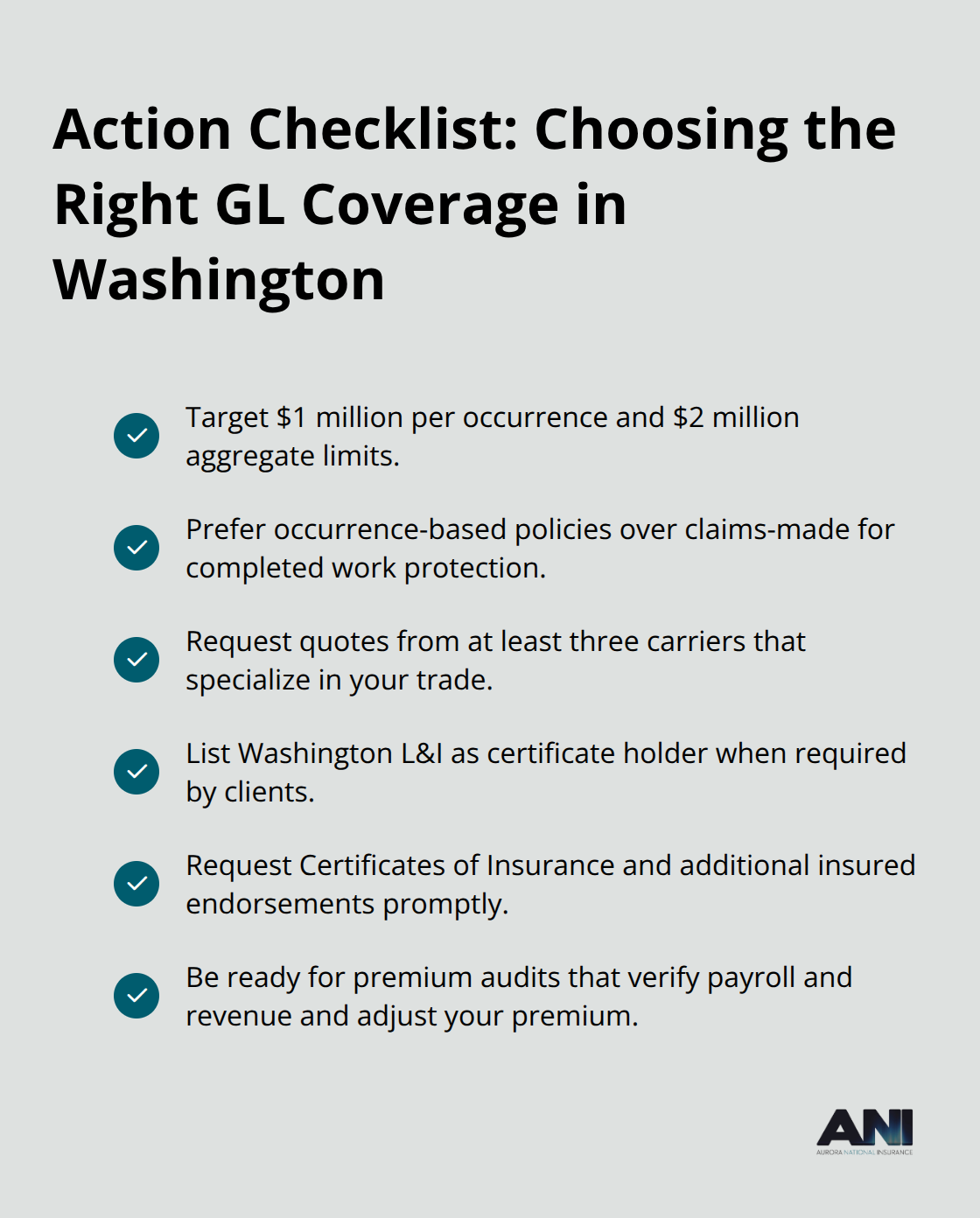
They also handle the practical details like ensuring L&I gets listed as certificate holder on your policy and managing premium audits that adjust your rate based on actual payroll. When you need additional insured endorsements because a client requires it, a local agent secures these quickly without delaying your job start. The difference between selecting coverage online and working with someone who understands Washington markets shows up immediately when claims happen or when you discover mid-project that your coverage doesn’t match what your contract actually requires.
Final Thoughts
Washington general liability insurance protects your business from the specific risks that operating in this state creates. The gap between state minimums and what clients actually demand means you need coverage that reflects market reality, not just legal requirements. Most Washington contractors carry $1 million per occurrence and $2 million aggregate limits because that’s what keeps them competitive and hired.
Your payroll size, industry classification, and the weather patterns unique to your region all shape what you’ll pay and what protection you actually need. Request quotes from multiple carriers that understand your specific trade rather than accepting the first number you receive. The difference between carriers can be substantial, and occurrence-based policies provide protection that claims-made policies cannot match for Washington contractors.
We at Aurora National Insurance help Washington business owners find the right coverage at competitive prices. Our licensed agents deliver tailored comparisons and expert consultation to match your specific operation with protection that actually works. Get an instant online quote and discover how proper general liability coverage protects your Washington business from the claims that matter most.
The information provided in this blog is for general informational purposes only and does not constitute legal, financial, or insurance advice. Coverage options, terms, and availability may vary. Please consult with a licensed professional for advice specific to your situation.
Artificial intelligence may have been used to generate text and images in some blog articles.


