Washington General Liability Coverage: Coverage That Scales With Your Business
Your business grows, and so do your risks. Washington general liability coverage protects you from the unexpected-whether it’s a customer’s injury on your property or damage you cause to someone else’s belongings.
At Aurora National Insurance, we know that one-size-fits-all policies don’t work for growing businesses. The right coverage limits today might not be enough tomorrow, which is why understanding your options matters.
What Your General Liability Policy Actually Covers
Three Core Protections Your Policy Provides
General liability insurance protects your Washington business from three main financial threats. First, it covers bodily injury claims when someone gets hurt because of your business operations-a customer slips in your office or a client sustains an injury at a job site. Your policy pays for their medical expenses, lost wages, and pain-and-suffering damages up to your coverage limit.
Second, the policy covers property damage liability when your business causes damage to someone else’s property. This includes accidental damage during service delivery, equipment you own damaging a client’s building, or a delivery vehicle hitting a parked car.
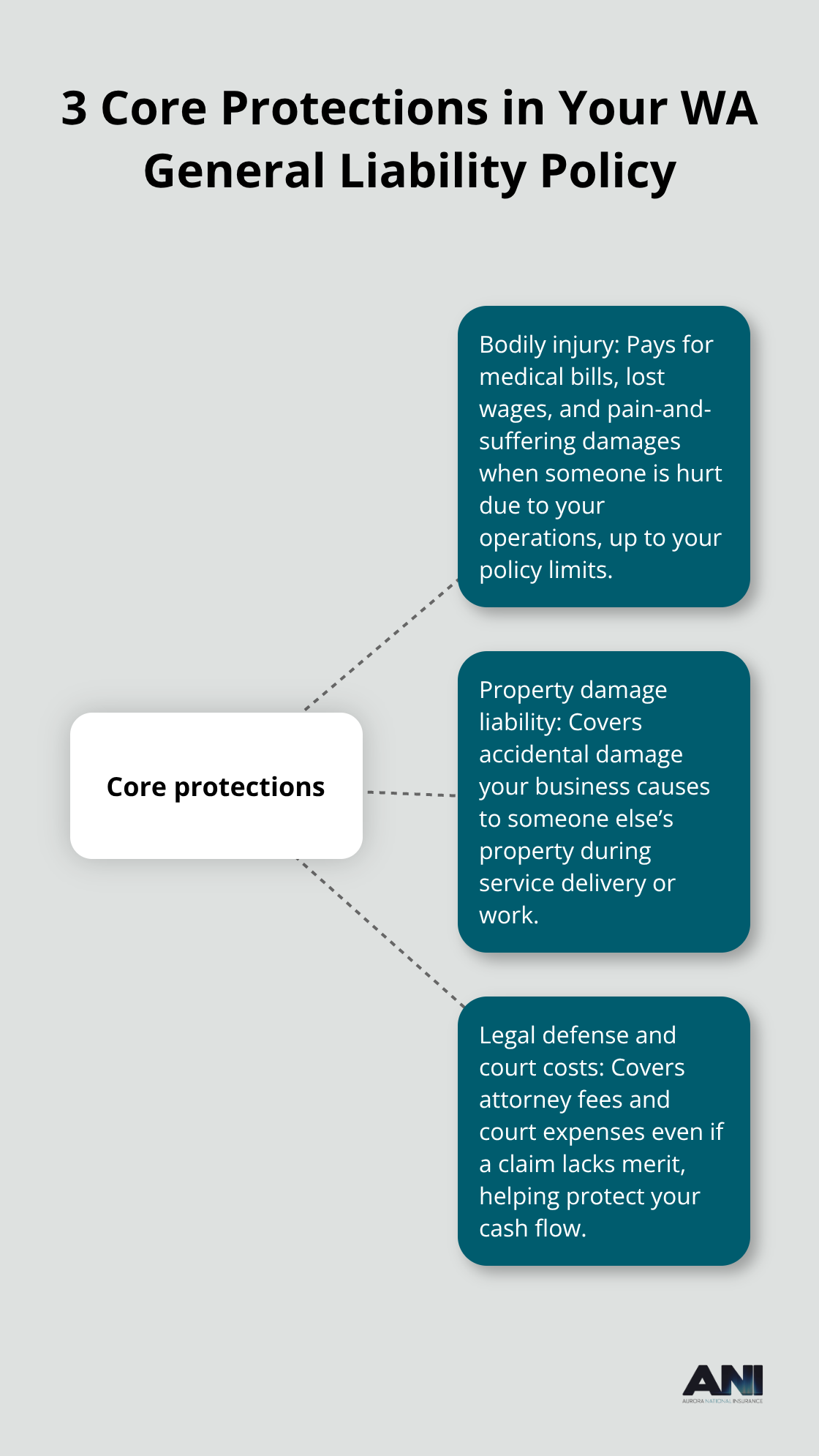
Third, general liability covers your legal defense costs and court expenses if you face a lawsuit, even if the claim lacks merit. Defense costs can add up quickly during litigation, which means this protection prevents a single lawsuit from draining your operating budget.
Advertising Injury Coverage You Might Not Expect
Washington businesses often overlook that general liability also covers advertising injury claims-claims that your marketing materials violated someone’s copyright or defamed their business. A small contractor who accidentally uses a photo without permission or a consultant whose advertisement faces accusations of false claims could face expensive legal battles. Your policy handles those defense costs too.
Finding the Right Coverage Limits for Your Situation
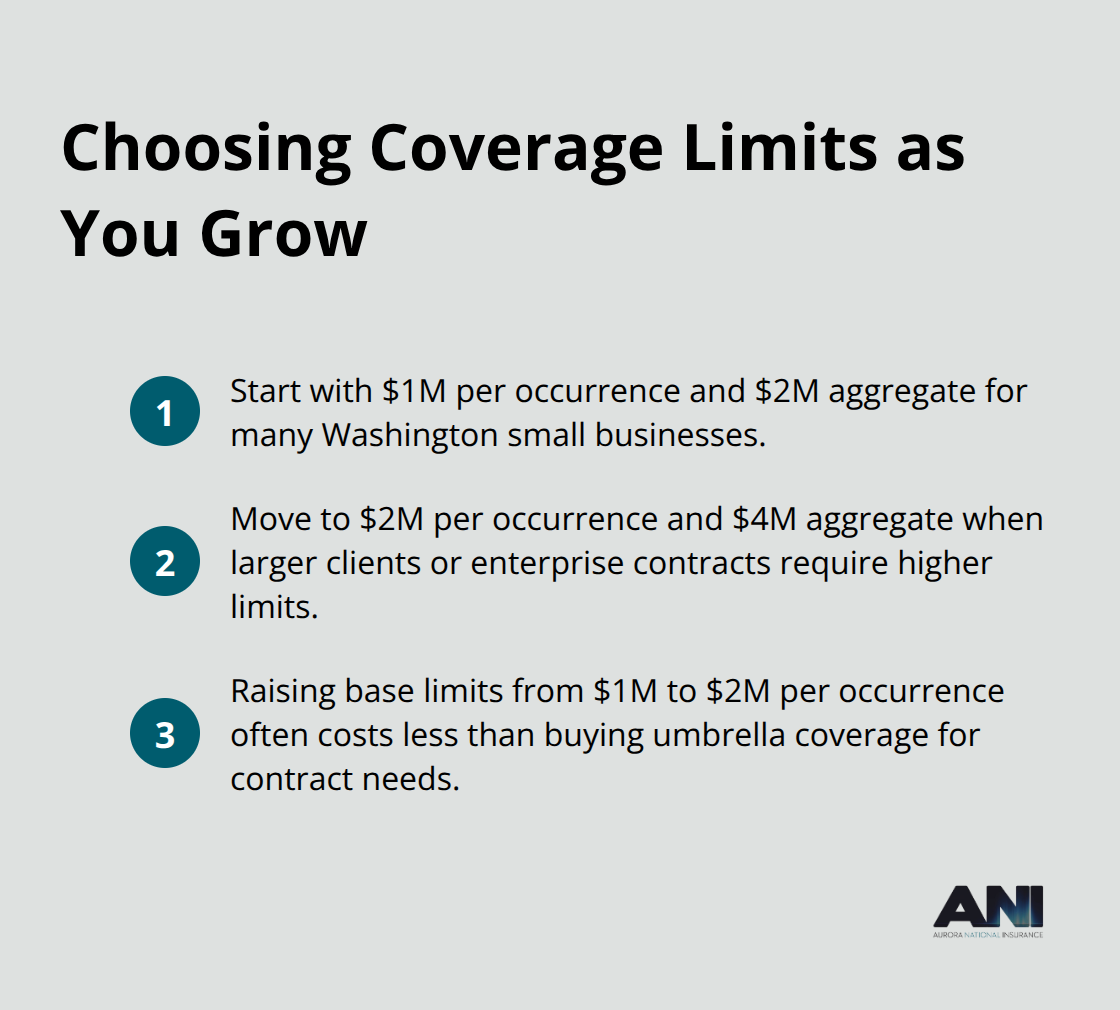
The standard starting point for most Washington businesses is $1 million per occurrence and $2 million aggregate. However, if you work with larger clients or sign enterprise contracts, you’ll likely need higher limits like $2 million per occurrence and $4 million aggregate. The cost difference between these tiers is often modest-raising your base limit from $1 million to $2 million per occurrence frequently costs less than purchasing umbrella coverage to satisfy contract requirements. Comparing quotes from multiple carriers shows you the real price of scaling up, and this comparison becomes especially important as your business takes on larger projects and client relationships that demand higher protection levels.
Why Your Business Needs This Protection Now
Washington’s Small Business Landscape Demands Coverage
Washington has over 644,000 small businesses, and most operate without fully understanding their liability exposure until something goes wrong. General liability insurance isn’t optional for businesses that want to survive a serious claim-it’s the difference between staying open and closing your doors. Many Washington business owners avoid coverage until a client demands a certificate of insurance before signing a contract, which is exactly when scrambling to get coverage becomes expensive and time-consuming. If you work with corporate clients, government agencies, or sign commercial leases, you’ll face mandatory insurance requirements. General liability meets these requirements and protects you when accidents happen on your property or during your work.
What Coverage Actually Costs Your Business
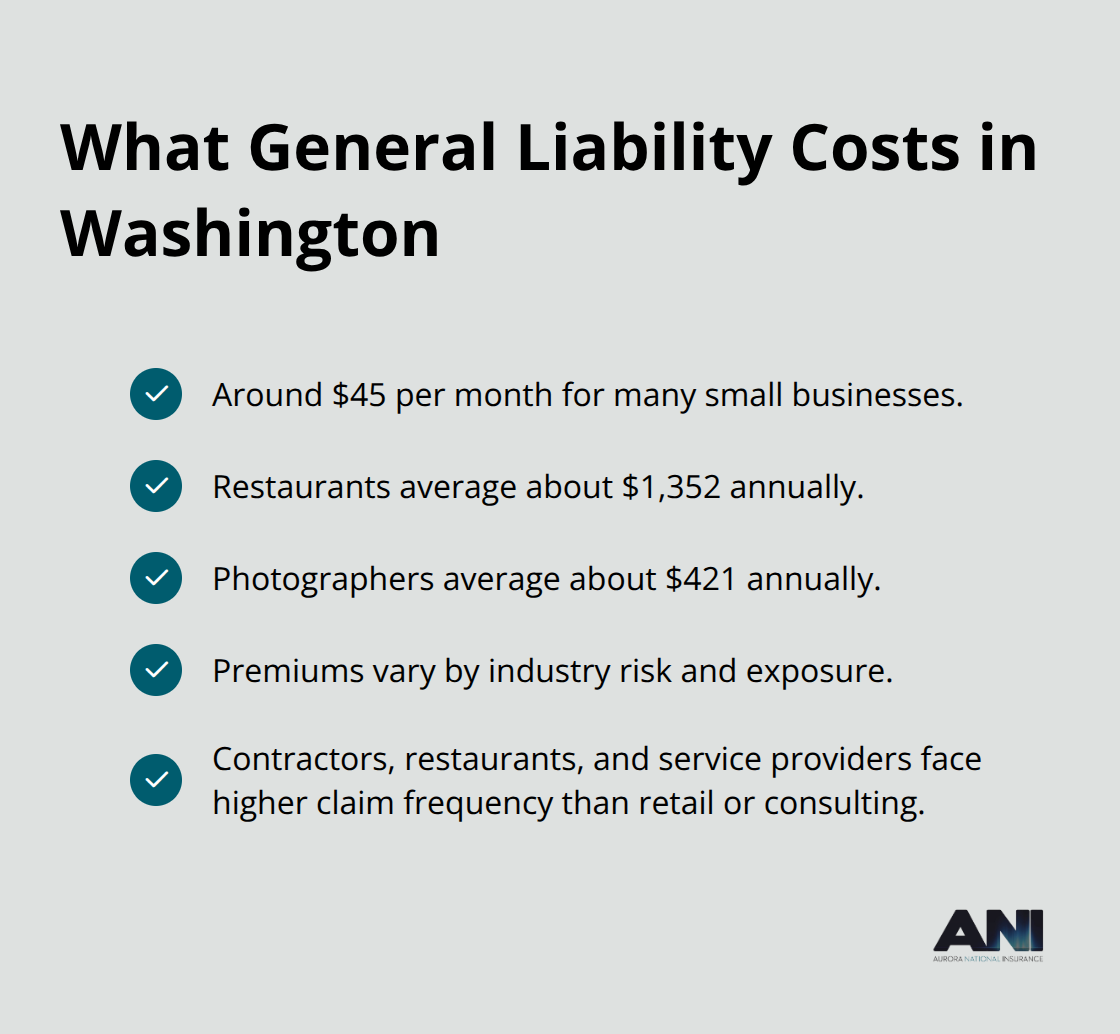
General liability insurance costs approximately $45 per month for small businesses in Washington, making this protection genuinely affordable for businesses at any growth stage. Your industry affects both your premium and your actual risk. A restaurant averages about $1,352 annually for general liability, while a photographer averages $421-the difference reflects real exposure differences. Washington contractors, restaurants, and service providers face higher claim frequency than retail or consulting businesses, which means your specific work determines your cost.
How One Claim Destroys Uninsured Businesses
The real cost of operating without coverage isn’t just about lawsuits. One bodily injury claim can destroy your business finances before your insurance even matters. Medical expenses, lost wages, pain-and-suffering damages, and legal defense costs add up faster than most business owners expect. A single lawsuit can drain your operating budget in weeks, leaving you unable to pay employees or suppliers. Without coverage, you personally face liability for these costs, which means creditors can pursue your personal assets and bank accounts.
Your Coverage Needs Change as Your Business Grows
As your business scales and takes on larger projects or hires more employees, your liability exposure grows too. Adding employees increases third-party injury risk, moving to a larger facility exposes you to higher property damage claims, and signing enterprise contracts typically requires limits higher than your current coverage. Your policy limits today might leave you exposed tomorrow. Review your coverage whenever you hit major business milestones-new office space, significant revenue growth, new product lines, or larger client contracts-because these changes directly increase your liability exposure and may require higher limits to protect your assets.
Sizing Coverage to Match Your Real Business Risks
Your Industry Sets Your Baseline Exposure
Your industry determines your baseline liability exposure far more than business size does. A contractor handling structural work faces exponentially higher bodily injury risk than a marketing consultant, which is why the U.S. Small Business Administration recommends starting at $1 million per occurrence and $2 million aggregate as a foundation, then adjusting upward based on your business liability exposure in your industry. Washington contractors, manufacturers, and service providers operating in physical spaces should seriously consider $2 million per occurrence and $4 million aggregate from the start because the cost difference is minimal compared to the protection gap. The Hartford’s data shows restaurants pay $1,352 annually for general liability while photographers pay $421, reflecting that your industry category is the single biggest cost driver.
Map Your Actual Exposures to Set Limits
You must identify what could go wrong in your specific business: a customer injured at your location, damage you cause during service delivery, or property damage from your equipment. Once you identify those scenarios, you can determine whether $1 million truly covers your worst-case liability or whether you need substantially more protection. This assessment prevents you from carrying inadequate limits that leave your personal assets exposed when a claim exceeds your policy.
Client Requirements Drive Your Coverage Decisions
Your revenue and the size of contracts you pursue should directly influence your coverage limits because clients and landlords now set minimum insurance requirements as standard contract language. Most enterprise clients and government agencies require at least $2 million per occurrence and $4 million aggregate before they’ll hire you, meaning your $1 million policy disqualifies you from bidding on larger work. Raising your base limit from $1 million to $2 million per occurrence typically costs less than adding umbrella coverage later, so comparing quotes from multiple carriers reveals the actual price of scaling up your protection.
Reassess Coverage at Major Business Milestones
When you sign a commercial lease, execute a government contract, raise funding, or cross a revenue threshold that attracts larger clients, you must reassess your limits because these milestones indicate your liability exposure has fundamentally changed. Obtain quotes at multiple limit tiers-$1M/$2M, $2M/$4M, and potentially $5M/$10M-because seeing the actual premium differences removes guesswork from your decision. Never assume your current coverage is adequate; instead, verify that your policy limits match your highest client requirement plus a reasonable cushion, ensuring you won’t face contract breaches or coverage gaps when claims happen.
Final Thoughts
Your Washington general liability coverage must evolve as your business grows, takes on larger clients, and expands into new markets. The $1 million per occurrence limit that protected you as a solo operator may leave you dangerously exposed once you hire employees, sign enterprise contracts, or move to a larger facility. Each business milestone-a new office lease, a government contract, significant revenue growth-signals that your liability exposure has changed and your coverage limits need reassessment.
We at Aurora National Insurance represent multiple top-rated carriers and can show you real quotes at different coverage tiers so you see exactly what higher limits cost. Our licensed agents deliver tailored comparisons that match your specific industry risks and client requirements, removing the guesswork from coverage decisions. Rather than guessing whether your current limits are adequate, you get concrete pricing on $1M/$2M, $2M/$4M, and higher tiers so you can make informed decisions based on your actual business needs.
Review your policy annually and whenever your business changes significantly. A policy that fit perfectly last year may leave gaps this year if your operations have expanded. The cost difference between limit tiers is often smaller than business owners expect, which means protecting yourself more comprehensively may cost far less than you assume. Get a quote from Aurora National Insurance today and see how your coverage can scale with your business growth.
The information provided in this blog is for general informational purposes only and does not constitute legal, financial, or insurance advice. Coverage options, terms, and availability may vary. Please consult with a licensed professional for advice specific to your situation.
Artificial intelligence may have been used to generate text and images in some blog articles.