
Washington Landlord Liability Coverage: Safeguards for Your Rentals
Rental property owners in Washington face real financial risks every day. Tenant accidents, guest injuries, and property damage claims can quickly drain your savings and threaten your investment.
At Aurora National Insurance, we know that Washington landlord liability coverage isn’t optional-it’s essential protection. This guide walks you through the risks you face, the coverage types that matter, and how to choose the right policy for your rentals.
Understanding Washington Landlord Liability Risks
Property Damage Claims Hit Hard and Fast
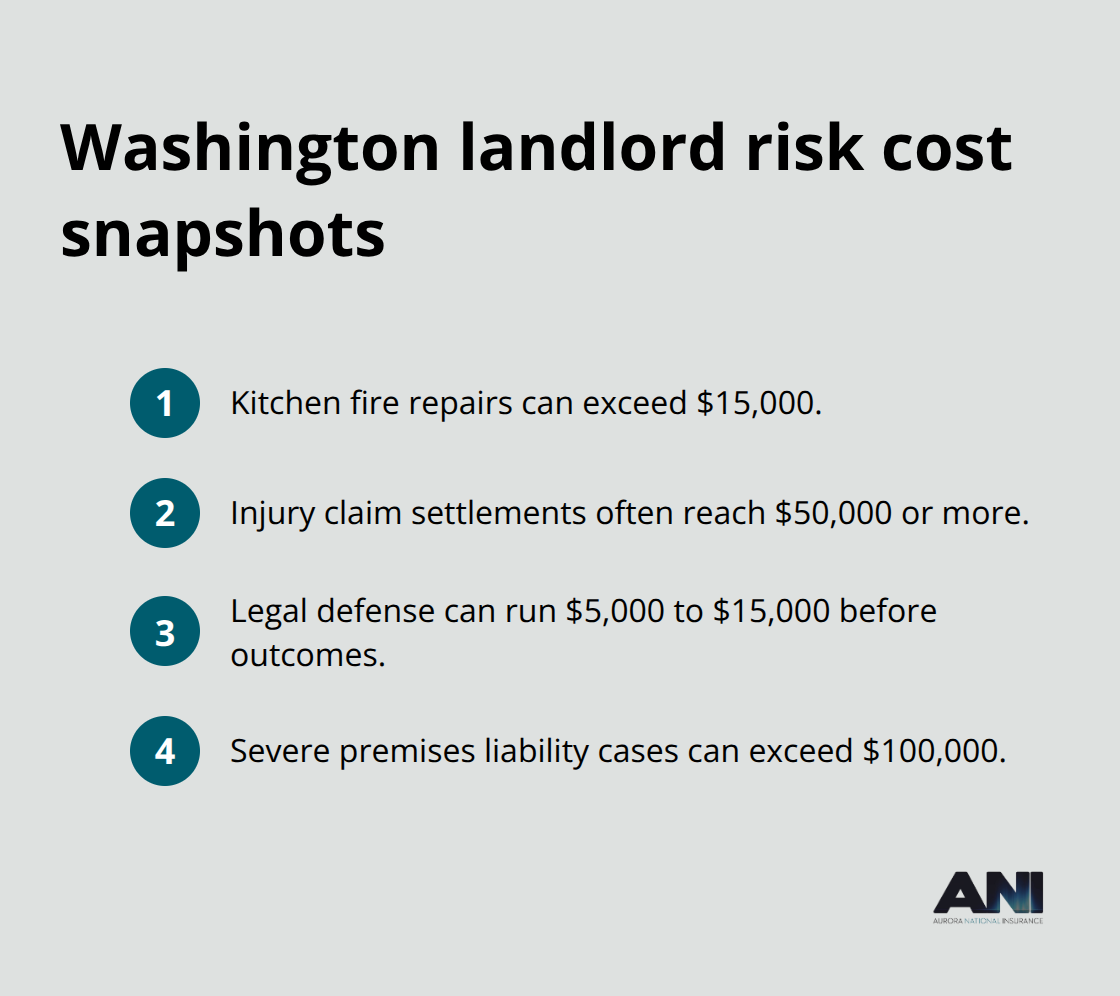
Property damage claims cost Washington landlords far more than most anticipate. A tenant’s cooking fire that spreads to cabinets and countertops can easily exceed $15,000 in repairs. Guest injuries sometimes trigger additional property damage claims when the injured party sues for medical expenses and lost wages simultaneously. Washington courts have awarded significant settlements in premises liability cases, with some exceeding $100,000 when injuries involve permanent disability.
The Washington State Department of Labor and Industries reports that slip-and-fall injuries on rental properties represent a substantial portion of premises liability claims filed annually. These aren’t rare scenarios-they’re predictable costs of operating rental property in Washington.
Bodily Injury Liability Creates Unpredictable Exposure
Bodily injury liability presents the most unpredictable financial exposure for landlords. A guest injured at your property doesn’t just file a claim for medical bills; they pursue compensation for lost wages, pain and suffering, and sometimes punitive damages if negligence is proven. A guest who slips on your stairwell and breaks their leg might file a claim for $50,000 or more, especially if they require surgery and physical therapy. Legal defense alone can cost $5,000 to $15,000 even before a settlement or judgment. Washington’s comparative negligence laws mean you could face partial liability even if the injured party contributed to the accident.
Property Damage During Tenant Disputes
Property damage claims from tenants fighting evictions sometimes include damage they cause intentionally during their final days in the unit-broken windows, damaged flooring, ruined appliances. These disputes escalate quickly because emotions run high and tenants know they’re leaving. Loss of rental income during tenant disputes compounds the financial strain; if eviction proceedings take three to six months, you lose $2,000 to $5,000 monthly on a typical Washington rental. The combination of these three risks (property damage, bodily injury, and legal costs) can exceed your annual rental income in a single incident. Understanding these specific exposures helps you recognize why liability coverage matters for your rental business.
Essential Coverage Types for Washington Landlords
Landlord Liability Insurance Fills the Protection Gap
Landlord liability insurance in Washington operates differently than standard homeowners coverage, and this distinction matters financially. Standard homeowners policies exclude rental properties entirely, leaving you unprotected if a tenant or guest files a claim. Many landlords discover this gap too late-after an incident occurs and their homeowners insurer denies the claim. Landlord liability policies cover bodily injury and property damage claims that arise from your ownership and operation of rental units. A typical Washington landlord policy covers medical expenses for injured guests, legal defense costs if you’re sued, and damages awarded by a court or settlement agreement.
These policies also cover property damage caused by tenants or guests, protecting you from significant losses. Most Washington landlords need coverage limits between $300,000 and $1,000,000 depending on property value and tenant profile. If your rental generates $2,000 monthly income, your policy should cover at least twelve months of lost rent, which means $24,000 in coverage for income protection.
Umbrella Policies Protect Against Catastrophic Claims
Umbrella policies add a critical layer of protection that many Washington landlords overlook until they face a catastrophic claim. Umbrella coverage sits above your landlord liability policy and activates when claims exceed your base policy limits. A guest injured severely enough to require ongoing medical care might pursue damages of $500,000 or more, far exceeding a standard $300,000 policy limit.
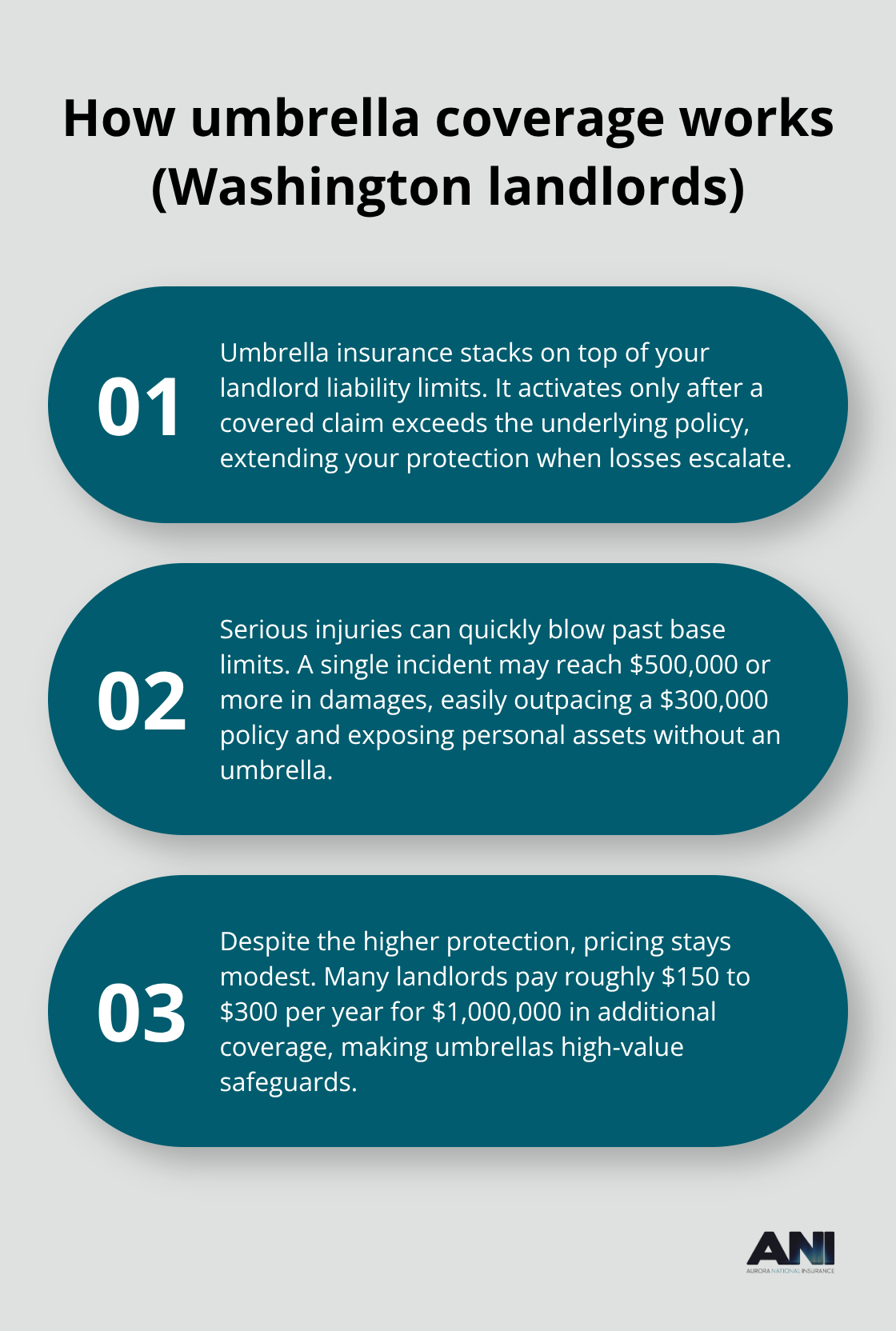
Umbrella policies typically cost $150 to $300 annually for $1,000,000 in additional coverage, making them remarkably affordable relative to the protection they provide.
Loss of Rents Coverage Protects Your Income Stream
Loss of rents coverage protects your income stream when tenant disputes, evictions, or property damage force you to leave units vacant. Washington eviction timelines average sixty to ninety days, meaning three months without rental income on a $2,000-monthly property equals $6,000 in lost revenue. This coverage reimburses you for lost rent during these periods, whether the vacancy stems from an eviction proceeding, necessary repairs after damage, or a legal dispute. Washington landlords operating multiple properties should stack loss of rents coverage across all units, since a single major incident can disrupt income across your entire portfolio.
Comparing Your Options Across Multiple Carriers
Getting quotes from multiple insurers reveals significant price differences for identical coverage. One carrier might charge $600 annually for $500,000 in liability limits while another charges $850 for the same protection. Your property type, location within Washington, tenant profile, and claims history all affect pricing substantially. Independent agents who represent multiple carriers can show you these differences side-by-side, helping you identify the best value for your specific rental situation.
How to Choose the Right Coverage for Your Washington Rentals
Assess Your Property Type and Tenant Profile
Your property type and tenant profile determine which coverage levels actually protect your income. A single-family home rented to a stable, employed tenant carries different risk than a multi-unit building with high tenant turnover and younger occupants. Start by calculating your property’s replacement value-this is what it would cost to rebuild after total loss. If your rental would cost $350,000 to rebuild, your liability limits should reflect exposure at that level.
Properties in Seattle’s higher-cost neighborhoods justify $750,000 to $1,000,000 in coverage, while rural Washington rentals might operate safely with $300,000 to $500,000. Tenant income matters significantly too; renting to professionals with stable employment reduces the likelihood of eviction disputes and intentional damage, potentially justifying lower loss-of-rents coverage. Conversely, properties with frequent tenant turnover demand higher loss-of-rents protection since vacancy periods become predictable expenses rather than rare events.
The Washington Rental Housing Association reports that properties experiencing evictions average sixty to ninety days of vacancy, translating to $2,000 to $5,000 in lost monthly income for typical rentals. Your property location within Washington also affects risk; urban rentals with higher foot traffic from guests and service providers face greater bodily injury exposure than rural properties with limited visitor activity.
Compare Quotes from Multiple Insurers
Getting actual quotes from multiple carriers reveals pricing variations that most landlords underestimate. Request quotes from at least three different insurers using identical coverage limits and deductibles so you can compare apples to apples. One carrier might quote $600 annually for $500,000 in liability limits while another charges $850 for identical protection-that’s a $250 annual difference, or $2,500 over ten years.
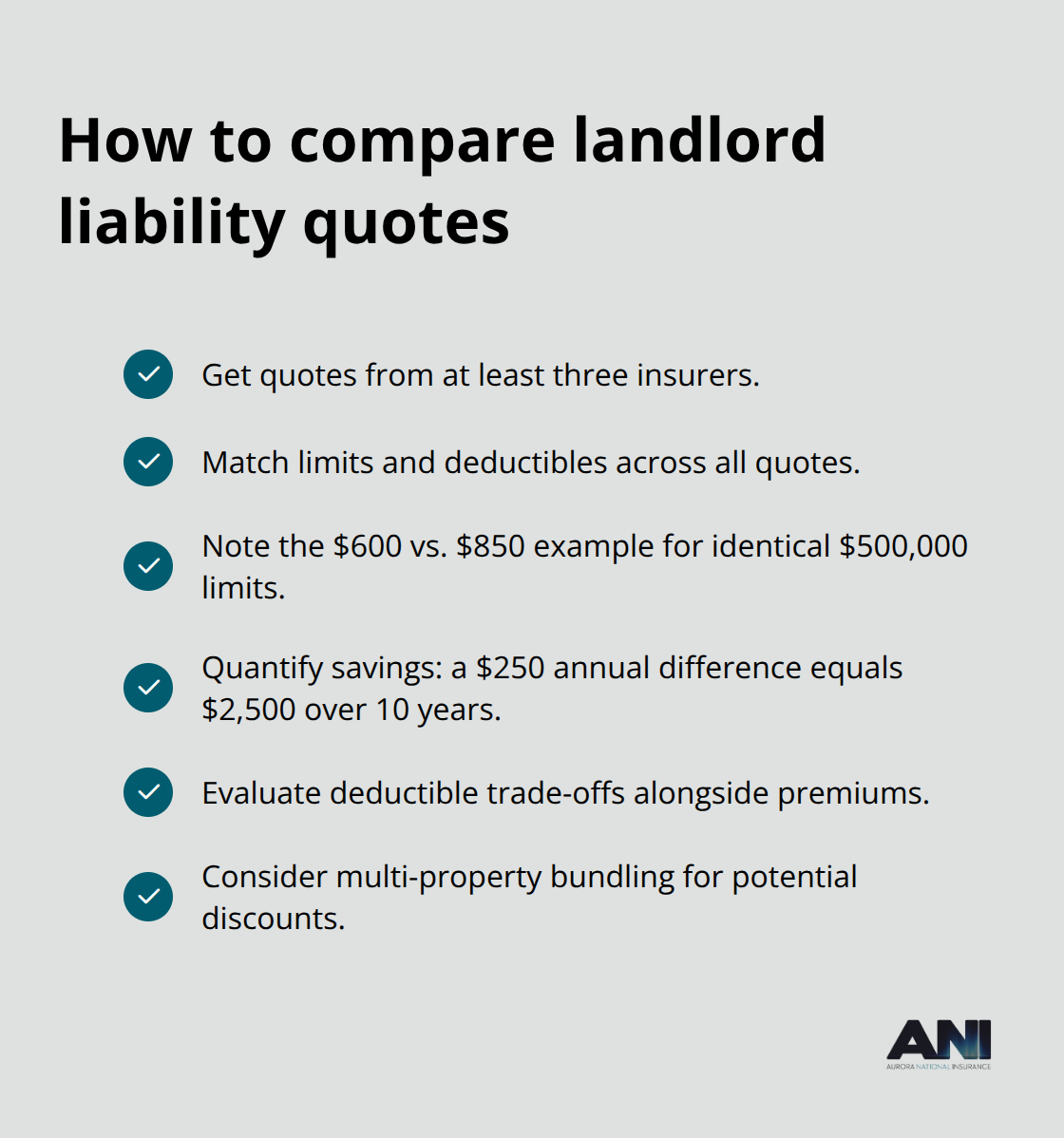
Deductibles significantly impact both your premium and your out-of-pocket costs when claims occur; a $500 deductible costs more than a $2,500 deductible, but you’ll pay $2,500 from your own pocket before coverage activates on each claim. Washington landlords operating three to five properties should calculate total premium costs across all units, not just individual property rates, since bundling coverage sometimes produces meaningful discounts.
Review Policy Limits and Deductibles
When comparing quotes, verify that loss-of-rents coverage extends for the full duration you might need it; some policies cover only thirty days while others extend to ninety days, making a substantial difference if eviction proceedings drag on. Policy limits matter more than premium cost; the cheapest quote means nothing if it leaves you exposed to claims exceeding your coverage.
Licensed agents in Washington can show you side-by-side comparisons that reveal which insurers offer the best protection for your specific rental situation at competitive prices. This approach (comparing multiple carriers simultaneously) saves you time and identifies genuine value rather than just the lowest price available.
Final Thoughts
Washington landlord liability coverage protects your rental income and personal assets from the financial devastation that a single claim can cause. Property damage claims exceed $15,000 regularly, bodily injury settlements often reach $50,000 or more, and legal defense costs drain thousands before any judgment occurs. Standard homeowners policies won’t cover your rentals, umbrella policies provide affordable catastrophic protection, and loss-of-rents coverage compensates you during evictions and repairs.
Your next step is straightforward: obtain quotes from multiple carriers using identical coverage limits so you can see actual price differences. A $250 annual premium difference between insurers compounds to $2,500 over a decade, but the cheapest quote means nothing if it leaves you exposed. Calculate your property’s replacement value, assess your tenant profile, and determine realistic loss-of-rents needs based on Washington’s typical sixty to ninety-day eviction timeline.
We at Aurora National Insurance represent multiple top-rated carriers and deliver side-by-side comparisons tailored to your specific rental situation. Get your Washington landlord liability coverage quote today and stop gambling with your rental investment.
The information provided in this blog is for general informational purposes only and does not constitute legal, financial, or insurance advice. Coverage options, terms, and availability may vary. Please consult with a licensed professional for advice specific to your situation.
Artificial intelligence may have been used to generate text and images in some blog articles.


