

Oregon Commercial Auto Policy: What You Need to Know
Running a business in Oregon means understanding your commercial auto insurance requirements. An Oregon commercial auto policy protects your vehicles, drivers, and finances from unexpected accidents and liability claims.
We at Aurora National Insurance know that choosing the right coverage can feel overwhelming. This guide walks you through the coverage types Oregon requires, how to pick the best policy for your business, and what factors affect your premiums.
Coverage Types Required in Oregon
Oregon requires all commercial vehicle operators to carry liability coverage, which protects you when your vehicle damages someone else’s property or causes bodily injury. The state mandates minimum liability limits of 25/50/20, meaning $25,000 per person, $50,000 per accident for bodily injury, and $20,000 for property damage. These minimums offer bare-bones protection that leaves your business dangerously exposed. Most Oregon business owners operate with higher limits, typically 100/300/100 or 250/500/100, because a single accident can easily exceed state minimums and threaten your company’s assets.
How Liability Limits Connect to Your Business Size
A single claim involving multiple vehicles or serious injuries can cost $200,000 or more in medical bills, lost wages, and legal fees. If you operate a fleet with multiple drivers, the risk compounds significantly. Businesses with five or more vehicles should carry at least 250/500/100 limits, while smaller operations with one or two vehicles should consider 100/300/100 as a practical starting point. Insurance industry data shows that businesses with inadequate coverage face financial hardship after major accidents. The Oregon Department of Consumer and Business Services does not mandate these higher limits, but the financial consequences of underinsurance speak clearly.
Physical Damage Coverage Protects Your Fleet
Physical damage coverage protects your own vehicles from collision, theft, vandalism, and weather events. Collision coverage typically carries a $500 or $1,000 deductible, and you choose the level based on your fleet’s age and replacement costs. A five-year-old commercial truck worth $35,000 makes sense to insure with collision coverage, while an older vehicle worth $5,000 might not justify the premium. Your deductible choice directly affects your monthly payment, so align it with your business’s cash flow and risk tolerance.
Uninsured and Underinsured Motorist Protection Fills Critical Gaps
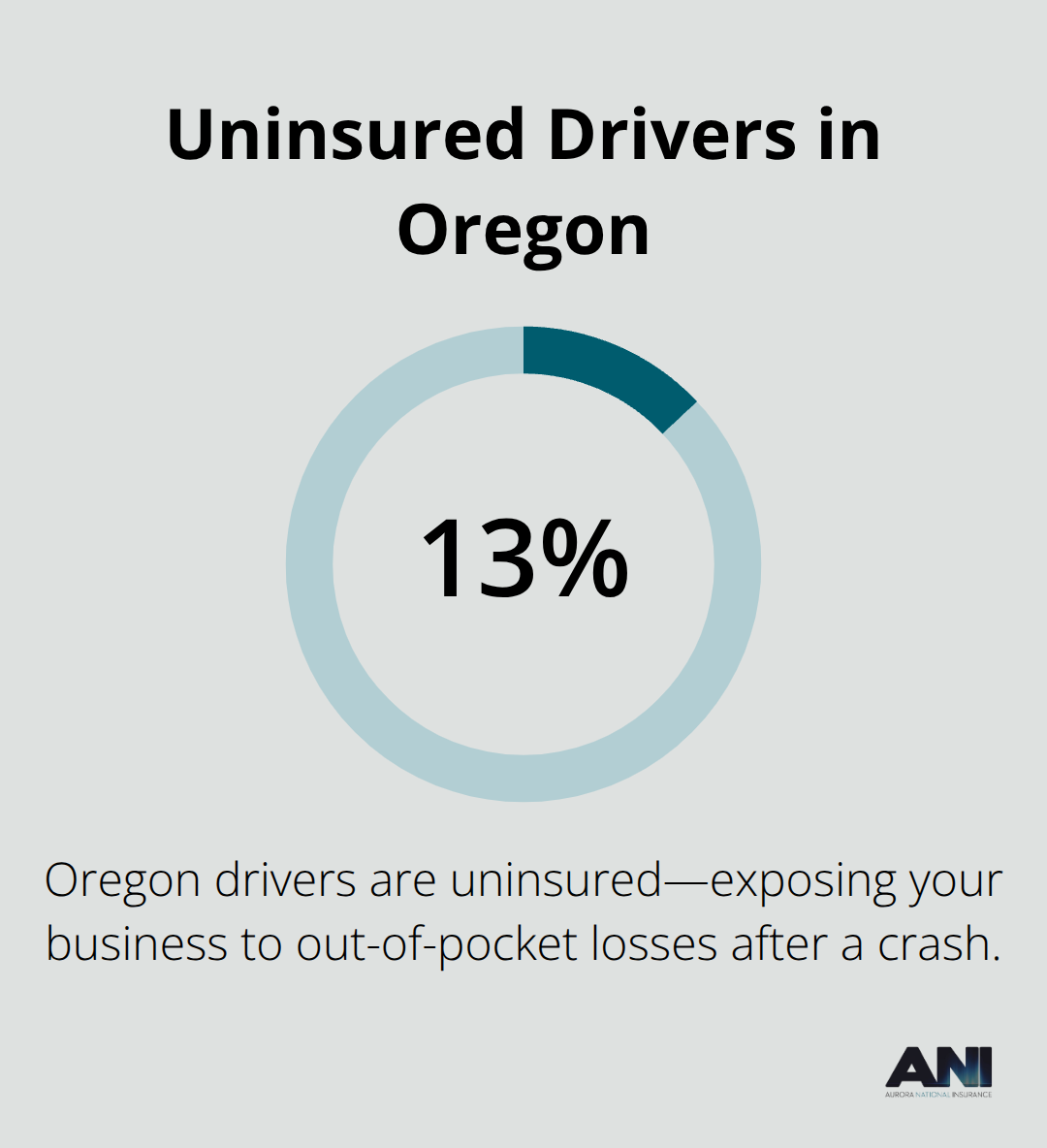
Uninsured motorist coverage protects your drivers when they collide with someone who carries no insurance. Oregon law does not require this coverage for commercial policies, yet roughly 13 percent of Oregon drivers operate uninsured according to insurance industry reports. Underinsured motorist coverage steps in when the at-fault driver’s liability limits fall short of your actual damages. If another driver causes $150,000 in injuries to your employee but carries only the state minimum $25,000 liability coverage, underinsured motorist protection bridges that $125,000 gap. Oregon commercial operators who haul goods across state lines or operate in high-traffic urban areas face elevated exposure to uninsured drivers and should treat this coverage as mandatory rather than optional.
Next Steps in Selecting Your Coverage
Your coverage choices depend on your specific business operations, fleet size, and risk profile. The next section walks you through how to assess your business needs and compare policies to find the right fit for your operation.
How to Select Coverage That Matches Your Operation
Assess Your Fleet and Business Risks
Selecting the right commercial auto policy requires you to understand exactly what your business does and the specific risks your vehicles face. A plumbing contractor operating one service van faces entirely different exposures than a delivery fleet managing 20 vehicles across Portland and Eugene. Start by documenting your fleet size, the types of vehicles you operate, annual mileage per vehicle, and whether your drivers transport cargo, passengers, or equipment. If you haul hazardous materials or operate tractor-trailers, your coverage needs shift dramatically compared to local service calls.
The Oregon Department of Consumer and Business Services does not provide a one-size-fits-all checklist, so you must build your own baseline. List each vehicle, its value, its primary use, and the driver assigned to it. This inventory becomes your foundation for comparing quotes and identifying coverage gaps.
Calculate Your Financial Exposure
Next, calculate your potential financial exposure by considering what a serious accident could cost your business. A driver causes a multi-vehicle collision injuring three people-medical costs, lost wages, and legal defense could easily reach $300,000 to $500,000. A single claim at that level would devastate most small to mid-sized operations, yet many business owners still purchase state-minimum coverage because they underestimate this risk.
Compare your current assets, annual revenue, and cash reserves against potential claim costs. Businesses generating $500,000 annually should carry coverage limits that match their actual needs rather than the bare 25/50/20 minimum, because a major accident could wipe out years of profit and threaten your ability to operate.
Compare Quotes Across Multiple Carriers
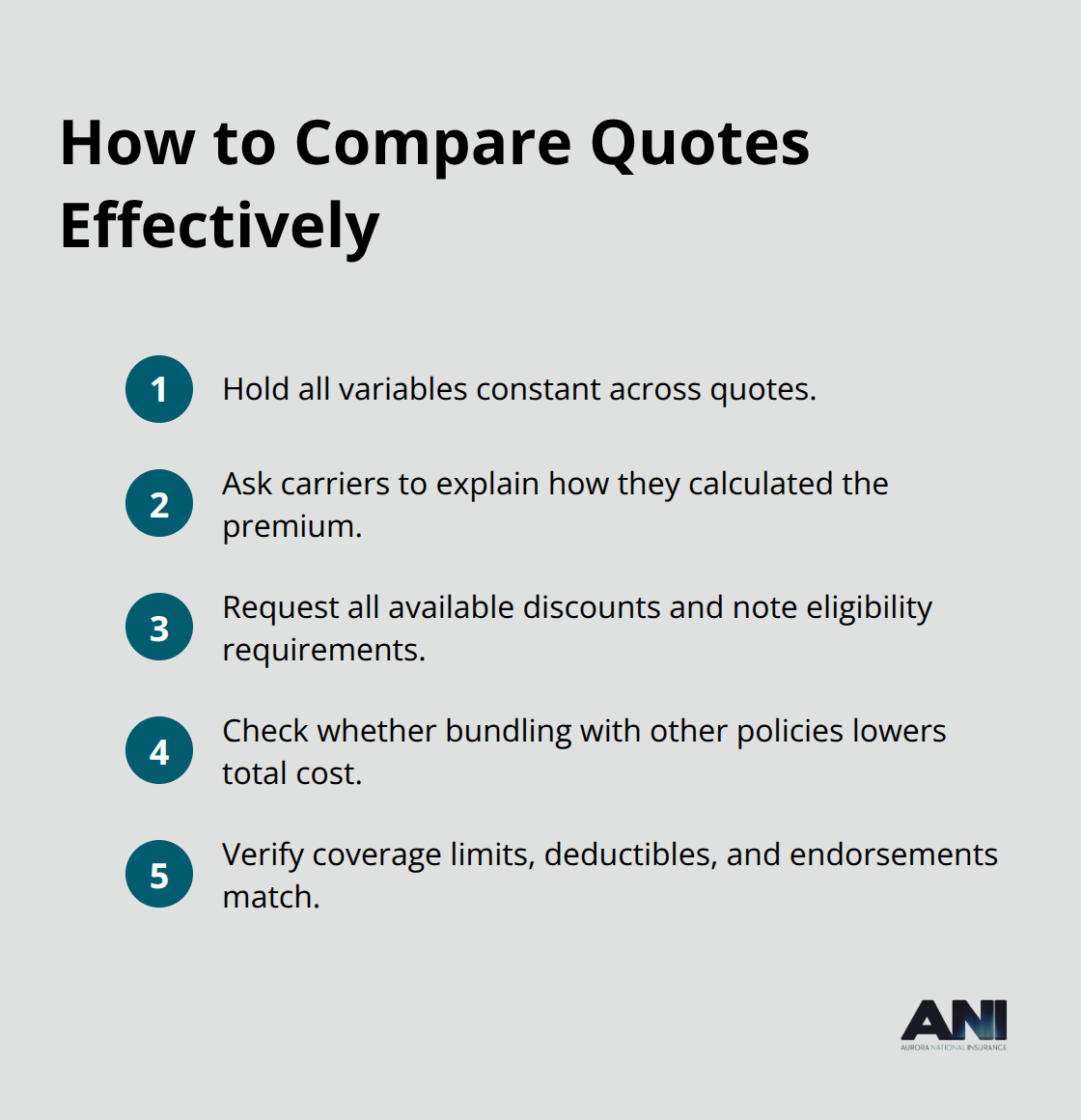
Once you understand your exposure, compare actual quotes from multiple carriers rather than assuming prices differ only slightly between insurers. Premium differences of 20 to 40 percent are common across carriers for identical coverage and business profiles, according to insurance industry data. Obtain quotes that hold all variables constant-same vehicles, same deductibles, same liability limits-so you can identify which carrier genuinely offers better value.
When you receive quotes, ask each carrier to explain how they calculated the premium, what discounts apply to your situation, and whether bundling commercial auto with general liability or property coverage reduces your total cost. Many insurers offer 5 to 15 percent discounts for safety features, driver training programs, or claims-free histories, but you must ask explicitly because these discounts rarely appear automatically.
Make Your Final Selection
Avoid selecting coverage based on price alone; a carrier charging 30 percent less might have slower claims processing or lower customer satisfaction ratings that create headaches when you need them most. As an independent agency licensed in Oregon, we work with multiple top-rated carriers, which allows us to compare options and find coverage that aligns with your specific operation and budget.
Your coverage choices now set the stage for understanding the costs behind your policy. The next section examines the specific factors that insurers use to calculate your premium and how your business profile directly affects what you pay each month.
What Drives Your Commercial Auto Premium
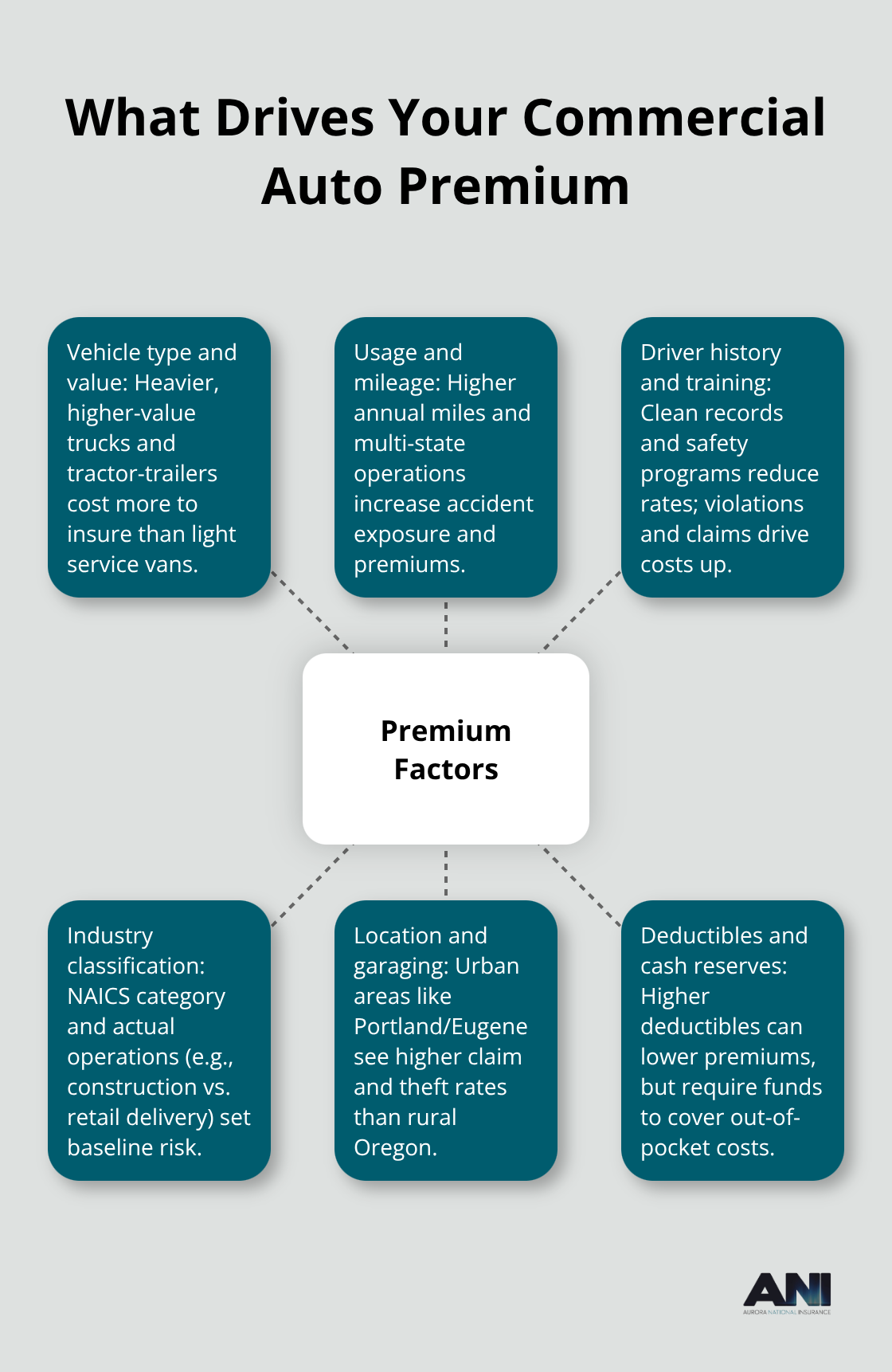
Your premium reflects the specific risk your business and vehicles represent to an insurer. Vehicle type matters enormously-a delivery van worth $30,000 costs less to insure than a commercial truck worth $80,000, and a tractor-trailer hauling freight across state lines carries substantially higher premiums than a local service vehicle. Usage patterns compound this effect significantly.
How Vehicle Type and Usage Affect Your Cost
A plumbing contractor driving 8,000 miles annually within Portland faces lower premiums than the same vehicle driven 40,000 miles across Oregon and Washington, because more time on the road increases accident probability. Insurers track annual mileage closely, and misrepresenting your actual usage can trigger policy cancellation or claim denial. Commercial vehicles used for passenger transport or hazmat hauling face premiums 30 to 50 percent higher than standard delivery or service vehicles because the liability exposure multiplies substantially.
Driver History Sets Your Rate Foundation
Your driver roster determines premium cost just as much as your vehicles do. A 55-year-old driver with twenty years of clean driving history costs significantly less to insure than a 25-year-old with two accidents and a speeding ticket within the past three years. Insurers assess each driver individually, so adding a new driver with poor history can increase your overall premium by 15 to 25 percent across your entire fleet.
Driver training programs and safety certifications reduce premiums, which means investing in ongoing driver education pays tangible financial returns. Your claims history follows your business for three to five years, so a major accident today affects your premiums for years to come. A business with zero claims over five years typically qualifies for preferred rates 10 to 20 percent lower than a business with one serious claim, according to insurance underwriting standards.
Industry Classification and Location Impact Rates
Your industry classification sits at the foundation of your premium calculation because some business types inherently carry higher risk. Construction contractors operating multiple vehicles face steeper premiums than retail delivery services operating similar vehicles, because construction sites present greater accident exposure. Restaurants with delivery fleets pay more than courier services with identical vehicle counts because delivery distances and traffic patterns differ.
The North American Industry Classification System (NAICS code) determines your industry category, and insurers apply different rate tables based on your classification. If your business operates across multiple categories-say, you deliver products but also haul equipment to job sites-you must disclose both activities to your insurer, because incomplete information leads to inadequate coverage and potential claim denial.
Location matters too; operating primarily in rural Oregon costs less than operating in Portland or Eugene because urban areas experience higher accident frequencies and theft rates. Your choice of deductible directly controls your monthly payment-raising your deductible from $500 to $1,500 typically reduces your premium by 10 to 15 percent, though you must maintain sufficient cash reserves to cover that deductible when accidents occur.
Final Thoughts
Oregon commercial auto policy decisions directly impact your business’s financial security and operational continuity. State minimum liability limits of 25/50/20 leave most Oregon businesses dangerously exposed, while higher limits of 100/300/100 or 250/500/100 provide realistic protection against the actual costs of modern accidents. Physical damage coverage protects your fleet investment, and uninsured motorist protection fills gaps created by the roughly 13 percent of Oregon drivers operating without insurance.
Your next step involves obtaining quotes from multiple carriers that hold all variables constant so you can identify genuine value rather than assuming prices differ only marginally. Premium differences of 20 to 40 percent across carriers are common, which means shopping around directly affects your bottom line. When you request quotes, ask each carrier to explain their calculation method, identify available discounts for safety features or claims-free histories, and clarify whether bundling commercial auto with other business coverage reduces your total cost.
A local insurance professional who understands Oregon’s specific requirements and your industry’s unique risks accelerates this process and prevents costly coverage gaps. Aurora National Insurance represents multiple top-rated carriers and delivers tailored comparisons with expert consultation to help you find the right protection at competitive prices. Your Oregon commercial auto policy protects more than vehicles-it protects your employees, your customers, and your company’s future.
The information provided in this blog is for general informational purposes only and does not constitute legal, financial, or insurance advice. Coverage options, terms, and availability may vary. Please consult with a licensed professional for advice specific to your situation.
Artificial intelligence may have been used to generate text and images in some blog articles.


