
Washington Rental Property Insurance: Local Solutions for Property Owners

Owning rental property in Washington comes with real financial exposure. Tenant injuries, property damage, and lost rental income can drain your savings fast.

Standard homeowners policies leave you vulnerable in these exact situations. At Aurora National Insurance, we’ve helped countless Washington property owners protect their investments with coverage designed specifically for rental properties.

Why Rental Property Insurance Protects Your Bottom Line

Liability Claims Can Devastate Your Finances

Liability claims from tenant injuries alone can cost $50,000 to $300,000 depending on severity, and standard homeowners policies explicitly exclude rental properties. A tenant who slips on your stairs, gets injured by a defective appliance, or claims discrimination can file a lawsuit that decimates your equity if you lack proper coverage. Most landlords across Washington assume their homeowners policy covers rental units-it does not. Rental property insurance provides the liability protection you need, typically starting at $500,000 in coverage for single-family rentals and scaling up for multifamily buildings.

Property Damage Happens More Often Than You Think

Property damage occurs constantly in rental units. Tenants cause damage through negligence or intentional acts, pipes freeze and burst during winter, and wind or hail from Pacific storms damage roofs and siding. A single burst pipe can cost $3,000 to $25,000 in repairs, and if the damage makes the unit uninhabitable, you lose rental income immediately. Standard homeowners policies will not pay for any of this because the property is occupied by tenants, not you.

Lost Rental Income Drains Cash Flow Fast

Loss of rental income is the financial killer most landlords underestimate. If a fire or major weather event forces repairs lasting three to six months, your mortgage, property taxes, and maintenance costs continue while rent stops coming in. In dense markets like Seattle, a six-month vacancy translates to over $13,000 in lost gross revenue on a modest two-bedroom rental. Rental property insurance includes loss-of-income coverage that replaces your actual rental income while repairs happen, preserving your cash flow when you need it most.

Washington’s Climate Creates Unique Risks

Western Washington experiences heavy rainfall and windstorms that damage roofs and gutters, while eastern Washington faces wildfire exposure that increases annually. The Cascadia subduction zone creates a 14 percent chance of a magnitude-7 earthquake within the next 50 years, another threat standard policies do not address. So ensure you add earthquake coverage in Washington. Understanding these regional hazards helps you select the right coverage limits and endorsements for your specific situation.

What Homeowners Policies Actually Exclude

Your Homeowners Policy Stops Working the Moment You Rent

Your homeowners policy was written to protect owner-occupied residences, not rental investments. The moment a tenant signs a lease, your standard homeowners coverage becomes invalid for that property. Insurance companies treat rental properties as commercial ventures with higher risk profiles than owner-occupied homes. A tenant injury, stolen appliance, or months of vacancy create exposures that homeowners underwriting never contemplated. Washington property owners who discover this gap only after a loss occurs face complete financial exposure-and by then it is too late.

Liability Coverage Vanishes for Tenant Injuries

The liability section of your homeowners policy explicitly excludes injuries to people who rent your property. If a tenant falls on your deck, gets hurt by a malfunctioning heater, or claims the property caused illness, your homeowners insurer will deny the claim outright. Courts in Washington have upheld these exclusions repeatedly because the policy language is clear: coverage applies only to owner-occupied dwellings. A single tenant injury lawsuit can result in significant legal and settlement costs, and that money comes directly from your pocket without insurance protection. Rental property insurance provides liability coverage for single-family rentals, with multifamily buildings requiring higher limits depending on unit count and local risk factors.

Lost Rental Income Receives Zero Protection

Your homeowners policy ignores lost rental income entirely, treating the property as a structure rather than an income-producing asset. When a fire, severe weather, or pipe burst makes a unit uninhabitable, your mortgage and property taxes keep coming due while tenant rent stops arriving. Landlords face substantial financial pressure during extended vacancies, yet homeowners policies offer zero reimbursement for this income gap. Rental property insurance includes loss-of-income coverage that replaces your actual rental revenue while repairs happen, typically covering 12 to 24 months of lost rent depending on the policy. This protection preserves your cash flow during the restoration period and prevents you from tapping savings or taking loans to cover fixed expenses.

Tenant-Caused Damage Falls Outside Standard Coverage

Damage from tenant actions-deliberate vandalism, negligent water leaks, or theft-falls outside homeowners coverage because the policy assumes you occupy the property and control its use. Tenants damage rental units far more frequently than owner-occupants damage their own homes, making this exclusion substantial. A single burst pipe costs $3,000 to $25,000 in repairs, and if the damage makes the unit uninhabitable, you lose rental income immediately. Standard homeowners policies will not pay for any of this because the property is occupied by tenants, not you. Rental property insurance covers these exact scenarios-the three areas where rental claims occur most often (liability, income loss, and tenant-caused damage).
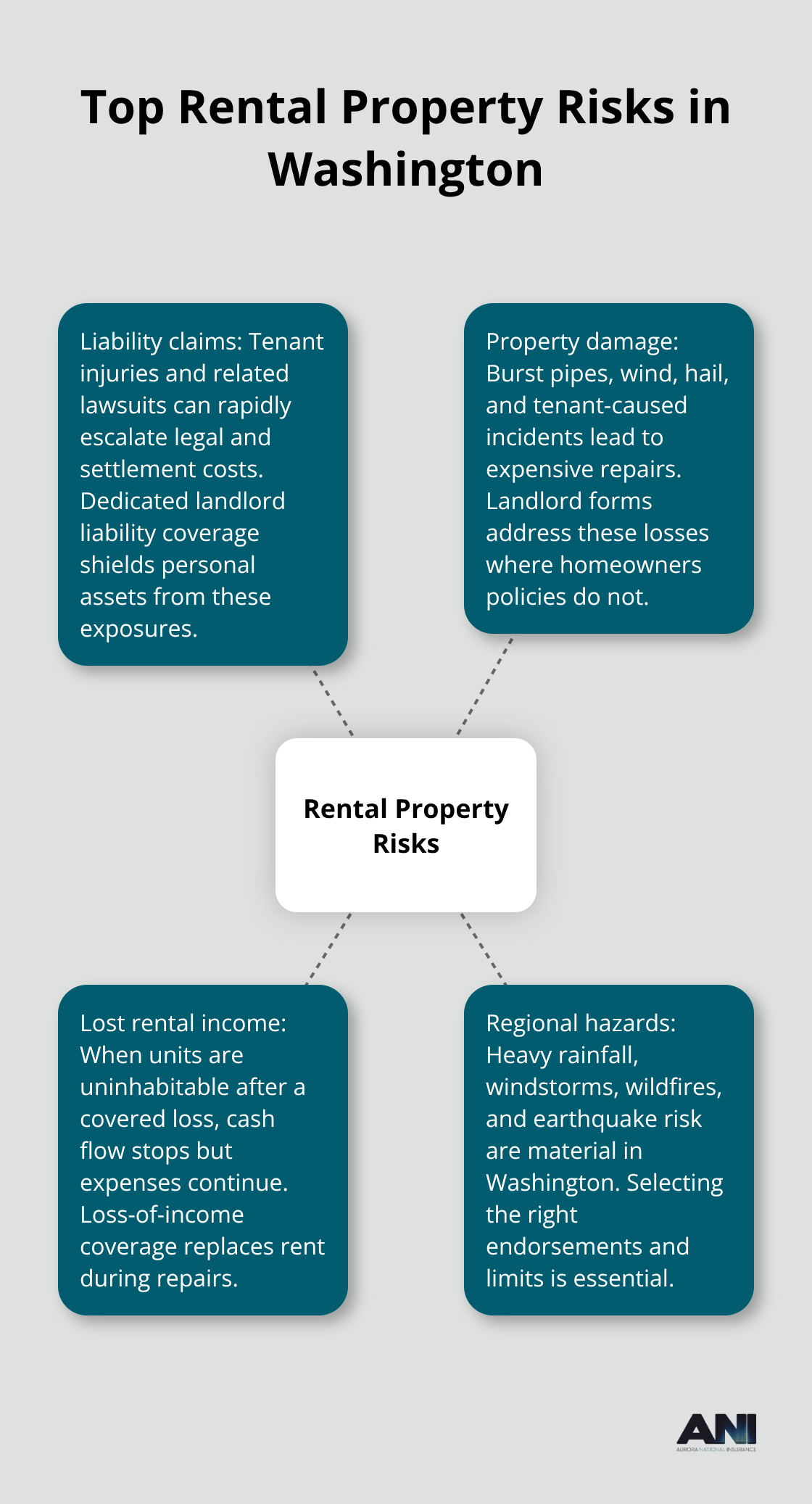
Diagram showing key rental property risk categories for Washington landlords

Understanding Your Coverage Gap Matters Now

Washington property owners who rely on homeowners policies for rental units face complete financial exposure. The exclusions are not ambiguous or subject to interpretation; they are explicit and enforceable. Your next step involves selecting the right rental property insurance form and coverage limits that match your specific property type and local risk exposure.

How to Pick the Right Policy for Your Washington Rental

Start With Your Property Details

Your property specifics determine coverage needs because a single-family home in Spokane requires different protection than a four-unit building in Seattle. Document the dwelling’s age, construction type, roof condition, and replacement cost before requesting quotes. Properties with roofs older than ten years almost always need DP-3 coverage instead of DP-1 or DP-2 because DP-3 provides open-perils protection with customizable endorsements that match aging structures. Calculate your actual replacement cost by researching local construction expenses; the Associated General Contractors of Washington reported construction costs grew about 16 percent from 2020 to 2023, meaning your repair estimates from three years ago are now substantially outdated.

Assess Your Specific Hazard Exposure

Eastern Washington property owners face wildfire risk that increased 45 percent in acreage burned between 2017 and 2022, requiring smoke damage coverage that extends beyond on-premises events. Western Washington landlords encounter heavy rainfall and Cascadia earthquake risk that demands loss-of-income protection lasting at least six months and serious consideration of standalone earthquake coverage. The United States Geological Survey estimates a 14 percent chance of magnitude-7 earthquakes in the next 50 years, and earthquake damage runs $50,000 to $150,000+ per unit, making this exposure impossible to ignore.
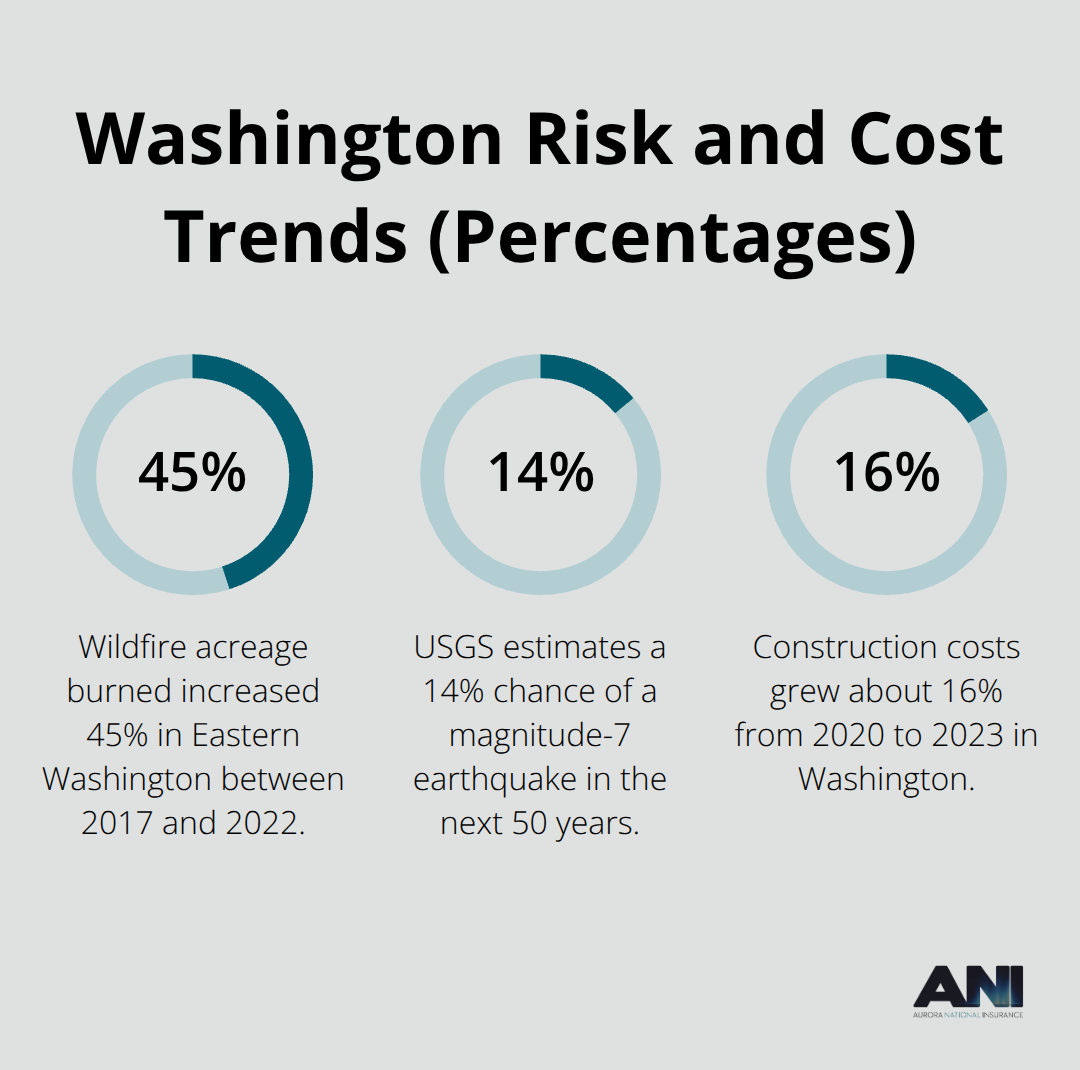
Chart of explicit percentage statistics affecting Washington rental properties - Washington rental property insurance

Set Your Deductible Strategy

Calculate your maximum acceptable out-of-pocket loss before a claim occurs; if you cannot absorb $5,000 in repairs yourself, you need lower deductibles even if premiums cost more. Conversely, if you maintain substantial reserves, raising your deductible from $1,000 to $2,500 yields roughly 12 percent premium savings.

Obtain Multiple Quotes and Compare Carefully

Obtain at least three quotes from different carriers because premium variations for identical coverage often exceed 30 percent. Provide each insurer with identical property information including square footage, year built, number of units, roof age, and loss history to ensure apples-to-apples comparisons. Request explicit coverage details for water damage, vandalism, theft, and loss of rent duration since these vary significantly between DP-1, DP-2, and DP-3 forms. Ask specifically about exclusions for cannabis cultivation, short-term rentals like Airbnb properties, and vacant units because Washington’s legal environment creates coverage gaps that standard policies do not address.

Work With Independent Agents Licensed in Washington

Verify that liability limits match your property type; single-family rentals typically need $500,000 minimum, while multifamily buildings with four or more units require $1,000,000 or higher depending on tenant density and local lawsuit frequency. Consider adding umbrella coverage of $1,000,000 or more for multifamily properties because a single serious injury claim can exhaust standard liability limits quickly. Work exclusively with independent agents licensed in Washington who represent multiple carriers rather than captive agents working for single insurers. Independent agents shop your property across numerous companies simultaneously, identifying discounts for security systems, seismic shut-off valves, monitored alarms, and sprinkler systems that can reduce premiums by 5 to 12 percent. Some Washington counties offer up to 20 percent credits for sprinkler systems in multifamily buildings, savings that captive agents often miss entirely. Avoid online quote tools that lack human review because they frequently misclassify properties or miss endorsements critical for Washington’s unique risks. Your agent should explain exactly why DP-3 costs more than DP-2 and whether that additional expense justifies the broader protection for your specific property and financial situation.

Final Thoughts

Washington rental property insurance protects your income stream and equity when tenant injuries, property damage, or weather events strike. Standard homeowners policies leave you completely exposed in these situations, forcing you to cover liability claims, repairs, and lost rent from your own pocket. A single tenant injury lawsuit costs $50,000 to $300,000, a burst pipe runs $3,000 to $25,000 in repairs, and a six-month vacancy in Seattle eliminates over $13,000 in gross revenue-these scenarios happen regularly across Washington’s rental market.

Document your property details including age, construction type, roof condition, and replacement cost before requesting quotes. Assess your specific hazard exposure based on location: eastern Washington properties need wildfire coverage, western Washington rentals require earthquake consideration, and all Washington landlords should plan for loss-of-income protection lasting at least six months. Calculate your maximum acceptable deductible based on your financial reserves, then obtain at least three quotes from different carriers using identical property information to ensure accurate comparisons.
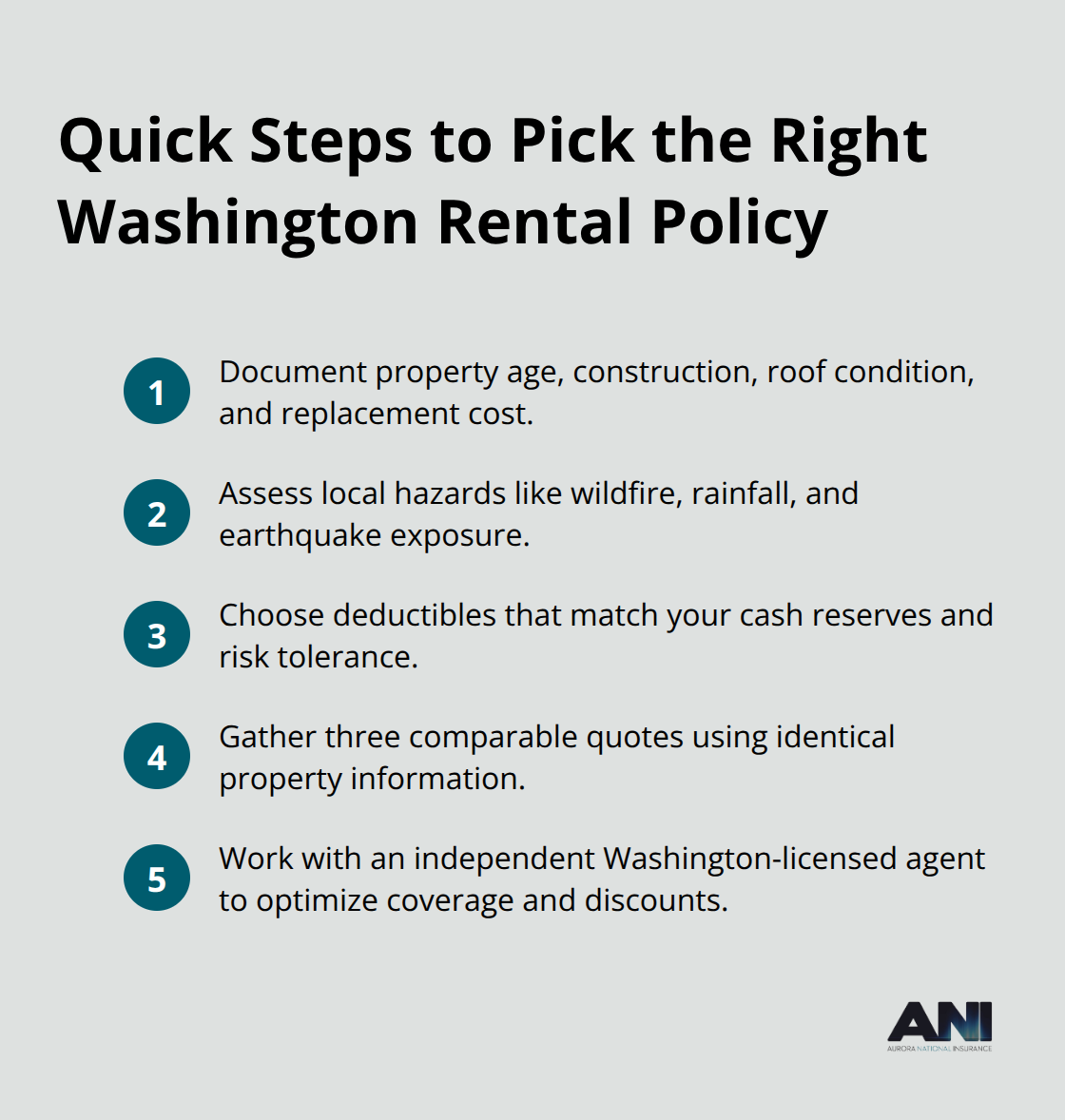
Compact checklist of steps for selecting landlord insurance in Washington - Washington rental property insurance

Work with independent agents licensed in Washington like Aurora National Insurance who represent multiple carriers rather than single insurers. These agents shop your property across numerous companies, identify discounts for security systems and monitored alarms that reduce premiums by 5 to 12 percent, and explain exactly why DP-3 coverage costs more than DP-2 and whether that expense justifies broader protection for your situation. Get started today with an instant online quote and take control of your rental investment’s financial security.

The information provided in this blog is for general informational purposes only and does not constitute legal, financial, or insurance advice. Coverage options, terms, and availability may vary. Please consult with a licensed professional for advice specific to your situation.
Artificial intelligence may have been used to generate text and images in some blog articles.


Master These 5 Habits Every Time You Enter Your Vehicle for to be a Safer Driver

Distracted driving has become a major concern, with thousands of injuries and fatalities reported each year. Not only does it pose a significant risk to ourselves and others on the road, but it has also led to skyrocketing insurance premiums and an increase in traffic accidents.


It’s crucial to understand that distracted driving goes beyond just texting or talking on the phone – it includes any activity that diverts your attention from the road, such as reading articles, eating, or grooming. To promote safe driving behavior, here are five habits you should master every time you get behind the wheel:

  1. Keep Your Phone Out of Reach: Make a conscious effort to put your phone out of reach when you enter your vehicle. Consider placing it in the back seat, your bag, or even the trunk. If you find it difficult to do so, constantly remind yourself, “Can it wait?” Most likely, the answer is yes. You can also put your phone on mute to avoid the temptation of reaching for it when it notifies you of incoming calls or messages. If you feel the need to be readily available, pull over and park your car before answering any calls.
  2. Set Up Your GPS Before Driving: Take the time to program your GPS or identify your destination before you start driving. Activate voice commands so that you can keep your eyes focused on the road at all times. This will help prevent distractions caused by trying to input directions while driving.
  3. Groom Before or After, Not While Driving: If you often find yourself running late and grooming on the go, it’s essential to break this habit. Instead, make it a practice to groom yourself once you have reached your destination or before you start your vehicle. This way, you can concentrate solely on driving and reduce the risk of accidents.
  4. Eat While Parked: Avoid the temptation of eating while driving. Instead, take a few minutes to park your car and enjoy your meal safely. This simple step can significantly reduce distractions and ensure that your focus remains on the road.
  5. Be a Role Model for Others: Lead by example when it comes to safe driving habits. Show your children how to avoid distractions while driving and explain the dangers associated with it. If you notice a friend or family member using an electronic device while driving, speak up and offer to assist them. You can offer to deliver their text messages, act as the co-pilot, or make necessary phone calls.

By adopting these safe driving habits, we can all contribute to a safer road environment. Remember, it’s not only about our own well-being but also the safety of those around us. Let’s strive to make a positive impact and promote responsible and focused driving for everyone’s benefit.

Essential Guide to Protecting Your Jewelry: Everything You Need to Know

Jewelry holds not only aesthetic value but also sentimental significance. Whether it symbolizes decades of marriage, has been passed down through generations, or commemorates a special occasion, its worth goes beyond monetary value. With this in mind, our local insurance agency aims to ensure that you have comprehensive protection for your precious pieces.


While the memories associated with your jewelry are irreplaceable, a robust insurance policy can offer financial security in the face of unforeseen events. Whether your jewelry is stolen, damaged, or lost during a leisurely swim in the ocean, insurance coverage can help ease the burden.

If you own jewelry valued at over $1,000, it’s advisable to consider obtaining an insurance policy endorsement specifically tailored to its worth. This endorsement can be seamlessly added to your existing home or renters insurance policy through what is known as a “floater,” an extension that provides coverage for valuables. A reliable policy will safeguard against theft and damage. The cost of coverage may vary but typically ranges from $1 to $2 per $100 in value annually. For instance, insuring a $5,000 ring could cost you approximately $50 to $100 per year. By contacting our agency, we will diligently assist you in finding the optimal coverage for your jewelry and address any concerns you may have regarding hypothetical scenarios.

To ensure a thorough understanding of your insurance coverage, we encourage you to discuss the following questions with our agents:

  1. If your jewelry is stolen, will you be reimbursed for the full amount you initially paid? What if it is accidentally lost?
  2. If the value of your jewelry appreciates over time, will your insurance company honor its new value or only the purchase price?
  3. What happens if a small piece of your jewelry is lost? Will your insurance cover the cost of replacing the stone?
  4. Don’t forget to inquire about available discounts! Some insurance companies offer reduced premiums if you securely store your jewelry when not in use.

While we hope that you never encounter a situation requiring an insurance claim for your jewelry, it is crucial to be prepared. In the unfortunate event of loss or theft, gather the following items:

  1. Original receipt
  2. Appraisal document (if the original receipt is unavailable)
  3. Gemological Institute of America (GIA) certificate or a similarly reputable certification
  4. Photographs of all your jewelry items stored either on the cloud or a secure zip drive placed in your safe

Keep these essential items in a safety deposit box or a secure safe within your home. For more information on insuring your jewelry, do not hesitate to contact an agent at our office. We are dedicated to offering you the best insurance options for your precious pieces and addressing any further inquiries you may have.

The Importance of Having an Umbrella Insurance Policy

Protecting oneself from major claims or lawsuits and protecting assets and earnings is a priority for anyone. This is where an umbrella insurance policy comes into play, providing an additional layer of coverage that goes beyond traditional policies. By insuring your future, you can protect your home, cash savings, and future earnings from unforeseen circumstances.


But when would you actually need to utilize your umbrella insurance policy? The answer lies in situations where your existing auto, home, or personal insurance policy reaches its limit in covering a claim. Let’s consider an example: You are involved in a car accident where you are deemed at fault. Your insurance policy provides coverage of up to $250,000 for third-party damages. However, the total cost of medical attention and car repairs for the other individuals involved amounts to $350,000.

In this scenario, you would be responsible for the remaining $100,000. If you have an umbrella insurance policy, it would step in to cover this excess liability. However, without such a policy, the burden of paying the remaining balance would fall on your shoulders. In some cases, if you are unable to afford the amount owed, a court may even order the garnishment of your future wages.

Similarly, homeowners also need protection against liability claims. Whether it’s a situation where you host a party and serve alcohol, someone has a slip and fall accident on your property, or your dog bites a neighbor, you can be held liable for medical bills, rehabilitation programs, and lost wages.

By purchasing an umbrella policy, you can ensure coverage in various areas, including bodily injury, property damage, other damages (such as libel and slander), and legal fees. One of the advantages of having an umbrella policy is that it helps cover the cost of hiring an attorney, which can be quite expensive.

There are countless situations that can occur and surpass the liability limits of your existing home or auto insurance policy. The good news is that umbrella insurance policies are relatively affordable, with prices typically starting around $155 per year. To determine the appropriate coverage for your needs, it’s recommended to contact an agent at our office. We can provide you with a personalized umbrella insurance quote tailored to your specific circumstances.

In conclusion, having an umbrella insurance policy is an essential component of a comprehensive insurance strategy. It provides peace of mind, protects your assets, and ensures that you are prepared for any unforeseen events that may arise. Don’t wait until it’s too late. Invest in an umbrella insurance policy today and secure your financial well-being for the future.

I’m Considered a High-Risk Driver – What Can I Do to Change That?

If you’re in the market for a new auto insurance policy and the company or agent informs you that you’re considered a “high-risk” driver, you might be wondering what that means exactly and what steps you can take to improve your situation. While there isn’t a clear-cut definition of a high-risk driver, individuals in this category typically fall into one or more of the following categories:


  1. Too Many Speeding Tickets or Moving Violations: If you have a history of frequent speeding tickets or other moving violations, insurance companies may label you as high risk.
  2. Accidents on Your CLUE Report: If your CLUE (Comprehensive Loss Underwriting Exchange) report shows a record of accidents, especially at-fault accidents, it raises red flags for insurance companies.
  3. Suspended Driver’s License: Having a suspended or revoked driver’s license indicates a lack of responsibility and can deem you high risk in the eyes of insurance providers.
  4. DUI/DWI or Major Violations: Offenses such as driving under the influence (DUI) or driving while intoxicated (DWI), as well as reckless driving, are considered serious violations and can result in high-risk driver classification.
  5. Excessive Speed Violation: Being caught driving at excessively high speeds, particularly if it leads to citations or other consequences, can contribute to your high-risk status.
  6. Fatal Accident History: Involvement in a fatal accident, regardless of fault, raises concerns for insurance companies and may categorize you as a high-risk driver.

Even if you don’t fit the specific criteria listed above, you may still face higher-than-normal insurance premiums due to factors such as:

  1. Credit History: Insurance companies often consider your credit history when determining premiums. Poor credit can result in higher rates.
  2. Age: Being a new driver or an elderly driver can be seen as higher risk due to limited experience or potential health-related issues.
  3. Exotic or Sports Car: Owning a high-performance or exotic vehicle can also lead to higher insurance premiums, as these cars are typically more expensive to repair or replace.
  4. Lapse in Insurance Coverage: If you have a history of gaps in your insurance coverage, insurers may view you as unreliable and charge higher premiums.

Being classified as a high-risk driver does mean that you’ll face higher insurance premiums, and some insurance companies may even refuse to insure you or limit the coverage options available to you. However, the good news is that you can work on improving your high-risk status over time by focusing on cleaning up your driving habits. By maintaining a clean driving record, avoiding traffic violations, and demonstrating responsible behavior on the road, you can gradually regain your status as a preferred driver. This will eventually lead to better insurance premiums and a wider range of coverage options.

It’s important to note that improving your high-risk status won’t happen overnight. It requires consistent effort and adherence to safe driving practices. Additionally, seeking guidance from insurance professionals who specialize in high-risk drivers can provide valuable insights and assistance in finding suitable coverage options tailored to your needs. With dedication and time, you can positively impact your driving record and enjoy more affordable insurance rates in the future.

Renters Insurance: Protecting Your Personal Property and Liability

As a local insurance agency, we strive to provide answers to all your insurance queries. When it comes to renters insurance, there’s a common misconception that your landlord’s insurance policy will cover any unfortunate incidents that may occur while renting an apartment, home, or condo.
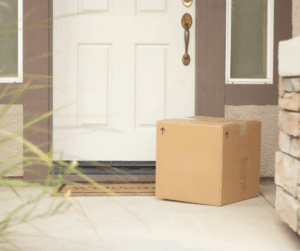
While your landlord’s insurance typically protects the property itself, it does not extend coverage to your personal belongings or liability. For example, if you experience water damage due to a burst pipe from your neighbor’s unit, resulting in damage to your personal property, you would not be covered under your landlord’s policy.

Renters insurance is designed to address these gaps in coverage and offers protection in the following areas:

  1. Personal Property: Renters insurance safeguards your belongings, such as clothing, furniture, electronics, bicycles, and jewelry, against theft, fire, smoke, or water damage. It’s important to note that if you possess high-value individual items, you may require additional insurance coverage to adequately protect them.
  2. Liability Coverage: In the event that someone is injured while in your rental unit, renters insurance provides liability coverage. This coverage helps with legal fees and medical bills if you are held responsible for the injury.

If you have a roommate who is not a close relative (parent, sibling, or spouse), it is unlikely that your renters insurance policy extends coverage to them. However, it’s important to consult with one of our licensed agents to confirm the specifics, as insurance companies may vary in their policies regarding roommates.

Fortunately, renters insurance is an affordable solution to ensure that your personal belongings are covered in case of damage or loss in your rental unit. We encourage you to reach out to our agency and speak with one of our licensed agents who can provide further guidance. Additionally, you may be eligible for a discount by bundling your renters insurance with another line of insurance, such as your auto insurance.

Don’t leave your personal property and liability unprotected while renting. Take the necessary steps to secure renters insurance and enjoy the peace of mind it brings. Contact us today to explore your options and find the coverage that suits your needs.

Protecting Yourself From Holiday Theft

The holiday season brings joy, cheer, and a sense of togetherness. Unfortunately, it also attracts increased incidents of theft, making it crucial for individuals to take proactive measures to protect themselves. As you stroll through your neighborhood during this festive time, it’s not uncommon to spot numerous holiday deliveries left unattended on porches, making unsuspecting homeowners vulnerable targets. Safeguarding yourself from holiday theft requires a strong emphasis on prevention. Here are some valuable tips to help you avoid falling victim to theft during this season of giving:
  1. Alter Delivery Locations: Consider having your deliveries sent to your workplace if permitted. This ensures that you or a trusted colleague can receive the packages in person, reducing the risk of them being left unattended at your doorstep.
  2. In-Person Pickup: For valuable shipments, request that the shipper holds the package for in-person pickup. Many reputable shipping companies now offer convenient apps to streamline this process, allowing you to retrieve your items directly from their facilities.
  3. Explore Additional Shipping Options: Some shipping companies, like Amazon, have introduced innovative solutions such as “lockers.” These lockers provide a secure location where your shipment can be placed, and you receive a unique code to access it at your convenience.
  4. Leverage Family Support: If you have retired relatives living nearby, consider having packages delivered to their homes. This not only reduces the risk of theft but also presents an excellent opportunity to spend quality time with loved ones during the holiday season.
  5. Stay Informed: Sign up for delivery notifications from the shipping companies. They often offer email notifications, and some carriers even provide text message alerts, keeping you informed about the progress of your deliveries and ensuring that you can take appropriate action upon their arrival.
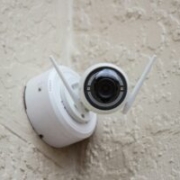
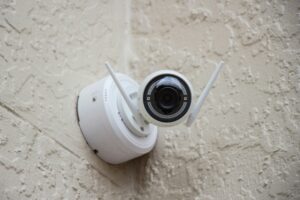
  6. Embrace Home Surveillance: Installing a home surveillance system that focuses on the area where your packages are typically delivered can provide an extra layer of protection. While this may be a pricier alternative, it grants you peace of mind, particularly when you cannot be present to monitor your home personally.
  7. Engage with Neighbors: Foster a sense of community by discussing the issue of theft with your neighbors. Encourage each other to be vigilant and keep an eye out for unfamiliar vehicles or suspicious activity in the vicinity. By working together, you can enhance the security of your neighborhood during the holiday season.

While enjoying the holiday season is undoubtedly a priority, safeguarding your possessions and personal belongings from theft should not be overlooked. By implementing these preventative measures, you can minimize the risk of falling prey to criminal activity and ensure that your holiday season remains joyful and stress-free.

Remember, prevention is key. By adopting these proactive strategies, we hope that your holiday season is filled with warmth, happiness, and a sense of security.

Home Security On A Shoestring Budget

Home security is essential, even if you’re on a tight budget. While monthly bills can be overwhelming, it’s crucial to prioritize the safety of your home and belongings. Thankfully, modern security companies offer affordable options to protect your home. Consider these cost-effective, tech-savvy solutions for home security:
  • SimpliSafe: Instead of spending $1,500 on an alarm system or committing to a lengthy contract with monthly fees, SimpliSafe provides DIY home security systems starting at just $245. To save even more, you can opt for a refurbished system. At the time of writing, 24/7 monitoring starts at only $0.50 per day. You can also use the alarm locally without paying an activation fee.
  • eufy SoloCam S340: A top-tier outdoor camera with solar/wireless capability, 3K resolution, full 360° pan/tilt coverage, designed to eliminate blind zones.
  • Cove: A newer name in home security, Cove offers affordable, no-contract systems designed for easy DIY installation. With customizable equipment packages and simple app-based controls, it’s a great choice for homeowners who want professional-level protection without high upfront costs or long-term commitments. Cove’s monitoring plans are flexible and budget-friendly, making it an appealing alternative to traditional alarm companies.
  • Arlo: With wire-free cameras and a weatherproof design, Arlo is well-suited for securing the outdoor areas of your home and capturing nighttime activities. Equipped with HD and night vision cameras, it ensures 24/7 security. You can even communicate through the cameras using the Arlo App. Receive alerts and HD video directly to your phone, allowing you to review and take necessary action. Arlo is an excellent option for DIY enthusiasts who prefer to avoid monthly fees. It includes free 7-day cloud storage.
  • Ring: A video recording doorbell is a genius invention. Ring captures motion and allows you to communicate with visitors through an intercom system, even when you’re not at home. Beyond doorbells, Ring offers various security camera options. Starting at $199, it provides simple and effective security right at your front door.
  • Blink: Backed by Amazon, Blink provides compact, wireless cameras that make home monitoring simple and accessible. Its devices are ideal for renters or smaller homes, offering motion detection, HD video, and smartphone notifications without complex setup or monthly fees. For those looking for a straightforward, camera-based security solution, Blink delivers reliable performance at a very affordable price.
  • Roku Indoor Camera SE: Ultra-budget indoor cam, ideal for simple monitoring (kids’ room, garage, etc) rather than high-security zones.

In addition to these affordable security solutions, there are other measures you can take to enhance home security on a budget:

  • Improve outdoor lighting: Well-lit exteriors can deter potential burglars. Install motion-activated lights or solar-powered lights around your property.
  • Secure doors and windows: Reinforce entry points with sturdy locks and consider adding security film to windows to make them more resistant to break-ins.
  • Install window and door alarms: These affordable devices can alert you when a window or door is opened unexpectedly.
  • Utilize timers for lights: When you’re away, use timers to automatically turn on and off lights throughout the house, giving the impression that someone is home.
  • Neighborhood watch programs: Joining or initiating a neighborhood watch program can promote community safety and awareness.

Remember, home security doesn’t have to break the bank. By leveraging technology and embracing a do-it-yourself approach, you can protect your home and keep your valuables secure. If you’re also seeking excellent home insurance coverage, contact us today or visit our website for more information.

Understanding Flood Insurance: Why Every Homeowner Should Be Prepared

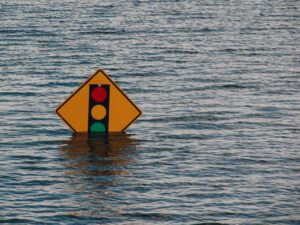
Floods can strike anywhere in the United States, as evidenced by FEMA’s data showing flood claims occurring in every state, with an average claim cost exceeding $31,000. It’s a common misconception that only properties situated near streams, rivers, or bodies of water are at risk.


The reality is that heavy rainfall can overwhelm drainage systems, water runoff from hillsides can infiltrate basements, and even levees can fail. Essentially, any area where rain falls is susceptible to flooding, regardless of its proximity to water. It is important to note that flood insurance is not typically included in standard homeowners insurance policies.

In the unfortunate event that you experience a flood and have flood insurance, there are several important considerations to keep in mind.

1) Report your claim as soon as possible and maintain open and frequent communication with your insurance adjuster.

Prompt reporting ensures that the claims process can begin promptly, allowing you to receive the necessary assistance. Additionally, it is crucial to document the damages by photographing the affected areas. If you have “before” pictures saved on a cloud platform rather than solely on a computer hard drive, it can provide additional evidence of the pre-flood condition. It is worth noting that your insurance company will likely conduct their own assessment and document the damages as well.

2) Creating a comprehensive list of all the items you lost in the flood is another important step.

Including receipts, if available, can substantiate the value of the lost belongings. These records will greatly assist in the claims process and help ensure a fair settlement.

3) It is also advisable to review your flood insurance policy to fully understand your rights and the extent of your coverage.

Being familiar with the terms and conditions of your policy will enable you to make informed decisions during the claims process.

If you are considering purchasing flood insurance, we are here to assist you. Contrary to popular belief, flood insurance does not have to be exorbitantly expensive. If your property is located in a floodplain or near a body of water, the premiums may be higher due to the increased risk.

However, if you reside in an area less prone to flooding, the cost of coverage can be much more reasonable. Considering the potential financial impact of a flood claim, it is prudent to assess your risk and explore your options for obtaining flood insurance.

If flood insurance has been on your mind recently, we encourage you to reach out to us. Our knowledgeable team can provide guidance and help you navigate the process of securing appropriate coverage.

Protecting your property and possessions from the devastating effects of a flood is a responsible decision, and we are here to support you in making the best choices for your insurance needs. Don’t hesitate to give us a call and discuss your flood insurance options.

Understanding Why Auto Insurance Rates Go Up

The auto insurance industry has experienced a consistent increase in premiums, which may have caught the attention of many individuals. While our agency represents several top insurance companies in the country and can provide quotes from multiple sources, it is important to understand the reasons behind this upward trend in premiums.

Several factors contribute to the rising premiums:

  • Expensive Repairs: The market is flooded with new cars that are costly to repair. Advanced technology and sophisticated features in modern vehicles make replacement parts more expensive than ever before.
  • Technological Advances: The intricate technology integrated into today’s vehicles comes with a higher price tag for replacement. Repairing or replacing these advanced systems can significantly impact insurance costs.
  • Distracted Driving: Distraction behind the wheel has become a major concern. Approximately one out of every four car crashes involves cell phone use. Such accidents lead to increased claims and higher premiums.
  • Rising Medical Costs: The complexity of the health insurance industry has caused medical payments associated with car accidents to skyrocket. The increasing cost of healthcare translates into higher insurance premiums.
  • Growing Claims Severity: The severity of claims, i.e., the amount paid out, is on the rise. This can be attributed to a combination of factors such as expensive repairs, medical costs, and higher compensation expectations.
  • Escalating Labor Costs: The cost of labor has increased significantly over time. When repairs are necessary, the expenses incurred for skilled labor contribute to higher insurance premiums.
  • Parts Delays: Manufacturing and labor shortages can cause delays in obtaining necessary parts for repairs. Such delays can prolong the time a vehicle spends in the repair shop, driving up costs and subsequently impacting premiums.

While these factors are beyond an individual’s control, there are measures you can take to manage your insurance costs effectively:

  • Review Your Coverage: Regularly assess your insurance coverage to ensure it aligns with your current needs and circumstances. Adjustments can be made to optimize your coverage and potentially lower your premiums.
  • Explore Discounts: Check for any available discounts with your current insurance carrier. You may be eligible for various discounts that can help reduce your premium.
  • Bundle Your Coverage: Consider bundling your insurance policies, such as home, auto, and specialty insurance, with a single carrier. Bundling often results in discounts, ultimately saving you money.

If you have specific inquiries about your auto insurance coverage, we strongly encourage you to reach out to our agency. As an independent insurance agent, we can thoroughly review your coverage and determine whether your current carrier remains the best option for your situation. We are here to assist you in obtaining the most suitable coverage at competitive rates.