Nonprofit General Liability Coverage: Safeguarding Your Mission
Nonprofit general liability coverage protects your organization from the financial fallout of accidents, injuries, and property damage claims. Without it, a single incident at your event or facility could drain resources meant for your mission.
We at Aurora National Insurance know that nonprofits operate differently than for-profit businesses. You need coverage that reflects your unique risks and budget constraints.
What General Liability Coverage Actually Covers
Protection Against Third-Party Injuries and Damage
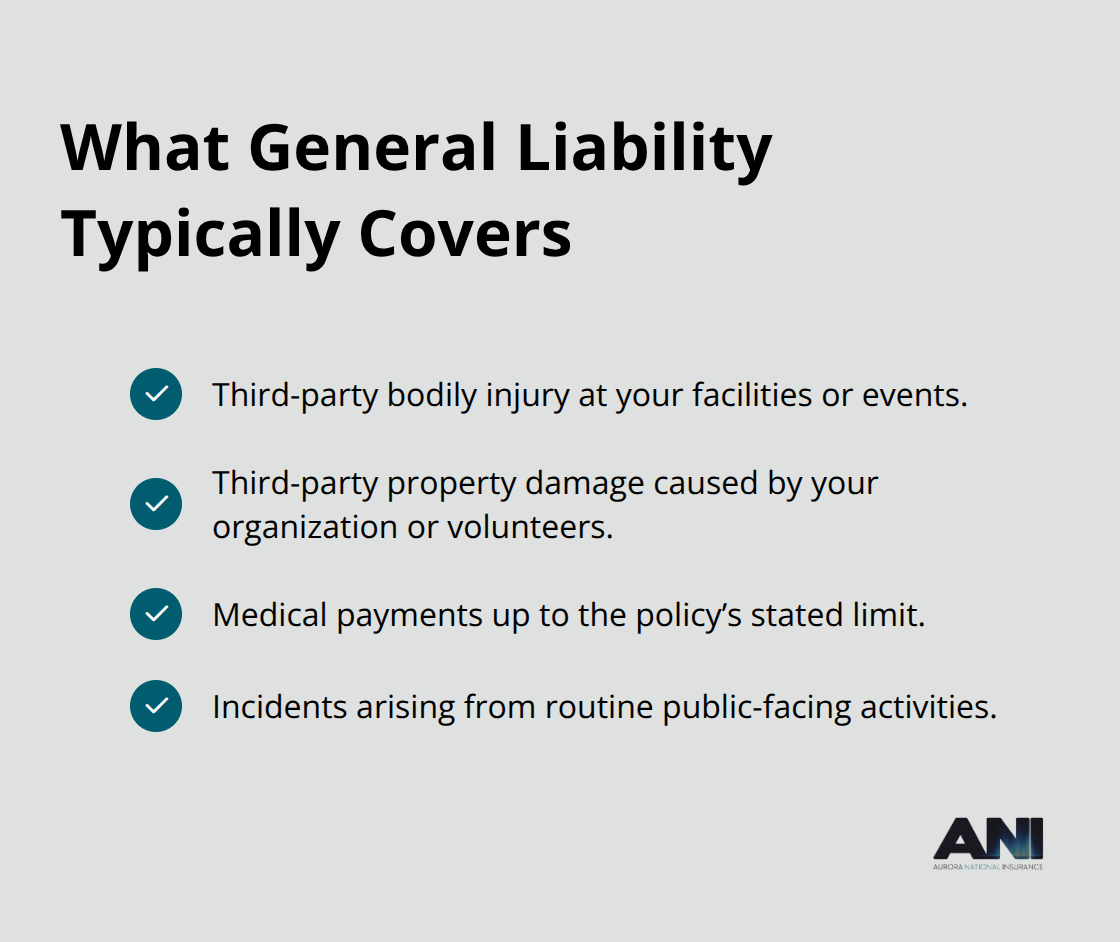
General liability insurance protects your nonprofit when someone gets hurt at your facility or event, or when your organization accidentally damages someone else’s property. A visitor slips on your stairs, a participant is injured during your program, or your volunteer accidentally damages equipment at a partner organization-these situations are exactly what this coverage addresses. The policy pays for medical expenses up to a set limit, though the exact amount depends on your chosen coverage level.
Legal Defense and Court Costs
More importantly, the policy covers the legal defense costs if someone sues your organization. Court fees, attorney fees, and settlement or judgment amounts can devastate a nonprofit’s budget, but general liability insurance absorbs these expenses so your mission funding stays intact. A common entry-level limit is $1 million per claim and $1 million aggregate, which works for smaller nonprofits, though organizations that run multiple programs or serve vulnerable populations should seriously consider higher limits like $2 million or $5 million per claim.
Personal Injury and Advertising Claims
The coverage also protects against personal injury claims like defamation or invasion of privacy, which matter if your nonprofit publishes newsletters, social media content, or marketing materials. If someone claims your organization damaged their reputation through something you published, general liability steps in. Advertising injury coverage, which is often bundled into general liability policies, handles these scenarios.
What This Coverage Does Not Include
This coverage only applies to third-party claims, meaning people outside your organization. It does not cover injuries to your employees-that is what workers’ compensation handles-and it does not protect your board members from governance-related lawsuits, which requires directors and officers liability coverage instead. The strength of general liability is its breadth. Whether your nonprofit hosts community events, operates youth programs, runs a food bank, or manages a shelter, this single policy covers the bodily injury and property damage exposure that comes with serving the public.
Understanding what general liability covers is the first step, but your nonprofit also faces risks that this policy alone cannot address. Your board members, staff, and volunteers need additional protections that go beyond third-party injury claims.
Why Nonprofits Face Greater Liability Exposure
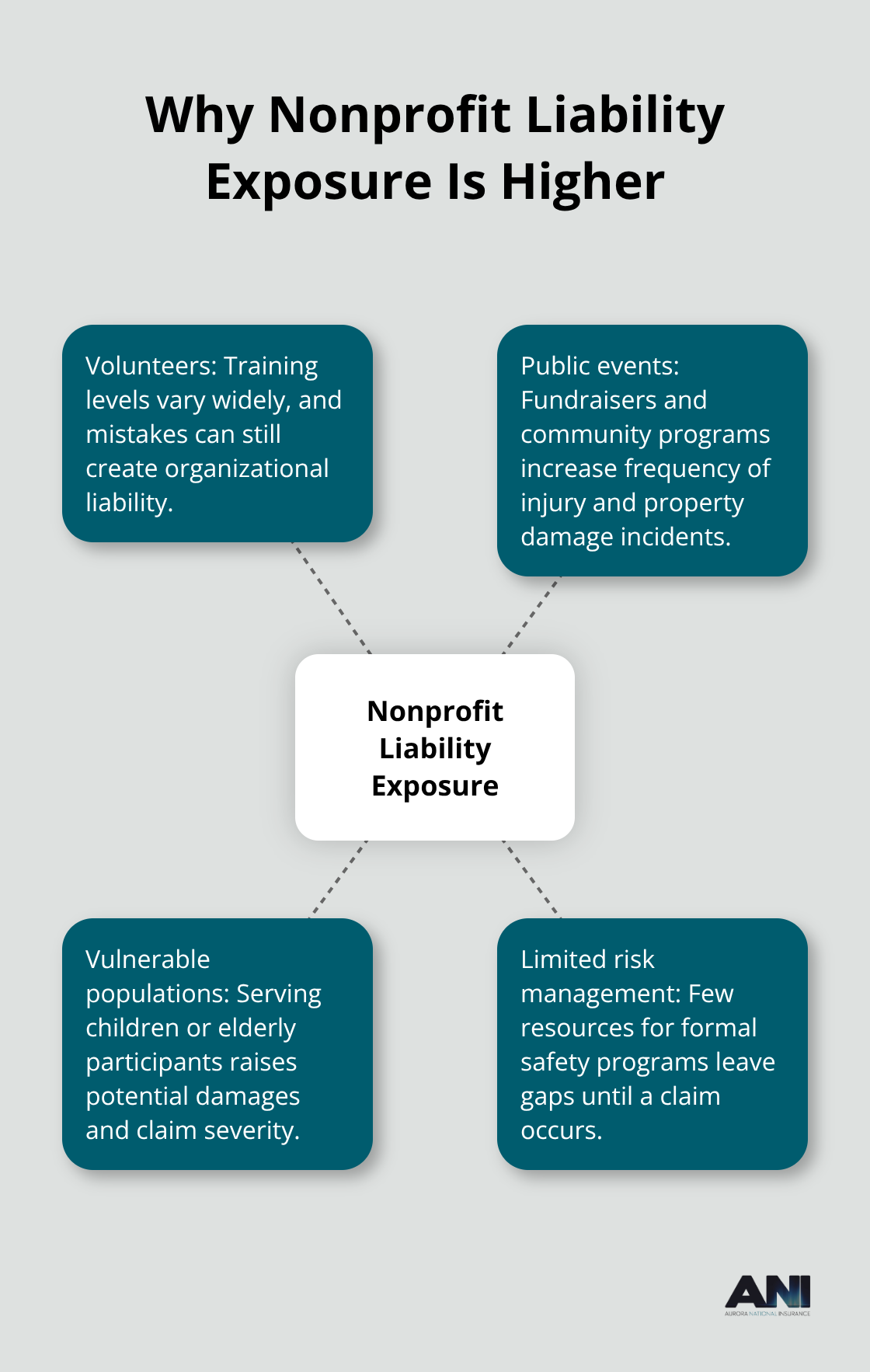
Nonprofits operate under liability risks that most for-profit businesses never encounter. Your organization likely relies on volunteers, hosts public events, and serves populations that require extra care and attention. This combination creates exposure that demands stronger insurance protections than what many nonprofits currently carry.
Volunteers Introduce Training Variability
Volunteers form the backbone of most nonprofits, but they introduce training variability that for-profit companies rarely face. Your volunteer might receive a two-hour orientation before leading a youth program, while a paid employee at a corporate facility completes weeks of formal training. If that volunteer accidentally injures a participant, your organization remains liable regardless of the volunteer’s preparation level. Many state volunteer protection laws offer some shield, but they do not eliminate your nonprofit’s exposure. General liability insurance fills this gap, though the coverage applies only if the volunteer acted within the scope of their duties when the incident occurred.
Public Events and Community Programs Amplify Risk
Public-facing programs and community events amplify your liability exposure significantly. Nonprofits that host fundraising events or operate community programs face substantially higher bodily injury and property damage claims than those with limited public interaction. An event attendee falls during your fundraiser, a participant in your after-school program gets injured, or someone damages property at your facility during a public gathering-these incidents happen regularly in the nonprofit sector. The more events you host and the more diverse your programming, the more critical it becomes to carry adequate liability limits. A $1 million per-claim limit may seem sufficient until you face a serious injury lawsuit where medical expenses, pain and suffering, and lost wages combine to exceed that threshold.
Limited Risk Management Resources Create Gaps
Limited resources for risk management separate nonprofits from larger organizations. You likely lack a dedicated risk manager or safety coordinator, which means liability exposure often remains unidentified until a claim occurs. Smaller nonprofits especially struggle to implement formal safety protocols across all programs and facilities. This reality makes liability insurance not optional but essential-it serves as your safety net when prevention efforts fall short. Nonprofits that assess their actual exposure before selecting coverage limits avoid the trap of defaulting to entry-level options that may leave dangerous gaps in protection.
Matching Coverage Limits to What Your Nonprofit Actually Needs
Start With Your Actual Activities
The most common mistake nonprofits make is selecting a $1 million per-claim limit simply because it sounds standard. This entry-level option works for small organizations with minimal public interaction, but it fails the moment your nonprofit hosts multiple events, serves vulnerable populations, or operates programs where serious injury is plausible. Map your actual activities first. A food bank distributing meals faces different exposure than a youth mentoring program, which faces different exposure than a community center hosting public events.
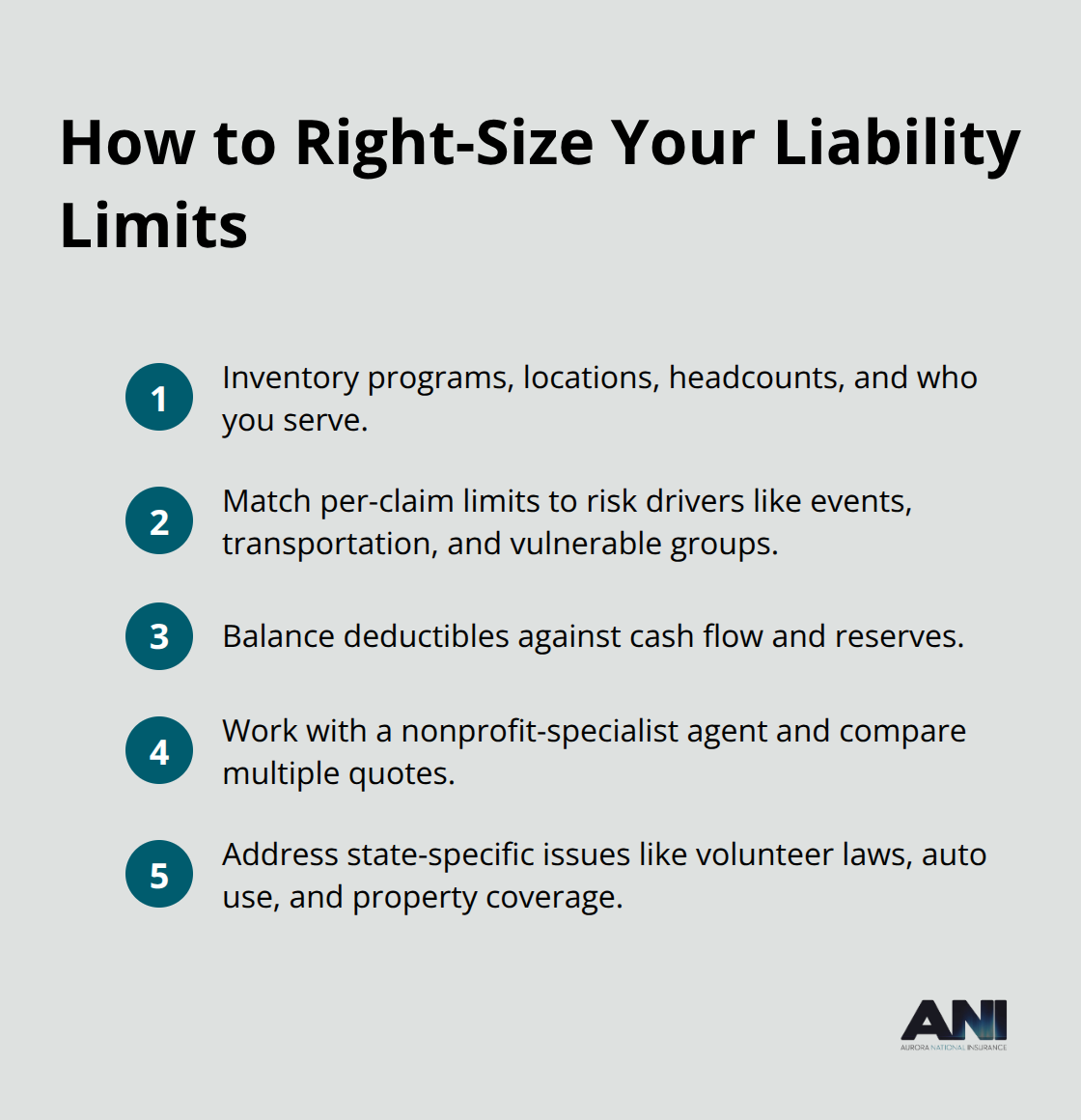
Document what you do, where you do it, how many people you serve annually, and whether volunteers or staff work directly with children or elderly participants. This inventory becomes your foundation for selecting appropriate limits.
Select Limits That Match Your Risk Profile
Organizations serving children or elderly populations should strongly consider coverage limits that reflect your actual risk exposure, since injuries to vulnerable groups often generate higher damages in settlement negotiations. If you host fundraising events with significant attendance, run transportation programs, or operate multiple facilities, higher per-claim limits provide the protection your budget actually needs. The Hartford’s data shows that nonprofit customers typically pay around $70 monthly or $836 annually for a Business Owners Policy combining liability and property coverage, though actual costs vary dramatically based on your specific activities, location, and claims history.
Balance Deductibles Against Your Cash Flow
Deductibles deserve equal attention to limits. A higher deductible like $2,500 or $5,000 reduces your premium substantially, but it means your nonprofit absorbs smaller claims entirely out of pocket. For organizations with stable funding and strong cash reserves, this trade-off makes sense. For nonprofits operating month-to-month, a lower $500 or $1,000 deductible prevents a single accident from disrupting operations. The premium difference between a $1,000 and $5,000 deductible might save you $100 to $200 per year, which matters for tight budgets but should never drive you toward underinsurance.
Work With Agents Who Specialize in Nonprofits
A nonprofit-focused agent understands that volunteer coverage varies by state, knows which additional policies like Directors and Officers liability or Improper Sexual Conduct and Physical Abuse coverage matter for your mission, and can articulate why your specific programs justify higher limits. These agents also navigate the underwriting process efficiently, since they understand what information insurers need upfront and can present your nonprofit’s risk profile in language that accelerates approval. Request quotes from multiple agents and ask specifically how they would structure coverage for your activities. An agent who simply quotes a standard BOP without asking about your programs, volunteer base, or event frequency is not the right fit.
Address State-Specific Coverage Questions
The agent conversation should address whether your state’s volunteer protection laws reduce your exposure, whether you need commercial auto coverage if volunteers use personal vehicles for organization business, and whether your property insurance adequately covers equipment and inventory. This consultation determines whether you carry the right protection or leave your mission vulnerable to a single claim that could have been prevented with better coverage planning.
Final Thoughts
Nonprofit general liability coverage protects your organization from the financial devastation that a single accident can cause. This protection allows you to serve your community without fear that one incident will drain resources meant for your mission. The coverage limits you select, the deductible you choose, and the additional policies you add all reflect how seriously you take your responsibility to protect both the people you serve and your organization itself.
Start by inventorying your actual activities, the populations you serve, and the events you host. Talk to an insurance agent who specializes in nonprofits and understands that your organization operates under different constraints than a for-profit business. Request quotes that reflect your real exposure rather than defaulting to entry-level options that may leave dangerous gaps in your protection.
We at Aurora National Insurance understand that nonprofits need coverage tailored to their specific operations. Our licensed agents work with organizations across Alaska, Washington, Oregon, Idaho, Arizona, Nevada, Texas, and Illinois to build insurance programs that protect missions without draining budgets. Contact us at Aurora National Insurance to speak with an agent who can walk you through the nonprofit general liability coverage options that fit your organization’s unique needs.
The information provided in this blog is for general informational purposes only and does not constitute legal, financial, or insurance advice. Coverage options, terms, and availability may vary. Please consult with a licensed professional for advice specific to your situation.
Artificial intelligence may have been used to generate text and images in some blog articles.